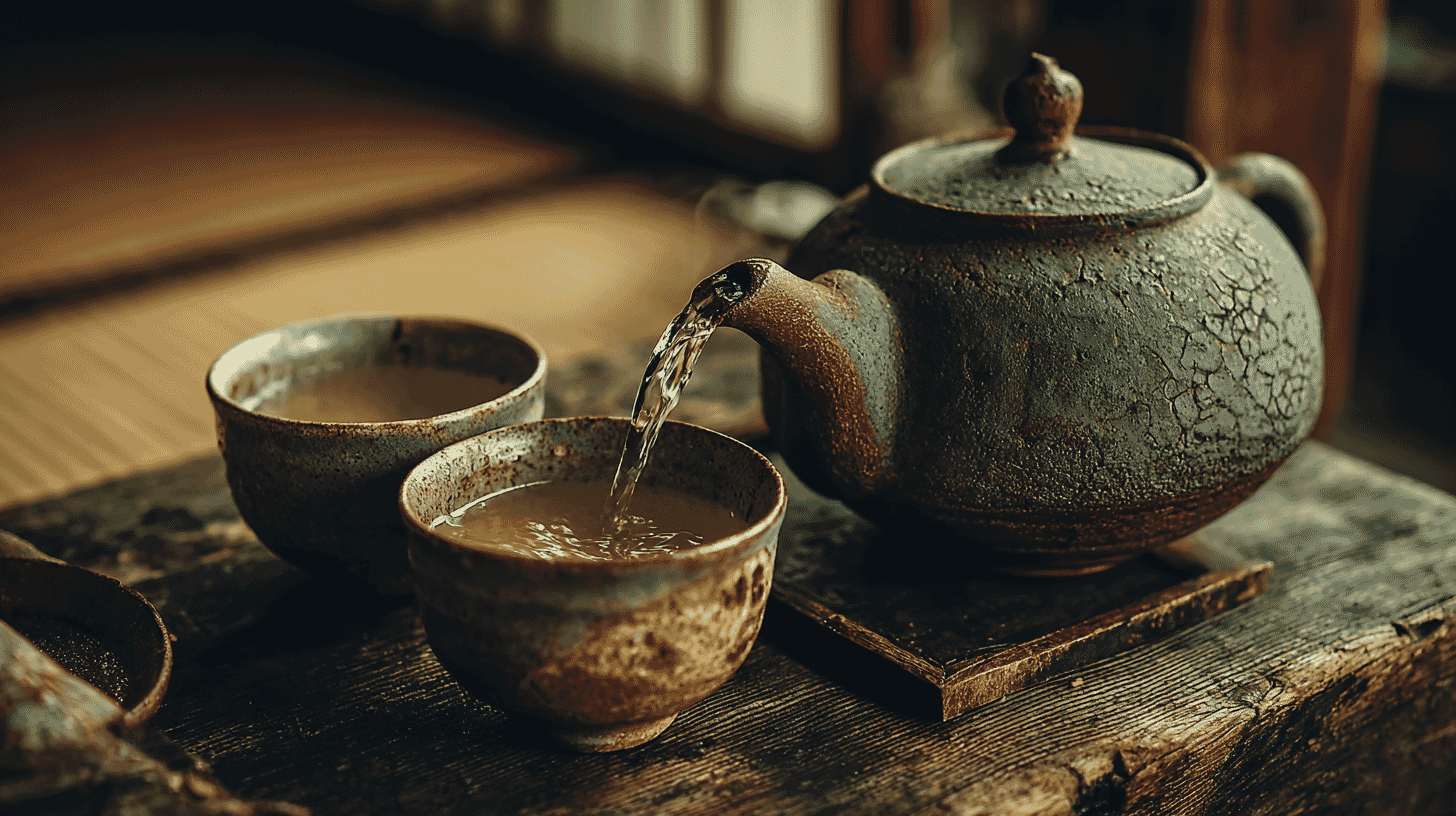
🍵 Matcha is everywhere right now: in lattes, in Kit Kats, sold out on shelves from Los Angeles to Bangkok. But back in Japan, a much quieter tea story is unfolding. The little side-handled pot that used to sit in every kitchen, the one a grandmother would reach for without thinking, is slowly disappearing. It is called a kyusu, and if you come to Japan, it is worth seeking out a cup brewed in one, before fewer and fewer people know how.
So what exactly is a kyusu?
A kyusu (急須) is the traditional Japanese teapot used to brew loose-leaf green tea, mostly sencha, the everyday tea of Japan. At a glance it looks like an ordinary small pot, until you notice the handle.
On most teapots around the world, whether for black tea or oolong, the handle sits directly behind the spout, like a coffee mug. The standard Japanese kyusu is different. Its handle sticks straight out to the side, at a right angle to the spout. This style has a name, yokode kyusu, meaning "side-handled kyusu," and it is the version found in ordinary Japanese homes.
The side handle is not a quirk. It lets you pour with one hand: you grip the handle, rest your thumb lightly on the lid, and tip. Many kyusu also have a built-in strainer, a patch of tiny holes or a fine mesh just inside the spout, so the leaves stay behind while clear tea flows out. Small pot, side handle, hidden strainer: that combination is what makes a kyusu a kyusu.
A teapot that started life as a sake warmer
The word kyusu has a slightly odd origin. It is usually traced to the idea of something "used (須) for an urgent (急) need." Centuries ago in China, the term referred to a small pan for warming sake. Somewhere along the way, that name and that kind of vessel were borrowed for tea.
The shape Japan ended up with is genuinely its own. The story most often told centers on a monk known as Baisao (1675–1763), often called the father of Japanese sencha culture. Baisao spent decades as a Zen monk, then took to selling brewed tea around Kyoto. To pour it, he used a Chinese side-handled vessel originally meant as a kettle. From around 1736, that side-handled pot became a talking point among Japan's writers and artists, the cultured circles of the day, and the habit of brewing leaf tea in such a pot spread outward from there.
Once Japanese potters began making their own, the design kept evolving. They added the internal strainer. They adjusted the angle of the handle so the pot was easy to pour while kneeling on a tatami floor. Step by step, an imported curiosity became a distinctly Japanese object. The side-handled shape is so unusual elsewhere that, in a small twist of history, these pots are now sometimes exported back to China as something rare and interesting.
If one place is tied to the kyusu, it is Tokoname, a pottery town on the coast of Aichi Prefecture and one of Japan's "Six Ancient Kilns." Tokoname has been firing clay since the late Heian period, but it became famous for kyusu specifically from the late Edo era onward. The local clay is rich in iron, which fires to a warm reddish-brown called shudei. That iron content is not just about looks: it is said to soften the bitterness of the tea. Tokoname's craft reached such heights that one of its kyusu masters, Yamada Jozan III, was named a Living National Treasure in 1998.
The quiet disappearance
Here is the uncomfortable part. Japan still drinks plenty of tea, arguably more than ever. It just doesn't brew it the old way anymore.
Walk into any convenience store and there is a wall of chilled green tea in plastic bottles. That is how most people in Japan now drink it: cold, ready-made, on the move. The numbers show the shift clearly. According to the agriculture ministry's tea situation report, annual household spending on loose-leaf tea and ready-to-drink tea combined has hovered around 11,000 yen since 2006. The mix underneath has flipped: in 2007 spending on bottled and canned tea overtook spending on loose leaf, and the gap has widened every year since.
When fewer people brew loose-leaf tea, fewer people need a kyusu, and the businesses around it feel it. The number of tea retail shops in Japan roughly halved between the early 2000s and the mid-2010s. In Tokoname itself, the workshop count has thinned out. By one local account, a town that had something like 70 to 80 pottery kilns two decades ago is now down to roughly 50, as older potters retire and few young people step in to take over.
The leaf side of the business is wobbling too. Teikoku Databank counted 13 tea processors that shut down or dissolved in 2025, the highest on record; adding one bankruptcy, 14 firms left the market. One trigger, awkwardly enough, was the global matcha boom: soaring demand for matcha raw material pushed leaf prices up while demand for sencha itself stayed weak, squeezing smaller processors from both sides.
It is not that anyone decided the kyusu should go. It simply asks for a few minutes that a vending machine does not, and over a couple of generations, those minutes quietly stopped being spent.
What you actually get for those few minutes
So why bother? Because a cup of tea brewed in a kyusu genuinely tastes different from one poured out of a bottle, and the reasons are pretty concrete.
Take that iron-rich Tokoname clay. Left unglazed, its surface has countless microscopic bumps and pores. Tea makers say this texture catches some of the harsher, more astringent notes, rounding the cup into something softer and mellower. The clay also holds heat well, so the leaves steep evenly.
Then there is the brewing itself, which rewards a little care. Good sencha does not want boiling water, which scorches the leaves and pulls out sharp bitterness. The trick is cooler water, somewhere around 70–80°C (160–175°F), which coaxes out the tea's sweetness and savory depth, the quality the Japanese call umami, before the bitterness takes over. A kyusu, small and made for short infusions, is built for exactly this.
And there is the part that has nothing to do with chemistry. A bottle is a solo, one-second act. A kyusu is shared. You measure the leaves, wait for the water to cool, pour a little into each cup, and almost always you do it with other people, talking while the tea steeps. As one Tokoname tea seller put it, the real pleasure of tea is brewing a pot and drinking it together over conversation. That is the thing quietly going missing, and it is not something a factory can bottle.
How to brew one cup, simply
You do not need to study tea ceremony to enjoy this. The home version is forgiving:
- Put about 4–5 grams of sencha leaves, roughly a tablespoon, into the kyusu, enough for two small cups.
- Boil water, then let it cool. Pouring it into the teacups first is an easy way to drop the temperature to around 70–80°C and measure your amount at the same time.
- Pour the cooled water over the leaves and let it steep for about one minute.
- Pour into the cups a little at a time, alternating between them so each cup ends up the same strength. Tip out every last drop.
Good sencha will give you a second and even third cup from the same leaves. Each one tastes slightly different, and that, tea drinkers will tell you, is half the fun.
If you come to Japan, skip the vending machine once
Japan is having a tea moment on the world stage, and most of that attention has gone to matcha, the bright green powder whisked into foam. Matcha is wonderful. But it is only one branch of a much older, broader tea culture, and the kyusu sits much closer to everyday Japanese life than a ceremonial bowl of matcha ever did.
So here is a small suggestion for any trip to Japan. Somewhere between the temples and the convenience-store runs, find a proper tea shop or a tea house. Kyoto, Shizuoka and Fukuoka's Yame region are all good for this. Order a pot of sencha brewed in a kyusu. Watch how the staff cool the water and pour in little rounds. Notice that the second steep tastes different from the first. It costs very little and takes only a few minutes, but it is a side of Japan that the bottled version, for all its convenience, simply cannot give you.
The kyusu may be fading at home. That is all the more reason, while you are here, to drink from one.
What about where you live? Is there a traditional way of making tea or coffee that is slowly being replaced by something faster and pre-packaged? We'd love to hear what is quietly disappearing from kitchens in your country.
References
- https://ja.wikipedia.org/wiki/%E6%80%A5%E9%A0%88
- https://sencha-note.com/root-of-kyusu/
- https://www.maff.go.jp/j/seisan/tokusan/cha/attach/pdf/230929-4.pdf
- https://seikatsuclub.coop/news/detail.html?NTC=1000001673
- https://shikinobi.com/tokoname_kyuusu
- https://senbirdtea.com/blogs/teaware/how-to-use-a-kyusu-or-traditional-japanese-teapot
- https://nioteas.com/blogs/sencha/how-to-brew-sencha








Global Discussion
3 comments