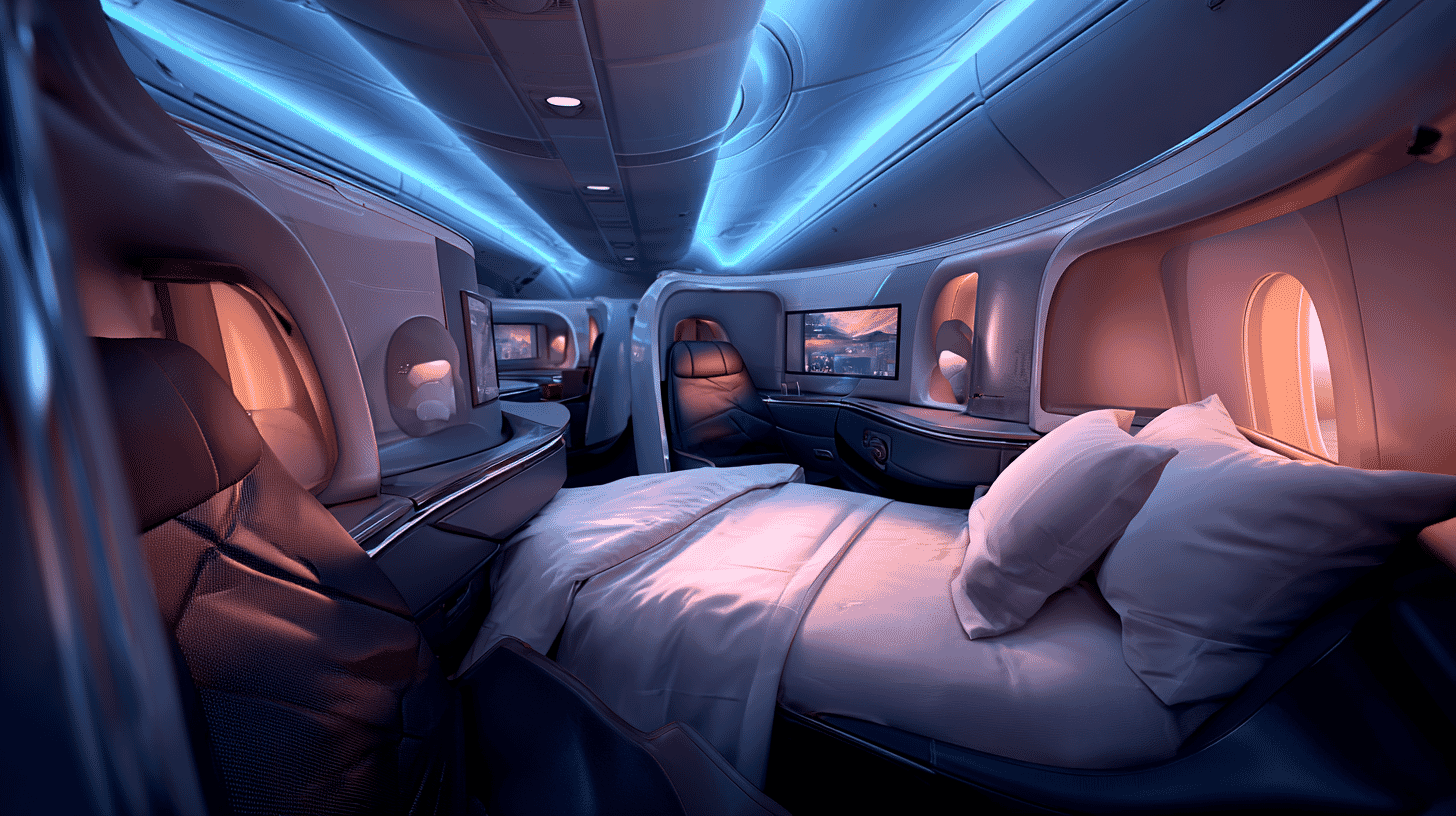
A leisure airline with budget leanings is getting private suites with sliding doors. In spring 2027, a Lufthansa Group leisure carrier will begin overhauling all 16 of its long-haul aircraft, with 4K screens at every seat, free Starlink Wi-Fi and fully flat beds about two meters long. The assumption that low-cost means cramped and inconvenient is starting to break down.
Who Is Discover Airlines?
Discover Airlines is a leisure airline belonging to the Lufthansa Group, one of the world's largest airline groups. It began in 2020 as an internal project called "Ocean" and started flying in 2021. Based in Frankfurt and Munich, it mainly operates long-haul routes from Europe to resort destinations in the Caribbean, Africa and Asia.
In industry terms it is classed as a "leisure carrier," but in practice it sits close to a low-cost carrier. It keeps base fares low and lets passengers add the services they need, much like ZIPAIR or Peach in Japan.
Now this budget-leaning airline, five years after its launch, has announced the largest investment in its history. The company describes it as a "three-digit million euro" sum, meaning more than €100 million. What it is buying rewrites the idea of a low-cost airline.
Ocean Blue Overhauls All Three Cabins
The new cabin concept, rolled out from spring 2027, is called "Ocean Blue." It takes its name from the airline's founding project, "Ocean," and uses the expanse and colors of the sea as its design motif. All 16 Airbus A330-300s will be refitted, with the work due to finish by mid-2028. After the refit each aircraft will have 288 seats: 227 economy, 31 premium economy and 30 business.
Business Class: All-Aisle Access and Fully Flat Beds
Today's business class offers almost no privacy between neighboring seats. Ocean Blue replaces it with a 1-2-1 layout. Every seat has direct aisle access and converts into a fully flat bed about two meters long. Adjustable privacy dividers let paired seats become a shared space for two, or be raised for privacy when traveling alone.
The seat model has not been disclosed, but industry media believe it is from Thompson Aero Seating's Vantage XL family, used by major airlines such as Delta, SAS and EVA Air. 4K screens, wireless charging, USB-C and USB-A ports and laptop power outlets come as standard.
Business Class Suites: "First-Class-Level" Space on a Budget-Leaning Airline
The biggest talking point is the two "Business Class Suites" in the front row of business class. Sliding doors about 1.2 meters high create private spaces, with 32-inch 4K screens, beds over two meters long, generous legroom and storage. A privacy divider allows the two suites to be used as one space or kept completely separate.
A dedicated expanded dining menu will also be offered, bringing a kind of space once found only in full-service carriers' first class into a leisure airline's cabin. The suites can be booked through the advance seat reservation program.
Premium Economy: The Top Specification for a Leisure Airline
Premium economy is a category the company says is "already the best among leisure carriers." Ocean Blue introduces hard-shell seats that recline without affecting the passenger behind. They offer 15-inch 4K screens, privacy screens, integrated leg rests and individual reading lights, and, unusually for a low-cost-style airline, noise-canceling headphones.
Economy Class: Modest but Real Improvements
In economy, optimized seat design delivers more legroom and a more comfortable seat angle at the same pitch. Six-way adjustable headrests and expanded storage improve comfort on long flights.
There is one caveat. According to industry media, the power outlets once found at every second seat will disappear, replaced by USB-C ports at every seat. These are said to be powerful enough to charge a laptop, but passengers who rely on outlets may see this as a step back.
A Technology Refresh and Free Starlink Wi-Fi
Ocean Blue is not only about seats.
Every seat in every class gets a large 4K touchscreen, and Bluetooth lets passengers connect their own wireless headphones directly to the entertainment system. This is becoming standard in the industry, but rolling it out fleet-wide is forward-looking for a low-cost-style airline.
Most notable of all is the decision to install SpaceX's Starlink satellite internet on every aircraft and offer it free to all passengers. Starlink offers more bandwidth and lower latency than conventional in-flight Wi-Fi. Major airlines such as Qatar Airways and United are also adopting Starlink, but how much is free varies from airline to airline. Making it completely free in every class is highly unusual for a low-cost-style carrier, and could by itself be a reason to choose Discover Airlines.
The airline will also introduce an intelligent lighting system called "human-centric lighting," which adjusts cabin lighting dynamically to passengers' body clocks to reduce jet lag.
The Line Around Low-Cost Carriers Is Fading
Discover Airlines' move reflects a wider trend in global aviation.
The industry used to have a clear hierarchy. Full-service carriers in the Middle East and Asia with first class sat at the top, followed by legacy carriers in Europe and North America, while low-cost carriers settled for being cheap, cramped and minimal in service.
In recent years that line has been blurring fast. Just as Japan's ZIPAIR drew attention by introducing fully flat seats despite being a low-cost carrier, it is becoming clear that low-cost operations and high-quality seats are not necessarily at odds. Discover Airlines pushes that trend a step further, bringing in suites with first-class-level space.
Behind this is a wave of cabin renewal across the Lufthansa Group. Alongside the parent airline's "Allegris," Edelweiss Air, the leisure airline under Swiss International Air Lines, announced a similar cabin refresh at around the same time. Ordering seats at group scale helps on cost. Industry media nonetheless describe Ocean Blue not as a scaled-down Allegris but as a more relaxed design tailored to leisure travel.
The "premiumization" of the leisure travel market is another tailwind. Since the pandemic, more travelers see the journey as part of the trip, and more are willing to pay for comfortable seats and high-quality service even on leisure trips. Discover Airlines CEO Ulrich Lindner calls the investment "a clear commitment to our growth strategy."
How Japan's Low-Cost Market Compares
Japan's low-cost market is also in the middle of change. ZIPAIR, owned by JAL, offers fully flat seats and free Wi-Fi as an international low-cost carrier, setting a new standard of cheap yet comfortable. ANA's AirJapan also began flying to Bangkok in 2024, entering the medium-haul low-cost market.
Domestic low-cost carriers such as Peach and Jetstar, meanwhile, still largely follow the traditional model of 74 cm seat pitch and paid services. ZIPAIR and AirJapan, with their longer routes, could well steer toward premium offerings like Discover Airlines, but none has gone as far as installing suites.
The End of "Put Up With It Because It's Cheap"
Business suites with sliding doors, 4K screens at every seat, free Starlink Wi-Fi and human-centric lighting: only a few years ago, all of these were found only on the flagship aircraft of major full-service carriers.
The quality gap that travelers once accepted because an airline was cheap is shrinking fast. The question is how the major carriers respond. If low-cost airlines offer seats as good or better, where will the big airlines show value that justifies higher fares? The competitive structure of the whole industry is changing.
In Japan, the image of low-cost airlines as cheap and poor still runs deep, but developments abroad suggest it may be time to update that view. How has the quality of low-cost airlines changed in your country?
References
- https://www.mynewsdesk.com/uk/discover-airlines/pressreleases/discover-airlines-takes-off-into-the-future-with-new-ocean-blue-long-haul-cabin-3428985
- https://www.futuretravelexperience.com/2026/02/discover-airlines-enhances-inflight-cx-with-new-ocean-blue-long-haul-cabin-for-a330/
- https://travel-dealz.com/news/discover-airlines-new-a330-cabin/
- https://aviation.direct/en/discover-airlines-baut-langstrecken-kabinen-umfassend-um
- https://www.airwaysmag.com/new-post/discover-ocean-blue-business-class









Global Discussion
16 comments