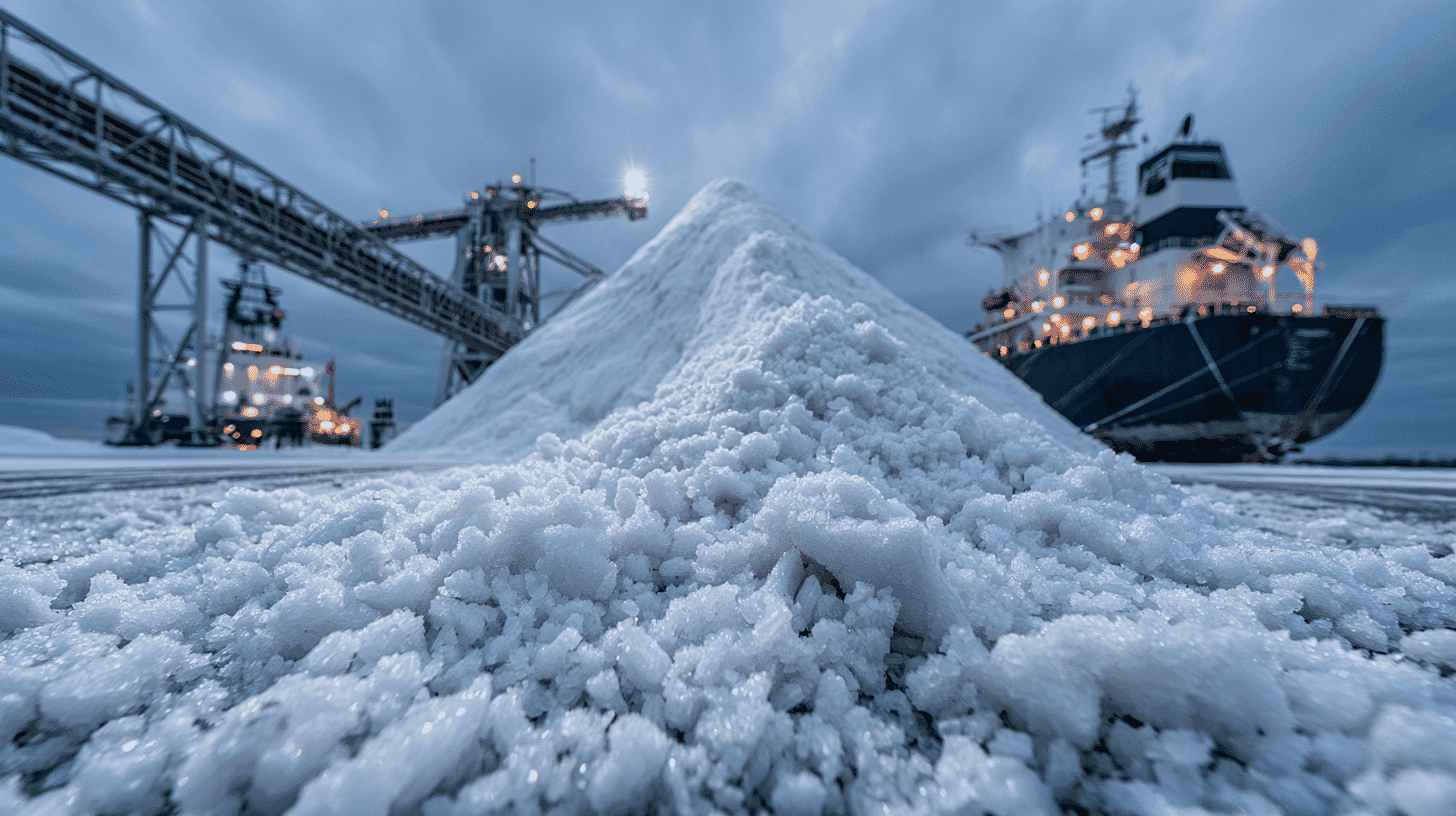
🧂 An island nation, ringed by ocean on every side, buys most of its salt from the far side of the world. In Hiroshima Bay there is a small island that turns white, piled with mountains of sea salt shipped three weeks across the Pacific from Mexico. Here is the strange reason Japan, a country that is almost all coastline, has to import the salt it runs on.
The white mountains off Kure
A television crew recently went looking for an island said to be covered in "mysterious white stuff" near the port city of Kure. Locals told them outsiders cannot land, but that the view is worth photographing. From the water, the reporters found what looked like snow in late April, on a day above 20 degrees Celsius. It was not snow. It was salt.
The island is Mitsugojima, a tiny uninhabited islet off the Ondo district of Kure. It is run by a company called Mitsugojima Futo, and it is the largest imported-salt transit base in Japan. The salt arriving there is solar sea salt from Mexico, carried roughly three weeks by ship and poured ashore by conveyor belt. The white hills shift shape constantly as cargo comes in and goes out. By some accounts, roughly 75 percent of all the industrial salt used in Japan passes through this one small island.

Mitsugojima, Kure, Hiroshima. Photo: KUNIO MIURA / Wikimedia Commons (CC BY 3.0)
That figure is the first clue to a real puzzle. Why is a country this surrounded by seawater importing salt at all, let alone by the millions of tons?
All that sea, and still no cheap salt
The answer starts with a humbling fact: seawater is only about three percent salt. To get the salt out, you have to drive off the other ninety-seven percent, which is water. The cheapest way to do that is to let the sun and wind do the work for free.
That is exactly what Mexico and Australia can offer. In places like Guerrero Negro on Mexico's Baja California peninsula, seawater is led into vast shallow ponds and left to evaporate for one to two years under a desert sky that sees less than 100 millimeters of rain a year. The salt crystallizes on its own, and is simply scraped up. The economics are brutal in Japan's favor as a buyer: enormous volume, almost no fuel, almost no labor.
Japan has the opposite climate. It is humid and it rains a lot, so seawater left in the open will not reliably dry into salt. For centuries, Japanese producers had to first concentrate seawater into a strong brine, then boil it down over fires to crystallize it, burning fuel and labor the whole way. Japan also has no rock salt deposits and no salt lakes to mine. The country has the ocean, but not the cheap, dry, sun-baked conditions that make salt almost free everywhere else.
Most of Japan's salt never reaches a dinner table
There is a second reason the numbers run so high. Japan uses roughly eight million tons of salt a year, but only a small slice of that, somewhere around ten to fifteen percent, is food. The salt in your miso, your pickles and your kitchen shaker is the minority.
The biggest single use by far is the soda industry. Salt is split into its two elements, sodium and chlorine, to make caustic soda, chlorine gas and soda ash. Those are the base ingredients behind an astonishing range of everyday things: soap and detergent, PVC and other plastics, glass, paper, dyes, and the chemicals that disinfect tap water. Roughly three-quarters of Japan's salt demand is this industrial kind, and essentially all of it is imported solar salt. Food salt, meanwhile, is mostly made at home in Japan.
So the rule of thumb is simple. The salt on your table is local. The salt inside your washing machine, your window glass and your water pipes came off a ship. That industrial appetite, not seasoning, is what drives the enormous import volume. All told, Japan makes only about a tenth of the salt it uses and ships in the rest. Mexico and Australia together supply close to ninety percent of those imports, and a single Mexican operation, ESSA, has long covered about half of Japan's total on its own. Mitsubishi bought into ESSA in 1973 and ran it with the Mexican government for half a century to secure salt for Japanese industry. In February 2024 the trading house agreed to transfer its entire 49 percent holding to Mexico's economy ministry, leaving the company state-owned, though it says it will keep buying and supplying ESSA salt. Either way, much of the white salt off Kure is, quite literally, Mexican.
Seto was once "the salt country"
It was not always this way. Japan used to make its own salt, and the Seto Inland Sea was the heart of it. Using a method called irihama, builders laid out tidal salt fields along the calm, low-rainfall coast, and the ten provinces ringing the inland sea produced an estimated eighty percent of the nation's salt in the Edo period. For four centuries, hand-raked salt was a defining industry of this region.
That landscape is gone. A 1971 modernization law shut down the salt fields entirely by the following year. Domestic production switched to a clean, efficient ion-exchange membrane method aimed at the food market, while the country's vast and price-sensitive industrial demand was handed over to cheap imported solar salt. The white mountains off Kure are the modern endpoint of that decision. The salt that Japan once raked by hand from its own shores now arrives by the shipload from a Mexican lagoon.
It is the kind of dependence that goes unnoticed until a shipping lane is threatened. Japan imports much of its food and most of its energy, and salt, the most basic mineral of all, turns out to belong on the same list.
Where does the salt in your kitchen actually come from: the sea nearby, a mine deep underground, or a ship from the other side of the planet?

Global Discussion
0 comments