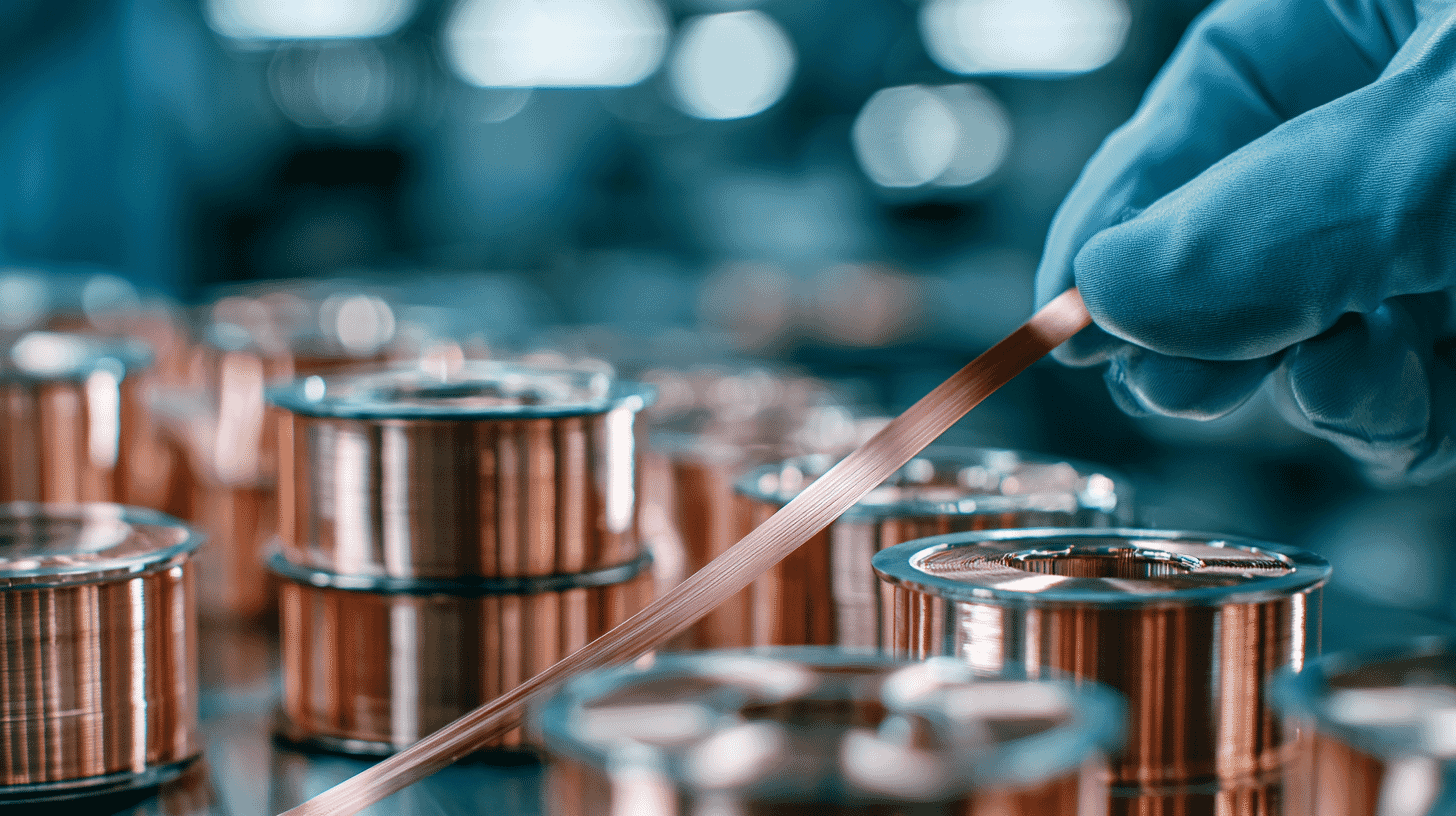
⚡ The future of fusion energy is riding on a strip of tape about as wide as your little finger.
To finish a single experimental reactor outside Boston, engineers need roughly 10,000 kilometers of the stuff, and just five years ago, almost no one on Earth could make that much. Now four physicists in Italy want to build Europe's biggest factory to produce it. The complication: the companies that already dominate this wire are, overwhelmingly, Japanese.
The tape that decides how big a reactor has to be
Fusion has a magnet problem. To squeeze hydrogen plasma hard enough to fuse, you need an enormous magnetic field, and the stronger that field, the smaller and cheaper the reactor can be. The relationship is brutal: the power a fusion reactor can produce scales with the fourth power of the magnetic field. Double the field and you get sixteen times the output. That single fact is why the whole industry has been chasing better magnets for decades.
The magnets are wound from high-temperature superconductor (HTS), specifically a material called REBCO, rare-earth barium copper oxide, layered onto a thin metal ribbon and sold by the kilometer as "tape." Cool it down and it carries current with zero resistance, letting you build magnets far stronger than the old low-temperature wire that machines like the giant ITER reactor in France still rely on.
Andrea Augieri, who spent two decades on this technology before co-founding the Italian startup Suprema, put the stakes plainly in an interview with Innovation News Network: HTS is the enabling technology for fusion, because you can only have a compact reactor with HTS tape, and without a compact reactor, fusion never gets cheap enough to matter.
When every meter was hard-won
For years the catch was simple: hardly anyone could make the tape in bulk.
Commonwealth Fusion Systems (CFS), the MIT spin-off building the SPARC reactor in Devens, Massachusetts, needed about 10,000 kilometers of HTS tape for that one machine, and its successor power plant, ARC, will need even more. Back in 2019 and 2020, CFS managed to buy a few hundred kilometers of wire over nine months, and even that small order was more than some vendors had produced over the preceding six years. Co-founder Brandon Sorbom later admitted he used to get laughed at when he suggested the company would somehow get 10,000 kilometers of tape for SPARC.
Nobody is laughing now. CFS has expanded HTS tape production by a factor of 40, and a single Japanese supplier, Faraday Factory Japan, has now shipped more than 5,000 kilometers of tape to fusion companies across four continents, turning up in tokamaks, stellarators, magnetic mirrors, and levitating-dipole machines alike. Industry watchers expect demand for HTS tape to grow roughly tenfold over the next five years.
That is the gap a tiny Italian company has decided to run into.
Four physicists and one factory
Suprema was founded in July 2024 as a spin-off from ENEA, Italy's national agency for energy and new technologies. Its four co-founders (Andrea Augieri, Fabio Fabbri, Francesco Rizzo, and Giuseppe Celentano) all came out of ENEA's fusion department, where, by their own account, they had been refining HTS tape for more than twenty years before deciding to commercialize it themselves.
Their pitch isn't to out-muscle the giants on raw volume. It's to make a better, cheaper tape. Suprema's process deposits the REBCO layer using pulsed laser deposition and then nano-engineers that layer, seeding it with tiny, deliberate defects that "pin" the magnetic field and let the tape carry more current under the brutal conditions inside a fusion magnet. Early results are promising: working with Germany's Karlsruhe Institute of Technology, a Suprema prototype reportedly hit a critical current density above 2 million amperes per square centimeter at 20 kelvin and 20 tesla, conditions that map directly onto what fusion magnets demand.
The money, so far, is modest. Suprema closed a pre-seed round of €900,000 (a touch over a million dollars at today's exchange rate) from Tech4Planet, a sustainability fund backed by Italy's state investment arm. With it, the company says it is moving from design into construction, aiming for a fully operative production line by the end of 2027, which it intends as the first of many. Augieri's read on the market is bullish to the point of bluntness: once the line is running, he expects buyers to take everything it can produce.
The incumbents speak Japanese
Here is the part that complicates Europe's clean-energy ambitions. Around fifteen companies worldwide make HTS tape, but the heavy lifting is done by a handful using the pulsed-laser-deposition route, and of the four top-tier producers, two are Japanese (Faraday Factory Japan and Fujikura), alongside Shanghai Superconductor in China and S-Innovation in Russia; together these four account for more than half of global output. Augieri himself frames the gap Europe has to close bluntly: 90 percent of HTS production, he says, sits in the East. Suprema, SuNAM of South Korea, and the Furukawa-owned SuperPower are among the challengers still scaling up.
Japan's lead is not an accident. Fujikura helped invent second-generation REBCO tape in the first place; its researcher Yasuhiro Iijima developed the IBAD process now widely used to make high-quality REBCO, work that earned him the IEEE's Dr James Wong Award in 2020 for contributions to applied superconductivity. Tokyo-based Faraday Factory Japan, for its part, bills itself as the world's largest producer of the tape.
And that dominance reaches right into Europe's own backyard. When German fusion startup Proxima Fusion needed superconductor for its stellarator, the supplier it signed was Faraday, a deal described as the largest HTS contract for any stellarator to date, and one that analysts say puts pressure on newer entrants like Suprema, which may struggle to win flagship contracts without Faraday's scale. Britain's STEP fusion program tapped Fujikura as a key supplier; Tokamak Energy, also in the UK, buys hundreds of kilometers from SuperPower, which is Japanese-owned through Furukawa Electric.
It is hard not to hear an echo here. Japan pioneered a foundational technology, as it did with semiconductors and solar cells, and is now watching newcomers in Europe, Korea, and China race to industrialize it. Whether this story ends like those ones, with the inventor's lead eroding as rivals scale, or whether Japan's two-decade head start on the manufacturing itself proves harder to copy, is the open question hanging over the whole sector. For now, the incumbents are still the ones shipping kilometers.
What's actually being raced
The reactors get the headlines, but the tape is the chokepoint, and the contest comes down to who can make this thin ribbon fast, cheap, and reliable enough to keep fusion on schedule. Suprema's bet is that Europe shouldn't have to import the most strategic material of the energy transition.
Japan built an early, deep lead in the wire that fusion runs on. The open question is who's content to keep buying it, and who decides they'd rather make their own. Where does your country sit in that race?
References
- https://xtech.nikkei.com/atcl/nxt/mag/ne/18/00145/00001/
- https://www.innovationnewsnetwork.com/enabling-fusion-commercialisation-with-europes-largest-hts-tape-production-plant/56860/
- https://www.commercial-fusion.com/p/europe-s-emerging-contender-in-hts-manufacturing
- https://www.commercial-fusion.com/p/faraday-factory-tightens-grip-on-hts-supply-chain
- https://blog.cfs.energy/how-cfs-is-building-a-fusion-factory-not-just-a-single-fusion-machine/
- https://www.prnewswire.com/news-releases/faraday-factory-announces-it-has-delivered-over-5-000-km-of-high-temperature-superconductor-tape-to-fusion-industry-302250067.html
- https://www.eurekalert.org/news-releases/1101339
- https://www.europe.fujikura.com/markets/industrial/superconductors/







Global Discussion
5 comments