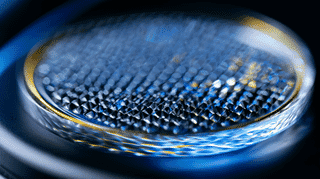
Kanazawa University and AIST report the first vertical diamond MOSFET with an inversion-layer channel. Diamond transistors that switch off this way existed by 2016; what is new is building one vertically.
Mizuno's Hyperwarp 96 weighs about 96 grams (size 27.0 cm) despite a thick sole and carbon plate. We compare it with Adidas's 97-gram Evo 3 and ask what one gram, and a 100 km lifespan, really mean.
Chihaya Adachi, a 2026 Citation Laureate, was first author of a 2001 paper on iridium-based OLEDs, then created TADF, which needs no rare metal. Yet iridium, mined at about 7 tonnes a year, is still in OLED screens.
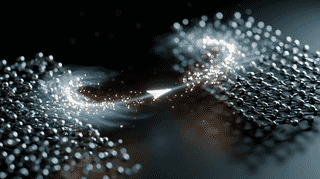
Japan's NIMS built a molecular sheet where some electrons act massless and others barely move. What that means, how a bamboo-basket word entered physics in 1951, and what the material might one day be used for.
Japan's National Institute of Genetics and Danish partners built a photovoltaic retinal implant with carbon electrodes and 40-micrometer pixels. The implant already in patients uses 100, and that width sets the ceiling.
Japan counted 6,220 university spinouts in October 2025, more than double the 2,905 five years earlier. A gene-edited sea bream and a pigment-free coating are the way in. Each Japanese listing raises only $28 million.
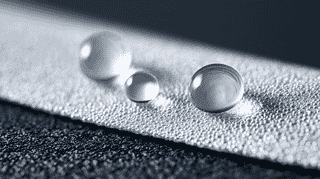
Kyoto University's deep foam photolithography makes white out of air instead of titanium dioxide, prints it at about 20,000 dpi and repels water without PFAS. Why the timing is European, and what Japan tried before.
Desalination makes about 35 trillion liters of fresh water a year and discards roughly 50 trillion liters of brine. A Tokyo lab drips it onto molten tin and recovers magnesium oxide, 280 times concentrated.
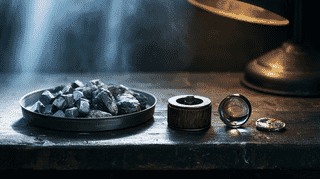
Hafnium keeps advanced chips and jet engines running, yet the world makes about 71 tonnes a year, nearly all of it in France and the United States. An Osaka chemical maker now wants a share of it by 2028.
China's rare earth magnet shipments to Japan fell 52.2% in July 2026 while US-bound shipments rose 4.6%. Japan tells itself pressure breeds breakthroughs. Optical glass and neodymium magnets agree; aluminium does not.
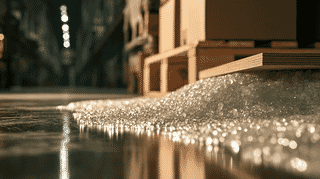
Kanazawa Institute of Technology and sand maker Yamakawa Sangyo scatter sapphire grains across a warehouse floor and let the load slide instead of resisting. The grains cost a few hundred yen per square meter.
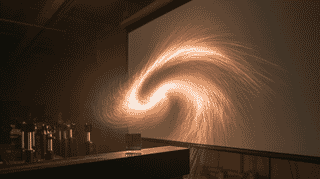
The hat, found in 2023, tiles the plane forever without repeating. A Japanese team etched 372,100 of its points into a silicon nitride film, fired a laser, and got back a pinwheel of light with no mirror image.
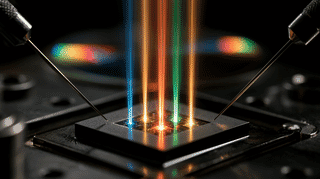
A terbium-doped AlGaN LED from the University of Osaka and Ritsumeikan University emits four colors from a single spot, with wavelengths that barely move as the current rises.
University of Toyama researchers crystallized an OLED's emitting layer inside a practical thin-film stack: up to 1,000 times the current density at 1 volt, and turn-on at 1.33 V.
Chemists at Nagoya University cut a bond inside a flat carbon molecule and rebuilt it, producing figure-eight, bathtub and double-helix nanocarbons that emit spiraling light and trap carbon dioxide. Published in Nature Communications.
Kuroda Precision holds about 30% of the global market for EV drive motor-core dies. The 100-year-old firm now bets on amorphous alloy and cobalt-heavy permendur, and on a supply chain shaped by geopolitics.
A century-old Japanese packaging company will launch a flexible CIGS solar cell in early 2027, betting that proven, long-life thin-film tech can beat still-maturing perovskite to Japan's weak roofs and walls. The contrarian logic, and the catches.
Researchers at the Institute of Science Tokyo have created a surface electrene: a crystal whose outermost layer is a sheet of loose electrons, with a work function lower than cesium. It survives open air because nitrogen caps it, then leaves as ammonia. Here is what it means for green fertilizer, and how it compares with the electrochemical routes pursued in China, Europe and the US.
Altermagnetism, the third type of magnet that stunned physics in 2024, had one flaw: no one could steer it. A Tokyo-KEK team aligned its domains in MnTe with a tiny millitesla field and watched them flip with polarized neutrons, with a stray field 10,000 times smaller than a ferromagnet's.
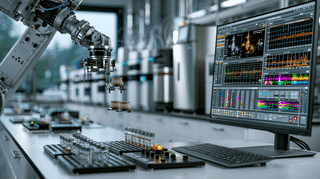
Toyota, Shinshu University and 11 partners are building a self-driving lab where robots run experiments and AI picks what to try next. Here is how Japan's closed-loop materials push compares with Berkeley's A-Lab and China's robot chemist.