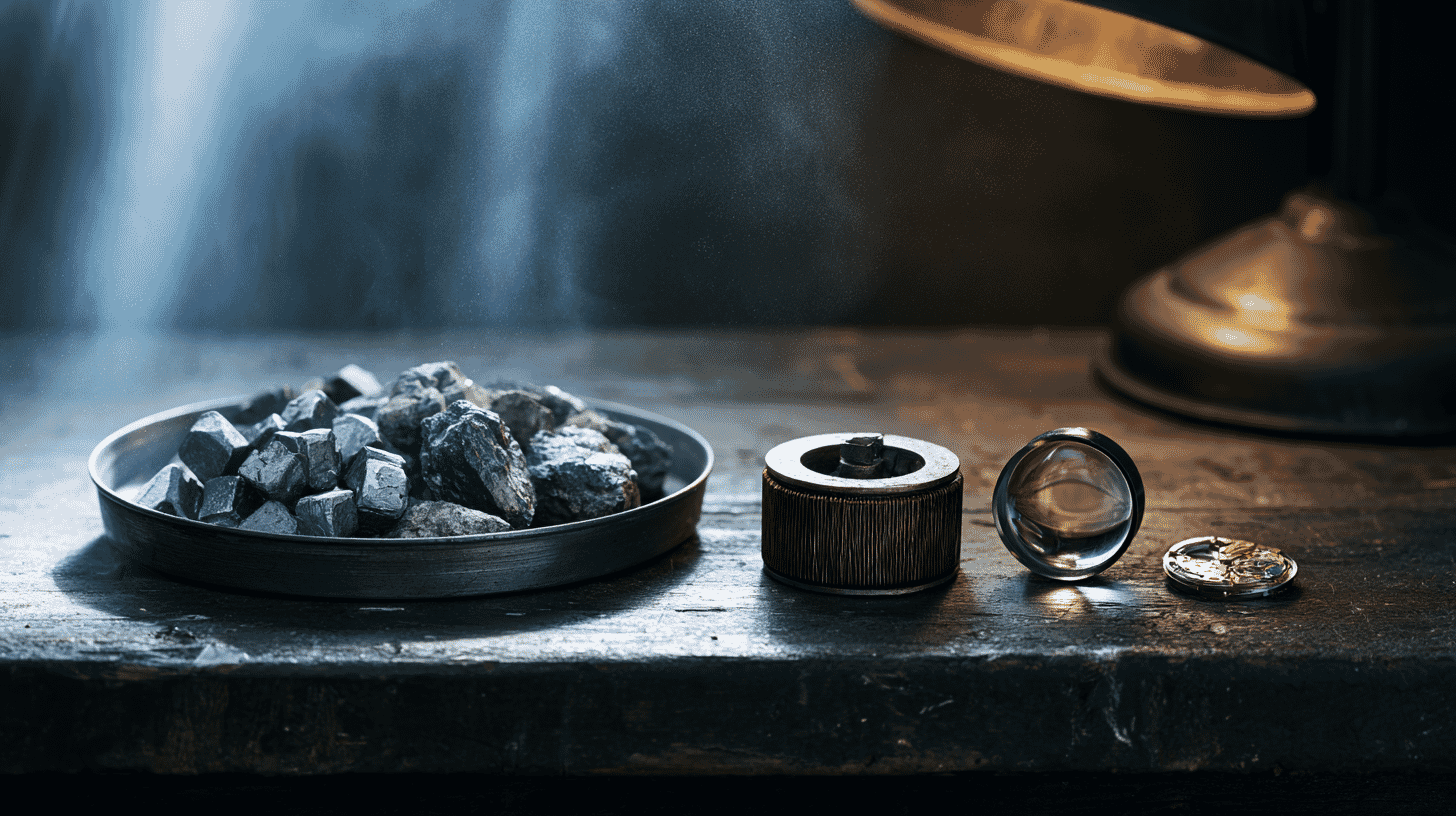
🧲 China is shipping more rare earths to the United States and almost nothing to Japan. In Japanese comment threads, that gap keeps summoning the same piece of national folklore: push us hard enough and we'll invent our way out of it. It's a good story. The actual record is stranger, and includes at least one industry that pushed back, lost, and never came home.
The temperature difference in the numbers
The shape of it is simple. According to Yomiuri Shimbun, China's rare earth magnet shipments to Japan in July 2026 were down 52.2 percent from a year earlier. In the same month, shipments to the United States rose 4.6 percent and shipments to South Korea rose 19.3 percent. China's total magnet exports actually fell in July, so this is not a story about volume. It is a story about who gets served.
On the two elements that matter most for heat-resistant magnets, the gap is absolute. Dysprosium shipments to Japan have been zero for nine consecutive months and terbium for eight. The raw materials research firm Tradium estimates that everything China exported of those two elements in July went to South Korea.
The seven elements placed under Chinese export licensing in April 2025 are samarium, gadolinium, terbium, dysprosium, lutetium, scandium and yttrium. Japan is the largest producer of rare earth magnets outside China, which makes the arithmetic uncomfortable: it is being cut off from the ingredients for the thing it does best. As of August 2026, with a Xi Jinping visit to the United States expected at the end of September, the asymmetry looks less like a supply constraint than a seating chart.
The things Japan built because it couldn't buy them
Japan does have a real record of building the things nobody would sell it.
Optical glass
When the First World War broke out in 1914, imports of the German optical instruments Japan relied on stopped. No rangefinders, no binoculars, no periscopes. Building them domestically became a matter of national policy, and on 25 July 1917 Nippon Kogaku was founded as a Mitsubishi undertaking, merging the optical instruments division of Tokyo Keiki, the reflector division of Iwaki Glass and the Fujii Lens Manufacturing works, with funding from Koyata Iwasaki, president of Mitsubishi Goshi. It is Nikon today.
The part usually left out of the triumphant version is the timeline. Optical glass is a harder material than it sounds, requiring a homogeneity ordinary window glass never approaches. Research began in 1918 and stalled on technical problems. In 1921 the company brought in eight German engineers, among them the lens design authority Dr Lange, and raised its standards under their instruction. Work restarted in 1922, only to stop again when the 1923 Kanto earthquake damaged the glass research plant. By March 1927 the team had run about 70 full melts and more than 220 test melts. Mass production arrived a decade after founding, and that was with imported expertise.
The quartz revolution
With watches, the motive behind the wall was commercial rather than military. What Switzerland feared after the First World War was not competition but copying. A practice called chablonnage, exporting movements as loose parts to be assembled where labour was cheap and tariffs avoidable, was spreading; in Pforzheim, Germany, an entire watch industry was built from scratch on it from 1922. The Swiss answer was Ebauches SA, the first cartel, formed in 1926, which brought production, pricing and export policy under a set of conventions. In 1934 the federal government imposed the Statut horloger, making manufacturing and exporting subject to permits, and from 1936 prices were set by the employers. The whole apparatus lasted until 1971. Machines and movements were not simply there to be bought.
Seiko went around the wall instead of over it. On 25 December 1969 it released the Quartz Astron 35SQ, the first quartz wristwatch to reach the market anywhere. Accuracy was within 0.2 seconds a day and 5 seconds a month, against the several to several dozen seconds a day that a mechanical movement typically drifted. It cost 450,000 yen, roughly the price of a family car at the time. Swiss watchmaking had 90,000 workers and 1,500 companies at the end of the 1960s; by 1985 it was down to 30,000 workers and 500 to 600 companies.
The tidy version, in which Japanese quartz killed Swiss watchmaking, is not what specialists find. Research by the business historian Pierre-Yves Donze concludes that quartz was not the cause of the crisis but an amplifier of one already underway. The underlying problem was the production system that the Statut horloger had frozen in place: unrationalised high-end manufacturing and mass-market cheap production coexisting as separate worlds, while Seiko fused the two and turned out watches that were accurate, well made and inexpensive at the same time. The wall kept the copying out, and froze the industry inside it as well.
The oil shock, which is the one clean win
In fiscal 1973, oil supplied 75.5 percent of Japan's primary energy. Then the fourth Arab-Israeli war broke out and international crude prices roughly quadrupled by January 1974. In November 1973 the neon signs of Ginza went dark to save power, and in January 1974 the government issued the first electricity use restriction order of the postwar era, banning non-essential consumption including neon and advertising lights.
What came after is the strongest evidence for the folklore. The Energy Conservation Act was passed in 1979 in response to the two oil shocks. Oil's share of primary energy supply dropped to 40.3 percent by fiscal 2010, with coal at 22.7 percent, natural gas at 18.2 percent and nuclear at 11.2 percent. And the frugality itself turned into an export: small efficient cars arrived in the American market at exactly the moment Americans wanted them, and factory heat recovery and efficient motors became things Japan sold to everyone else.
That win came less from finding new suppliers than from needing less of the thing. Diversification helped; using less helped far more.
Today's bottleneck was born from yesterday's panic
The first rare earth magnets were samarium-cobalt, and the accepted wisdom was that only cobalt could produce a genuinely strong magnet. Masato Sagawa, then a researcher at Fujitsu, could not let that go. Cobalt was scarce and expensive, and its production was concentrated in politically unstable countries such as Congo. If iron could be paired with a rare earth instead, the result ought to be cheaper and more reliably supplied. In January 1978, hearing Tohoku University's Masaaki Hamano explain that iron-based magnets failed because iron atoms sit too close together, Sagawa realised that adding boron, with its small atomic radius, might push them apart. Fujitsu had by then deprioritised magnetic materials, so in 1982 he moved to Sumitomo Special Metals, now Proterial, and completed the neodymium magnet there. Its magnetic force is close to double that of samarium-cobalt.
Japanese firms kept improving on it. On 20 February 2018 Toyota announced a magnet that uses no terbium or dysprosium at all and cuts neodymium by 20 to 50 percent against conventional designs, making up the difference with lanthanum and cerium, which are relatively abundant and cheap as rare earths go.
The gap has not closed, though. Japan's dependence on China for rare earth imports fell from 89.8 percent in 2010 to 62.9 percent in 2024, according to the Japan Research Institute of Finance and Economics, with Vietnam supplying 32.2 percent and Thailand 4.8 percent. But dysprosium and terbium remain close to fully China-dependent, and supply from outside China is projected to cover under 20 percent of demand even in 2035. Fifteen years of concentrated national effort bought a partial hedge rather than independence.
And the industry that never came back
The same oil shock produced the opposite result somewhere else. Aluminium smelting capacity in Japan peaked at 1.64 million tons in 1978. Smelting is essentially electricity in solid form: turning bauxite into fresh ingot takes roughly 21,100 kilowatt-hours per ton, and at the time about 70 percent of the power the industry used came from oil-fired generation. When oil prices went up, the whole business model went with them.
The government designated smelting a structurally depressed industry, and in 1977 the Industrial Structure Council recommended cutting capacity to 1.25 million tons. Over the following decade the 1.64 million tons came down to 35,000. Employment fell from 8,286 workers in 1978 to 483 in 1988. After 1987 the only survivor was Nippon Light Metal's Kambara works, which owned hydroelectric plants on the Fuji River, and that stopped too, in March 2014, closing 80 years of domestic smelting that had begun in 1934.
No substitution, no clever workaround, no comeback. Japan concluded the arithmetic did not work, stopped, and buys aluminium now.
When Japan was the one doing the squeezing
One more case, and it is the least comfortable. On 1 July 2019 Japan announced it would remove South Korea from its list of favoured export-control partners and shifted three semiconductor materials, hydrogen fluoride, fluorinated polyimide and photoresist, from blanket licences to contract-by-contract approval. Seoul read this as retaliation over wartime labour rulings and responded by pushing substitution and domestic production, not only for those three items but across the parts and materials it imported from Japan.
The outcome split down the middle. According to an analysis by the Japan Research Institute, hydrogen fluoride was hit hardest: even after shipments resumed, exports stayed at roughly 20 percent of the previous year's level, because Korean firms began importing liquid hydrogen fluoride from China and Taiwan and refining it themselves. Photoresist for EUV lithography, by contrast, was barely affected, in a segment where Japanese firms hold something like 90 percent of the world market and the technical barrier is correspondingly higher.
Calling the hydrogen fluoride substitution complete would be going too far, though. A review by Nikkan Kogyo Shimbun found that Japanese suppliers kept exporting to South Korea throughout, and Stella Chemifa's own reading was that replacement by imports from other countries or by domestic production had not taken hold. Reduced but not eliminated is closer to what happened. Japan decided to relax the three-item restrictions in March 2023.
Both halves are instructive. Cutting someone off accelerates substitution wherever substitution is technically possible, and where it isn't, what you get is a permanent grudge and a customer who now shops with one eye on the exit. Japanese commentary about Beijing overplaying its hand has to be measured against both halves at once.
So which one is this?
The optimistic case has real substance. The magnet industry has already demonstrated it can engineer around specific elements when it has to, and it has options in 2026 that did not exist in 2010, including seabed mud in the Minamitorishima exclusive economic zone and recovery from scrap.
The pessimistic case is also strong. China's dominance is concentrated in separation and refining rather than mining, and refining is exactly where environmental regulation and cost structure hurt a country like Japan most. The aluminium precedent shows what happens when the numbers stop working: Japan does not heroically persist. It exits.
The honest reading is that this will be neither. Japan will probably reduce its exposure again, slowly and expensively, and still not escape it.
And the July figures point at something the technology story misses entirely. South Korea got the dysprosium. Not because Korean engineers solved something Japanese engineers couldn't, but because Seoul is not currently in a dispute with Beijing. Before a supply chain is a technical problem, it is a diplomatic one.
So: which mineral could your country not replace next year if someone decided to stop selling it, and who holds it? Was that arrangement ever decided by anyone, or did it settle into place while nobody was looking?
References
- https://news.yahoo.co.jp/articles/9ef023bc47c977fa5df3c4d5beeac93db109af25
- https://www.jetro.go.jp/biznews/2025/04/9008601e0d63d27d.html
- https://jrife.or.jp/post-833/
- https://www.enecho.meti.go.jp/about/whitepaper/2023/html/2-1-1.html
- https://www.enecho.meti.go.jp/about/special/tokushu/ondankashoene/shoenehoukaisei.html
- https://www.fepc.or.jp/enelog/focus/vol_60.html
- https://koueki.jiii.or.jp/innovation100/innovation_detail.php?eid=00072&age=stable-growth&page=keii
- https://xtech.nikkei.com/atcl/nxt/column/18/00001/00079/
- https://www.senshu-u.ac.jp/~off1009/PDF/180220-geppo656/smr656-ohara.pdf
- https://nikon.co.jp/corporate/history/overview/index.htm
- https://museum.seiko.co.jp/knowledge/Quartz01/
- https://www.swissinfo.ch/fre/economie/comment-la-menace-%C3%A9trang%C3%A8re-a-fa%C3%A7onn%C3%A9-l-industrie-horlog%C3%A8re-suisse/46637548
- https://www.nikkeikin.co.jp/news/common/pdf/p2014031401.pdf
- https://koara.lib.keio.ac.jp/xoonips/modules/xoonips/download.php/KO90001001-20144104-0004.pdf?file_id=155431
- https://www.jri.co.jp/page.jsp?id=36627
- https://newswitch.jp/p/36312





Global Discussion
4 comments