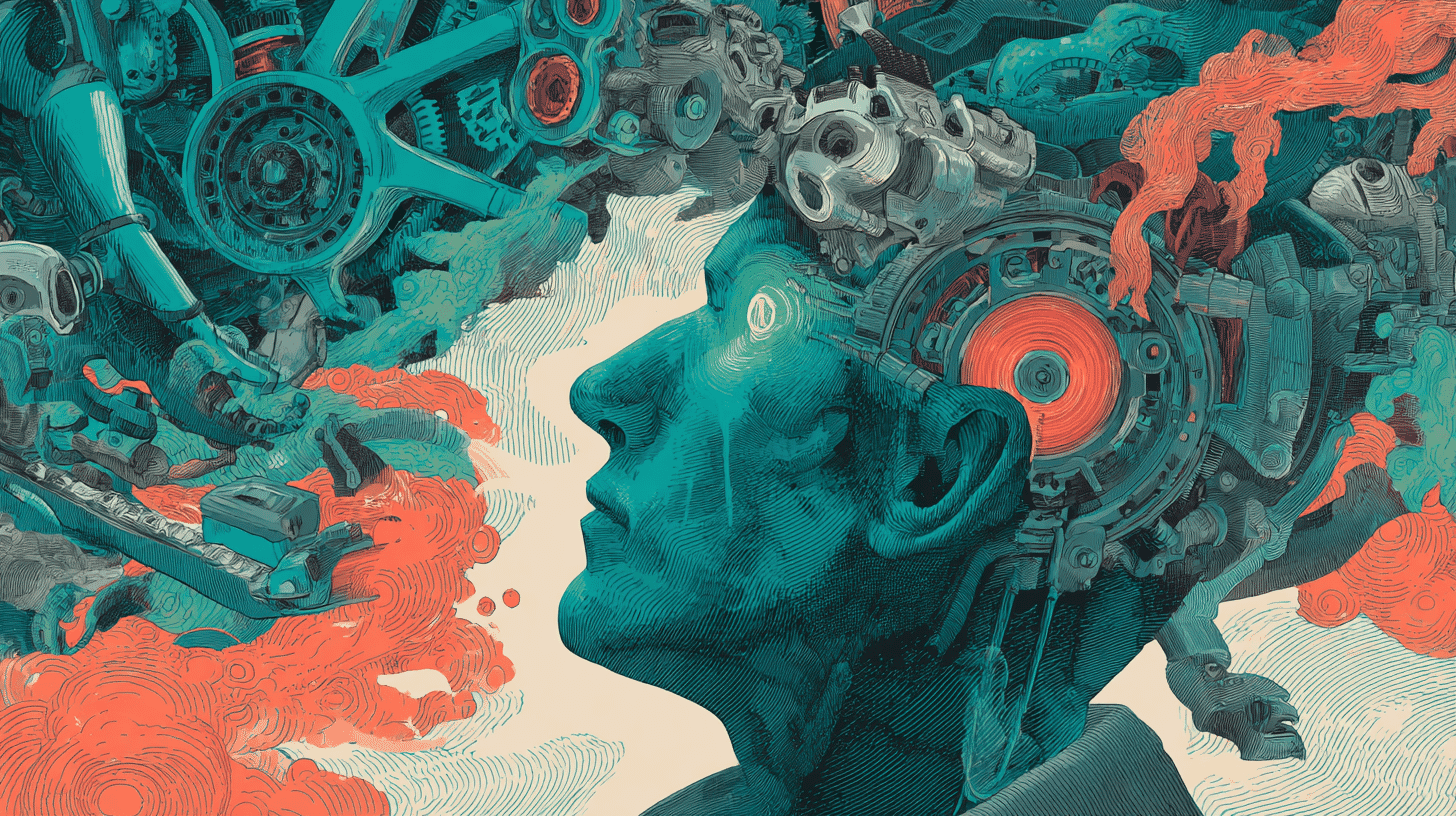
What if "lacking motivation" isn't laziness after all? You know you need to do something, but you just can't get started. Kyoto University has discovered a "brain brake" that operates independently of your willpower to block action initiation. This finding could help improve treatment for depression and prevent burnout in overworked populations.
The Brain Circuit That Stops You From Starting
We've all experienced moments when we simply can't get started on tasks we know we need to do. Putting off that difficult phone call, procrastinating on a report for a demanding boss, this inability to take the first step is a universal human experience.
In January 2026, a research team led by Dr. Ken-ichi Amemori at Kyoto University's Institute for the Advanced Study of Human Biology (WPI-ASHBi) uncovered the neural mechanism behind this phenomenon. The work was carried out with researchers Jungmin Oh and Satoko Amemori, Professor Emeritus Masahiko Takada and Ken-ichi Inoue (now at Nagoya City University) of Kyoto University's Center for the Evolutionary Origins of Human Behavior, and Kei Kimura of Tohoku University. Their findings, published in the journal Current Biology, reveal that our brains have a built-in "motivation brake" that operates independently of conscious willpower.
How the "Motivation Brake" Works
The research team focused on a specific neural pathway in the brains of macaque monkeys. They examined the circuit connecting two deep brain structures: the ventral striatum (VS) and the ventral pallidum (VP), collectively known as the VS-VP pathway.
While these regions were already known to be involved in reward processing and motivation, the study revealed something unexpected. Rather than generating motivation, the VS-VP pathway actually functions as a brake on action initiation, particularly when negative outcomes are anticipated.
What the Experiments Showed
The researchers trained monkeys to perform two types of tasks. One offered only rewards (water), while the other, the "aversive task", combined rewards with punishment (an unpleasant air puff to the face).
Using a technique called chemogenetics, the team selectively suppressed activity in the VS-VP pathway. The reward-only task showed no behavioral change, but the monkeys began initiating the aversive task without hesitation once this neural brake was disabled.
Crucially, the monkeys' value judgments, their preferences between reward and punishment combinations, remained unchanged. This indicates that the VS-VP pathway specifically controls whether to initiate action, not how situations are evaluated. All of these results come from monkeys; whether the same circuit works the same way in humans has not yet been tested.
Implications for Depression Treatment and Burnout Prevention
This discovery has significant medical implications. The extreme inability to start necessary tasks is clinically known as "avolition," a symptom prominently seen in depression, schizophrenia's negative symptoms, and Parkinson's disease.
The identification of the VS-VP pathway's role suggests future treatments could potentially regulate this circuit through deep brain stimulation or pharmacological interventions, offering new hope for patients suffering from severe motivational deficits.
However, the research team also issued an important warning. If the VS-VP pathway becomes too weak, people may push through even in dangerously stressful environments without any internal brake engaging, potentially leading to burnout syndrome.
Not Laziness, But a Neural Safety Mechanism
Perhaps the most profound implication of this research is that the inability to start unpleasant tasks isn't necessarily a character flaw. Our brains contain sophisticated systems for controlling action initiation, and these systems automatically apply the brakes when stress is anticipated.
From another perspective, this could be viewed as a "safety mechanism" protecting us from excessive stress. Without this brake, we might work ourselves past our limits, causing serious physical and psychological damage.
The research team emphasizes that rather than simply trying to boost motivation, society should discuss how to support people in facing stress while living authentically.
Future Directions
While this study was conducted on primates, verification in humans remains a future challenge. However, the identification of the VS-VP pathway as a clear target opens possibilities for new treatment strategies specifically focused on the inability to initiate action.
As neuroscience advances, our understanding of "motivation" is fundamentally changing. This discovery may serve as a catalyst for reconsidering cultures of overwork and reducing stigma around mental health conditions.
Japan has long struggled with issues of overwork and presenteeism. This research suggests that both "pushing too hard" and "being unable to push at all" may be two sides of the same neural coin, a matter of balance in the same brain circuit.
How does your country approach situations when someone lacks motivation? Are people told to "push through," or is rest encouraged?




Global Discussion
15 comments