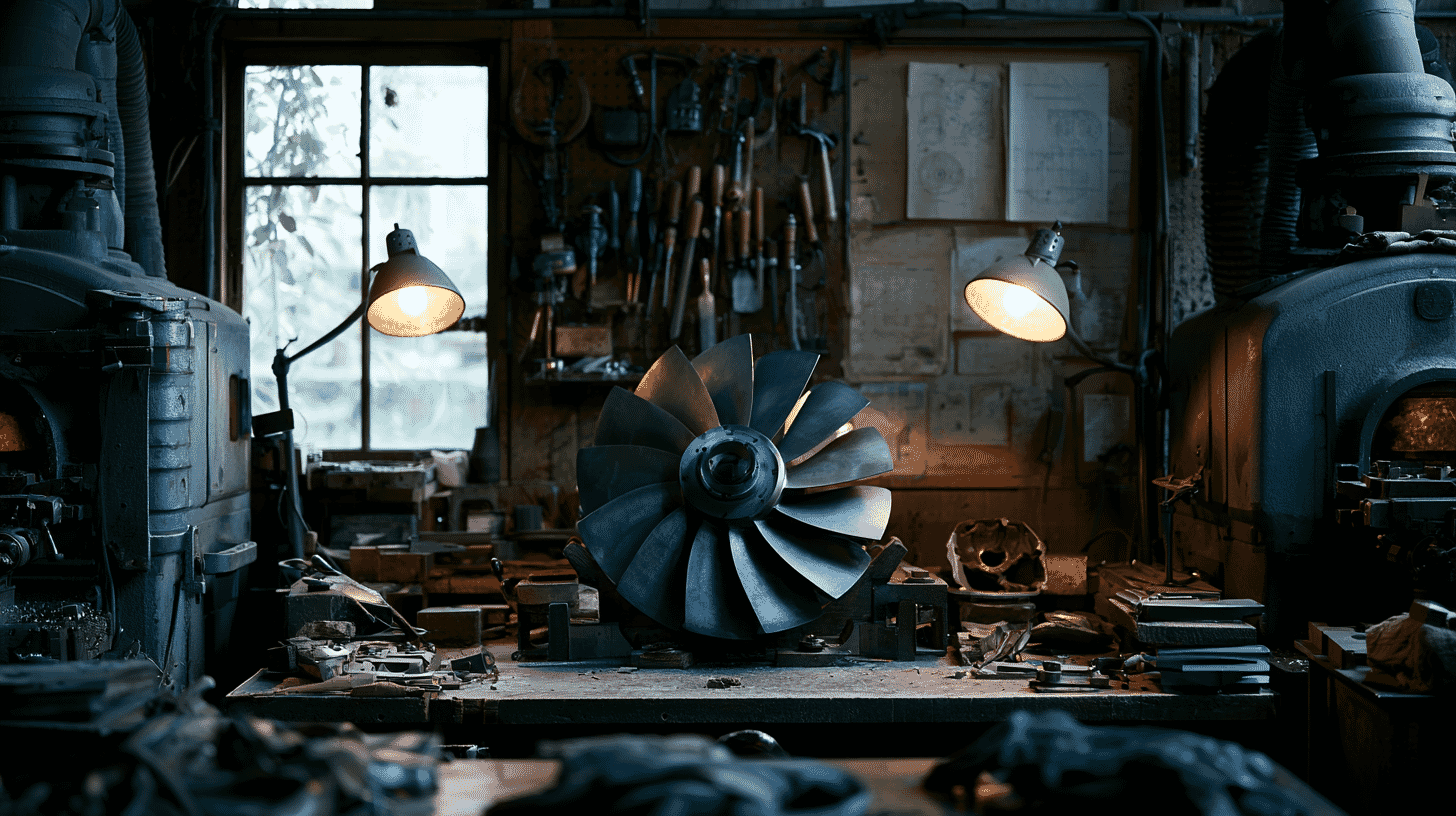
🌀 Behind every semiconductor fab, road tunnel and power station is a machine most people never see: an industrial blower, pushing air where it has to go. Venting toxic fumes, cooling furnaces, keeping tunnels breathable. In a small factory east of Osaka, a company of about forty people has spent nearly sixty years building these machines to order. It has shipped more than 30,000 of them, and it has never built the same one twice.
"Making wind," one machine at a time
Nissin Giken sits in Higashiosaka, the dense warren of small workshops that has underpinned Japanese manufacturing for generations. Its products are the kind nobody photographs: industrial blowers and fans that dry, cool, vent and convey air and gas inside factories and public infrastructure.
The company began in 1968 as a one-man shop founded by Yamamoto Shinichi, and was incorporated under its current name in 1988. From the start it has followed a single rule that its president, Yamamoto Ken'ichi, sums up as ippin-ichiyo, loosely "one product, one form." Every blower is engineered from scratch for one customer's one problem. Even the company name carries the idea: Nissin comes from a phrase meaning "renewed by the day," a nudge to keep making something new.
Why not just build one good model and sell thousands? Because a blower that draws corrosive fumes out of a chemical plant is a different animal from one handling scorching exhaust gas, or one pushing powder through a pipe. The materials, the casing, the shape of the impeller all shift with the job. (A quick note on terms: "fans" mostly move large volumes of air at low pressure, while "blowers" push smaller volumes at higher pressure. Nissin makes both, plus dust collectors and pneumatic conveying gear.)
The wall built into the business
Here is the catch that defines the company: what makes Nissin valuable is also what makes it hard to run.
Because every unit is bespoke, the work resists automation. High-speed impellers spinning thousands of times a minute demand fine tolerances, and you cannot stamp those out on a mass line. The president is blunt about it. In one-off manufacturing, he says, what finally decides quality is human skill.
The stakes are unforgiving, too. Nissin's blowers end up in chemical plants, public infrastructure and heavy industry, settings where, as the company puts it, stopping is not an option. A blower failing inside a running plant is not a product complaint, it is a shutdown. That is why, the president says, the culture rewards people who treat every project as their own and report a problem the instant they spot it, over people who are merely good at looking impressive.
Then there is the outside pressure. A forty-person shop with ten million yen (about $62,000) in capital is not competing on scale with the global giants of air handling. On paper, it should have been squeezed out long ago.
Choosing not to chase scale
It survived by refusing to play that game.
Rather than fight on price and volume, the ground where commodity manufacturers win, Nissin planted itself in the niche the big catalog makers can't be bothered with: the awkward, one-of-a-kind jobs where a standard product simply won't fit. Its evaluation system reflects the same instinct. The president personally reads the daily reports and weighs how people work, not only what they produce. Results, he argues, are partly luck; process is the thing you can actually build on.
The second move was to stop being only a blower company. In 2004 Nissin began developing "fine bubble" technology, ultra-fine gas bubbles suspended in liquid, small enough to behave in strange and useful ways. Joint research with Osaka University began in 2009 and later widened to the university's Institute of Scientific and Industrial Research and to Kansai University. The draw: fine-bubble water can sterilize food without chemicals and help keep it fresh at room temperature.
30,000 units, and a bubble that reached orbit
Six decades of custom work has bought the company something a catalog can't: trust. More than 30,000 delivered blowers is 30,000 running references, each one a plant that kept breathing.
The fine-bubble bet has paid off in unexpected places. According to the company, its technology was used in May 2020, on the Kounotori 9 resupply mission, to ship fresh food to the International Space Station, with freshness preserved and no chemical additives. At the 2025 Osaka-Kansai Expo, Nissin presented a "super oxygen water" (ultrafine-bubble water) made with the same know-how. It is still working to turn the sterilization system into a shippable product.

Illustration only: a generic industrial centrifugal fan (not a Nissin product). Photo: Wikimedia Commons / Air fans, CC BY-SA 4.0
None of this shows up on a market-share chart. Nissin's moat isn't dominance, it's being the maker you call when nobody else can build the thing you need. In an economy obsessed with scale, that is a quieter kind of strength.
The world map of blowers, and where Japan's makers sit
Zoom out, and the air-handling industry looks nothing like Nissin. The global market is consolidated at the top. By one 2025 estimate, just five firms, America's Ingersoll Rand, Germany's Aerzen and Kaeser, Sweden-headquartered Atlas Copco and China's Shandong Zhangqiu Blower, together hold roughly half of the industrial-blower market. Germany alone fields a deep bench of specialists, from Aerzen (in the business over 160 years) to Piller and TLT-Turbo. Japan has its own giant in Ebara, which builds blowers alongside pumps and semiconductor equipment.
These players compete on things Nissin doesn't: standardized high-efficiency product lines, global service networks, market share. And the pressure is arriving at Japan's door. Aerzen registered a Japanese subsidiary, Aerzen Japan, in July 2025 and started operations there on January 21, 2026, building on a long partnership with the distributor Ebara Jitsugyo (a separate company from the Ebara Corporation mentioned above).
But the giants and the workshop aren't really fighting over the same ground. Analysts describe the market as consolidation at the top with a long tail of niche suppliers underneath, and in that tail sit the engineering-to-order specialists, in Japan and abroad alike (America's AirPro plays a similar bespoke role), who exist precisely because standard products can't cover every job. Nissin isn't a hidden champion in the usual sense of a firm that owns a global share. It's the opposite archetype: a maker whose whole value is that it can't be commoditized.
In Japan, a shop like this can survive on irreplaceability alone. In your country, who builds the one-off machines the big factories depend on, and would anyone notice if they vanished?
References
- Newswitch (Nikkan Kogyo Shimbun): https://newswitch.jp/p/48659
- Nissin Giken Co., Ltd.: https://www.osaka-nissin.co.jp/


Global Discussion
3 comments