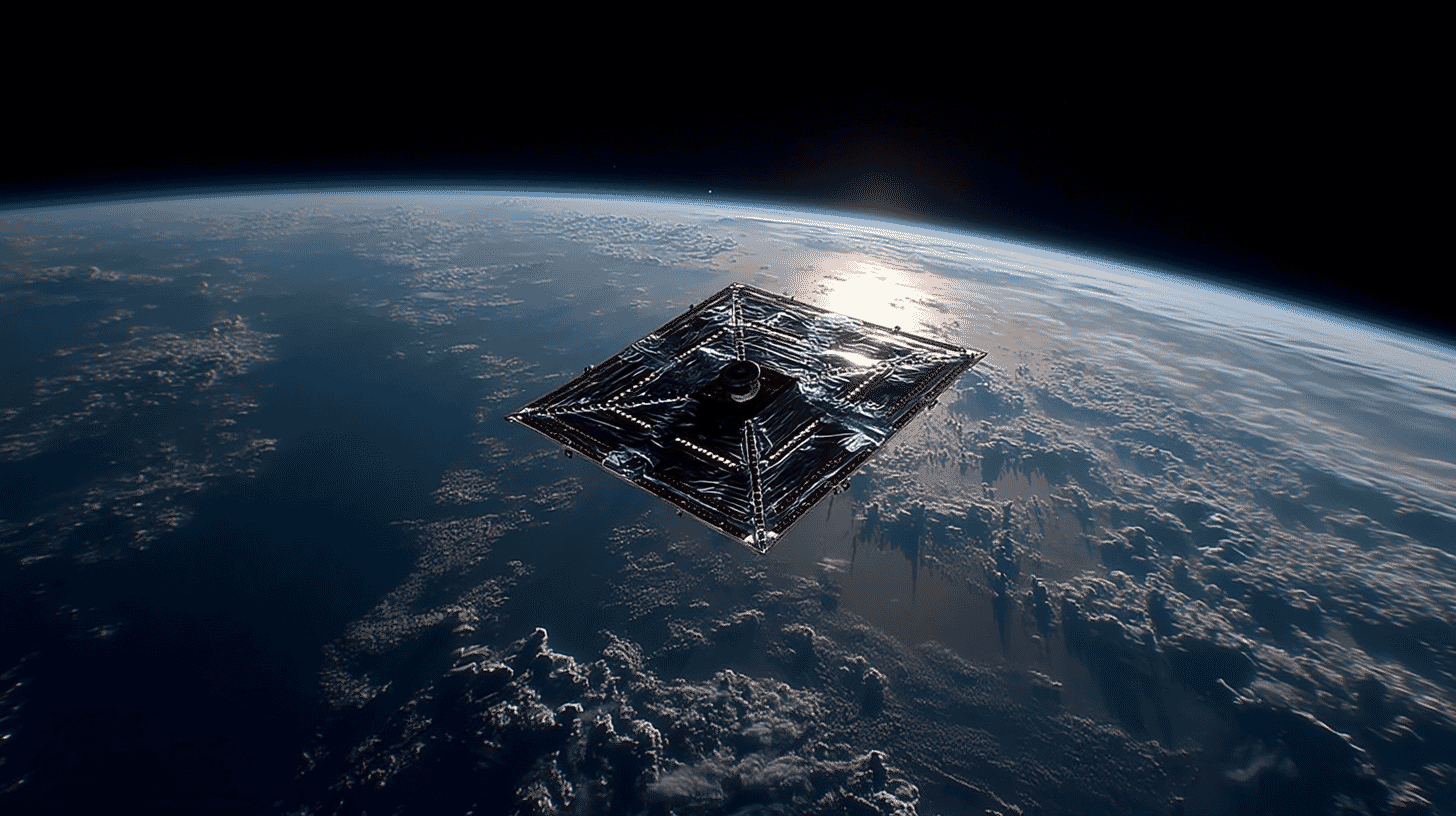
🛰️ In a Tokyo factory that has been turning out screws since 1938, someone learned to fold a film thinner than kitchen wrap so cleanly that it can unfurl in orbit and drag a dead satellite down to burn up. The screw maker never went looking for the stars. The stars turned up at a local trade fair and asked for help.
The district where Tokyo still makes things
Ota Ward sits at the southern edge of Tokyo, running from the Tama River down to Haneda Airport. It is one of Japan's densest concentrations of small factories: workshops that machine, forge, press and polish metal, often with a handful of staff and a family name over the door.
Katsuragawa Seira is one of them. Founded in 1938, it was an early adopter of cold forging, a way of shaping metal by squeezing it into a die at room temperature instead of melting or cutting it. Ever since, the company has made the least glamorous objects imaginable: small screws, washer-assembled bolts, precision parts for cars and motorcycles. By the Tokyo metropolitan government's profile of the firm, it keeps around 3,000 different parts in production at any given time, running each one in batches of 5,000 at minimum, and for some items in the millions.
That invisibility is worth a number. By one industry estimate a single passenger car takes about 5,000 fasteners, and the research firm Stratistics MRC puts the global automotive fastener market at roughly $26 billion in 2026. Every car assembly line on the planet runs on that river of parts, and small shops in places like Ota sit somewhere upstream of it.
A startup that folds space by hand
A few kilometres away, a very different company was stuck on a very different problem.
cosmobloom was founded in 2023 by Momoko Fukunaga and colleagues out of an aerospace lab at Nihon University. It works on "gossamer structures": things made of ultra-thin film and cable that pack down into almost nothing, then spread into something large once they reach orbit.

Source: cosmobloom Inc.
Its core asset is a simulation code called NEDA, built during those lab years, which predicts how a flimsy membrane will behave as it deploys. NEDA was used in the deployment simulations for IKAROS, the JAXA craft that in 2010 became the first to fly between planets on a solar sail as its main propulsion. IKAROS opened a sail 14 metres on a side by spinning the spacecraft and letting centrifugal force do the work.
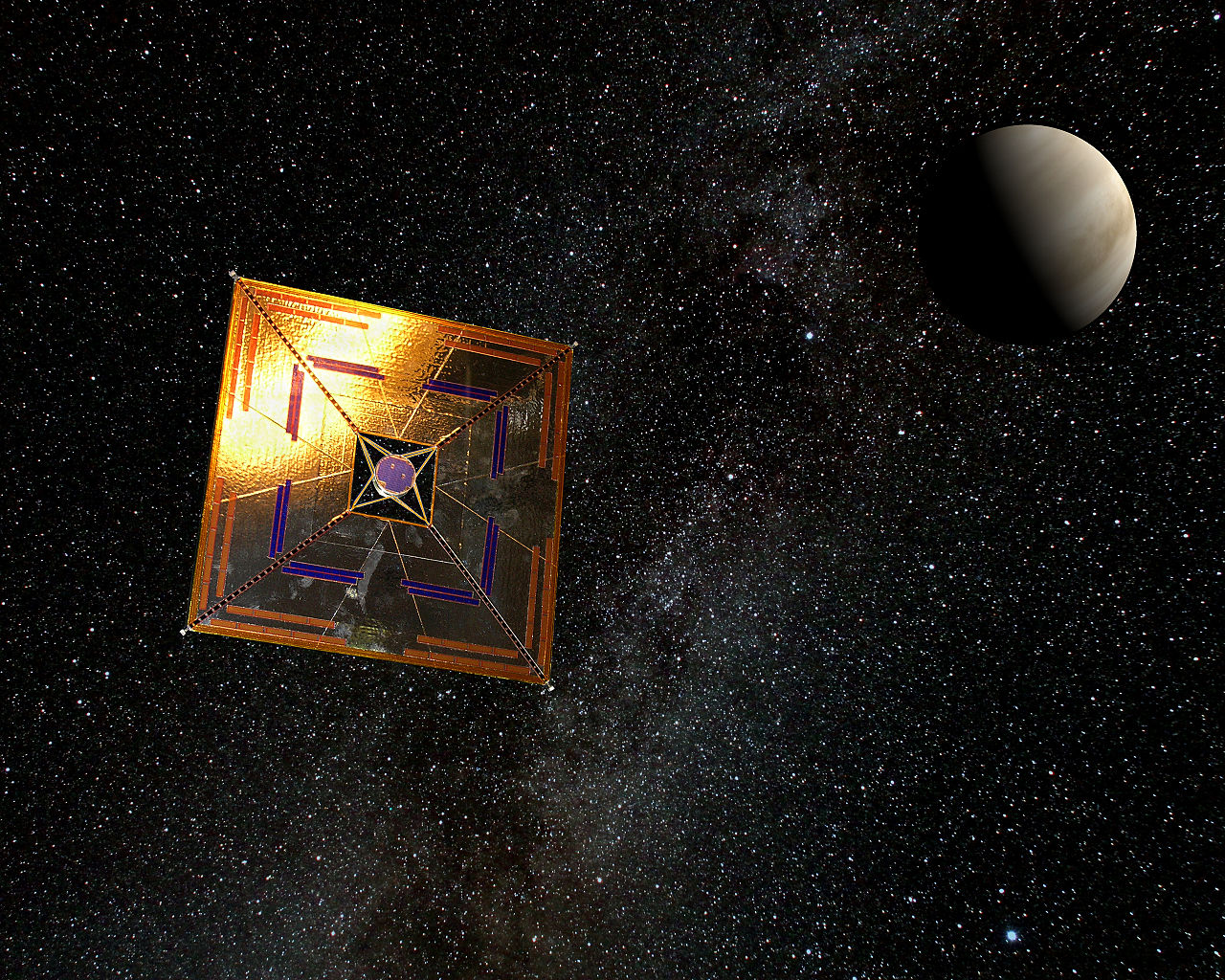
Artist's depiction: Andrzej Mirecki / Wikimedia Commons (CC BY-SA 3.0)
The product cosmobloom has pushed furthest toward market is a deorbit device called LEAF, short for Lightweight Expandable Aerobraking Film. It answers a growing headache in low orbit: as small satellites multiply, so does the risk that a dead one lingers for decades in everyone's way. The U.S. Federal Communications Commission now expects satellites in low orbit to be cleared out within five years of the end of their mission, and many of the smallest craft carry no propulsion at all to do it with.
LEAF is almost absurdly compact. Folded, it occupies 82 by 82 by 30 millimetres, smaller than a deck of cards. In orbit it opens, with no motor and no drive mechanism, into a membrane of up to about 3.64 square metres. That sail catches the faint traces of atmosphere still present at those altitudes, adding just enough drag to pull the satellite down. cosmobloom designed it so that even during a solar lull, with the membrane only 80 percent open and the satellite tumbling, it could bring a 12-kilogram satellite (6U class) down from 550 kilometres inside the five-year limit.
One obstacle was deeply unglamorous. The membrane, thinner than the plastic wrap in a kitchen drawer, has to be folded by hand, and for a long time the cosmobloom team did it themselves, late into the night, crease by crease. The folding is not busywork: the company's own engineers note that the pattern of creases affects how flat and true the film opens later. A careless fold in Tokyo becomes a bad deployment 550 kilometres up.
"We'd love to do it"
The turn came from an ordinary place. In its first year, cosmobloom exhibited at an Ota Ward trade show through a district startup facility called Rokugo Base. Fukunaga has said she went because you never know who you will meet. Who she met was Katsuragawa Seira. When she mentioned the nightly folding, the screw maker's answer was immediate: they wanted to do it.
On paper it is a strange pairing, a precision metal shop volunteering to fold film. But Katsuragawa Seira had already decided that a town factory has to try new things to survive, and had been helping other space ventures out of the spotlight, even lending them room to run experiments. Their craft, at its root, is coaxing material into an exact shape without breaking it, and folding this film cleanly turned out to be that same problem in an unfamiliar material. Where that crease pattern came from, Fukunaga has said, was the eye of people who spend every day with metal in their hands.
The ward's open-factory listing names two local space ventures Katsuragawa Seira works with: cosmobloom, and Dymon, maker of the tiny YAOKI lunar rover. The screws-and-brackets ecosystem has acquired a second life pointed at the sky.
From folding film to machining parts
Once the folding worked, the relationship moved to what Katsuragawa Seira actually knows best. cosmobloom began asking it for the metal parts too. The two now sit over the same drawings, with the veteran shop pointing out where a design is missing something a real part would need. Fukunaga says she is at Katsuragawa Seira almost daily, more or less commuting to a screw factory to build a spacecraft component.
The work hit a milestone this year. cosmobloom completed LEAF's ground development, and in May 2026 Katsuragawa Seira delivered the finished deorbit device to the startup. The real test is still ahead: LEAF has to prove itself in the one place it was built for, and cosmobloom has an on-orbit demonstration planned for the winter of 2026.
None of this makes Katsuragawa Seira a space company. It is still, overwhelmingly, a maker of automotive fasteners. What the story shows is smaller and more interesting: the distance between the most ordinary part in your car and a satellite in orbit can be a few kilometres and one conversation at a trade fair.
Who makes the screws on your satellites?
Rockets and founders get the headlines. Behind every satellite, though, is a supplier turning out the small, exact parts that hold it together and, increasingly, bring it back down. In your country, who makes those parts, and would it ever have occurred to you to ask?
References
- https://www.neji-bane.jp/news/20260720_03_02/
- https://prtimes.jp/main/html/rd/p/000000012.000148294.html
- https://rokugobase.com/magazine/7004/
- https://o-2.jp/mono/oof2024/4728/
- https://www.kaisyahakken.metro.tokyo.lg.jp/old/kigyou/katsuragawa-seira/
- https://www.isas.jaxa.jp/missions/spacecraft/past/ikaros.html







Global Discussion
4 comments