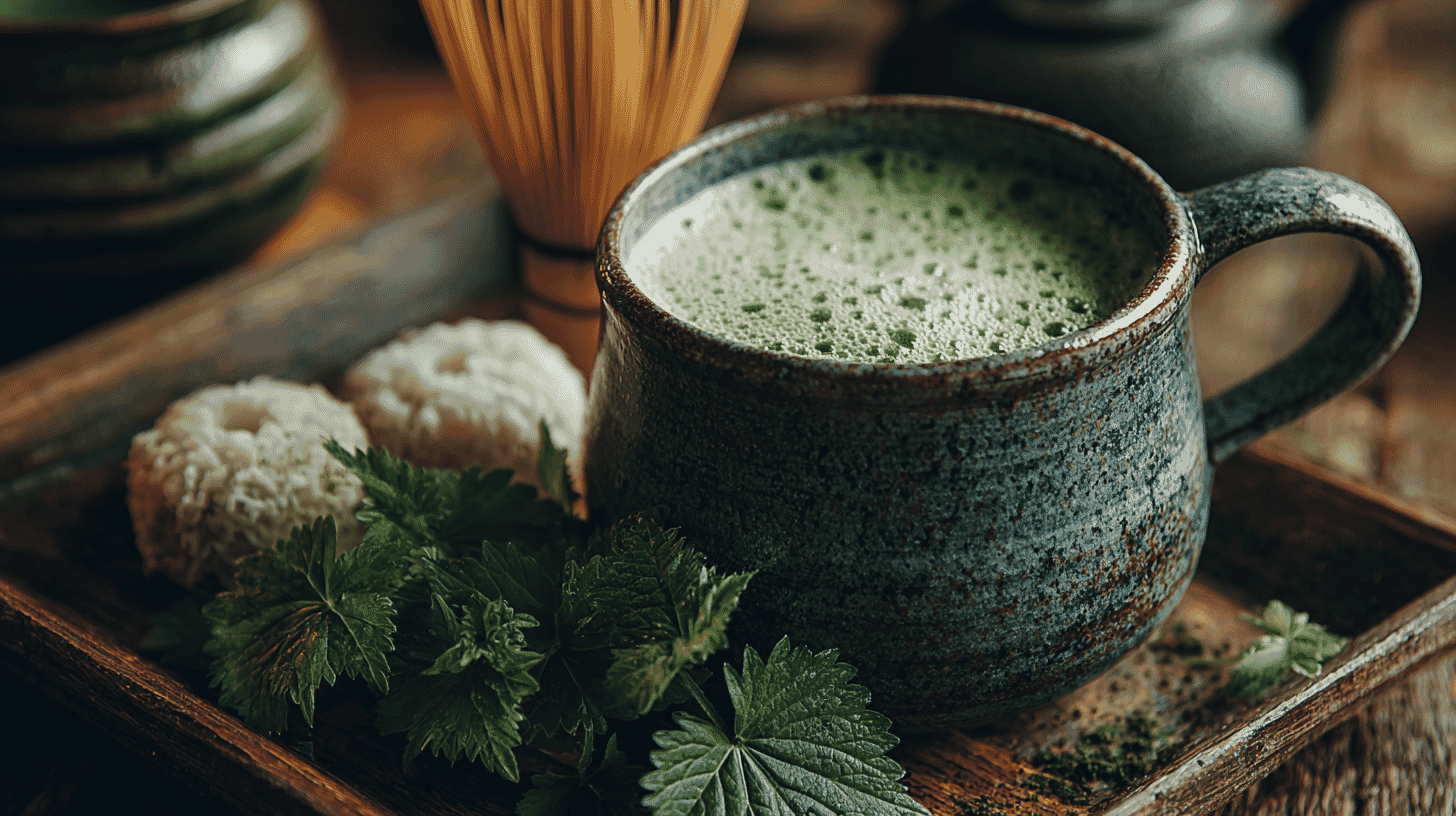
As matcha shortages and soaring prices ripple through cafés worldwide, an unassuming roadside herb in Japan is being floated as the next big thing. Locals call it yomogi. The rest of the world calls it mugwort. One Osaka supplier shipped a record 754 tons last year, mugwort-steam wellness salons grew 1.8x in three years, and a former trading-company employee quit his job to brand the stuff. Could this nostalgic Japanese weed really become the "next matcha"?
A café where everything is mugwort
In the city of Nagahama, Shiga Prefecture, a recently opened café serves nothing but yomogi: vibrant green mugwort lattes, bean-flour-dusted dumplings, confections of every shape. Owner Hideyuki Enami told Kansai TV he started the café because he wanted to spread the appeal of yomogi further.
Similar mugwort-focused cafés are appearing beyond Tokyo and Osaka, in smaller regional cities. The driver is the global matcha boom, and the supply crunch and price surge that came with it.
Record 754 tons shipped, cultivation expanded 1.5x
The matcha supply squeeze has become a tailwind for what the trade is calling "next matcha."
Uenochu, an Osaka-based mugwort wholesaler, shipped a record 754 tons of yomogi in 2025, and expects 2026 to be higher. A senior advisor at the company, Ueno, explained the dynamic to Kansai TV: matcha has become expensive and scarce, so the trade is gravitating toward yomogi as the next green option. The company has already expanded its cultivation area by 1.5x.
Ueno points to three strengths. Mugwort pairs easily with a wide range of foods, Japanese, Western or Chinese. You need less of it than matcha to get an intense green. And it is naturally caffeine-free, which makes it workable for evening drinks, for pregnant women and for children.
That last point matters globally. Caffeine-free wellness drinks fit the Western sober-curious movement and the broader shift toward functional beverages, a category where matcha alternatives like hojicha and rooibos are already gaining ground.
What yomogi is, a primer for international readers
For readers unfamiliar with the plant: yomogi (Artemisia indica var. maximowiczii, also written A. princeps) is a perennial herb in the daisy family, growing wild across Japan in fields, on riverbanks and along roadsides. The young spring shoots are picked, boiled and pounded into rice cakes, producing the green-flecked sweets known as kusa-mochi, yomogi-mochi and yomogi-dango. The flavor is grassy and aromatic with a gentle bitterness, from essential oils like cineole.
The mugwort family is global. In Europe it is Artemisia vulgaris. In Korea it is ssuk (쑥). In China it is ai cao (艾草), used in traditional medicine and moxibustion. Medieval European herbalists called Artemisia the mother of herbs. The same genus gives French cuisine its tarragon and the spirits world its absinthe, from wormwood (Artemisia absinthium).
Mugwort, in other words, is not a uniquely Japanese plant. What Japan developed most distinctively was the culinary system of pounding it into sweet rice cakes.
Nutrition: a different green from matcha
According to Japan's Standard Tables of Food Composition (eighth revision, 2023 supplement), 100g of boiled yomogi leaves contains 7.8g of dietary fiber and 6,000 micrograms of beta-carotene, ten times the 600-microgram threshold Japan uses to classify a vegetable as a green-and-yellow vegetable. It also carries 3.0mg of iron, 140mg of calcium and 380 micrograms of vitamin K.
Yomogi and matcha do not share a nutritional profile. Matcha leans on catechins, L-theanine and a moderate caffeine kick: alertness plus antioxidants. Yomogi leans on fiber, beta-carotene and the absence of caffeine. Rather than a premium-versus-budget comparison, the two are different green ingredients working on different axes.
Mugwort steam salons jumped 1.8x in three years
Yomogi's growth is not limited to food. A warming therapy called yomogi-mushi, sitting over a steaming pot of dried mugwort, has spread quickly in Japan, mostly among women seeking relief from poor circulation. According to Kansai TV, the number of mugwort-steam salons across Japan grew roughly 1.8x over the past three years.
Worth being honest about the origin: yomogi-mushi is not a Japanese invention. The practice is generally traced to Korea and China, where versions of it have existed for centuries. Japan is a relatively recent participant in this category.
The same is true of mugwort lattes. Ssuk lattes have been a fixture in Seoul cafés for years, and Korean mugwort powder is already marketed abroad as a traditional superfood. Japanese yomogi entering the global café conversation is catching up rather than leading.
What is happening, more accurately, is an East Asian green renaissance, with Korea, Japan and China rediscovering mugwort more or less simultaneously, each tapping a different part of the wellness market.
A trading company veteran who quit to farm "weeds"
Mugwort's path forward is not without obstacles.
Hironori Morii, head of Fukayoshino Yomogi in Nara, told Kansai TV that the unit price for raw mugwort is low and that most of the yomogi consumed in Japan is imported from China. Few Japanese growers can make a living from it.
One person trying to change that is Masafumi Shimizu. Five years ago Shimizu was working at a trading company. He saw an opportunity in the small scale of domestic production and quit to farm. Neighbors mocked him at first: what are you going to do, grow weeds?
His strategy was branding. He registered his mugwort under the trademark Aozora Yomogi no Shimizu, and rather than selling raw leaves he makes and sells finished goods like bath additives and culinary powder. Controlling the brand and the product format has let him raise the unit price substantially. As he put it to Kansai TV, the point is not to sell cheap things cheaply but to add value and sell at a margin that works.
This is exactly the playbook the Japanese tea industry has run for decades: Uji matcha, Yame gyokuro, Tamba black soybeans. Take a humble raw material, attach geography, technique and trademark, then climb the value ladder. Yomogi is starting that climb.
What it would actually take to be the "next matcha"
Matcha's global success was not inevitable. It rested on a stack of conditions: a centuries-old tea ceremony tradition, regional brands like Uji and Nishio, technical practices like shade-cultivation and stone-grinding, and adoption by global café chains.
For yomogi to truly cross over, several walls would need to be cleared.
The first is grading. Matcha has industry definitions (ground tencha leaves) and tiers (ceremonial versus culinary grade). Yomogi has none of that standardization. Without it, the problem now plaguing matcha, cheap powdered green tea sold abroad under the matcha name, could replicate itself in mugwort.
The second is regional branding. Higashiyoshino Village in Nara carries a legend that the Buddhist monk Kūkai ate the local mugwort, which gives the area a story measured in centuries. Translating that into language that resonates with overseas consumers is the next job.
The third, and biggest, is differentiation from Korean ssuk, which already owns the international mugwort-latte conversation. Japanese yomogi will need to lean into what is genuinely Japanese about it: the kusa-mochi tradition, the wagashi context, the tea-ceremony adjacency.
What about your country?
Behind the matcha boom, a nostalgic Japanese green herb is starting to spread its wings.
A bitter green ingredient pounded into a paste, mixed with grain or steeped into something hot is not unique to East Asia. Italians have stinging-nettle pasta. Mexicans have nopal cactus paddles. Brazilians have jambu. Eastern Europeans simmer sorrel into soup. North Africans cook molokhia. Even kale and spirulina fall into the same broad family of green, slightly bitter, traditionally medicinal foods.
So here is the question: in your country, what is the bitter green plant that grandmothers used to forage and turn into something delicious? Is the younger generation still eating it, or is it slipping away? Tell us in the comments.





Global Discussion
14 comments