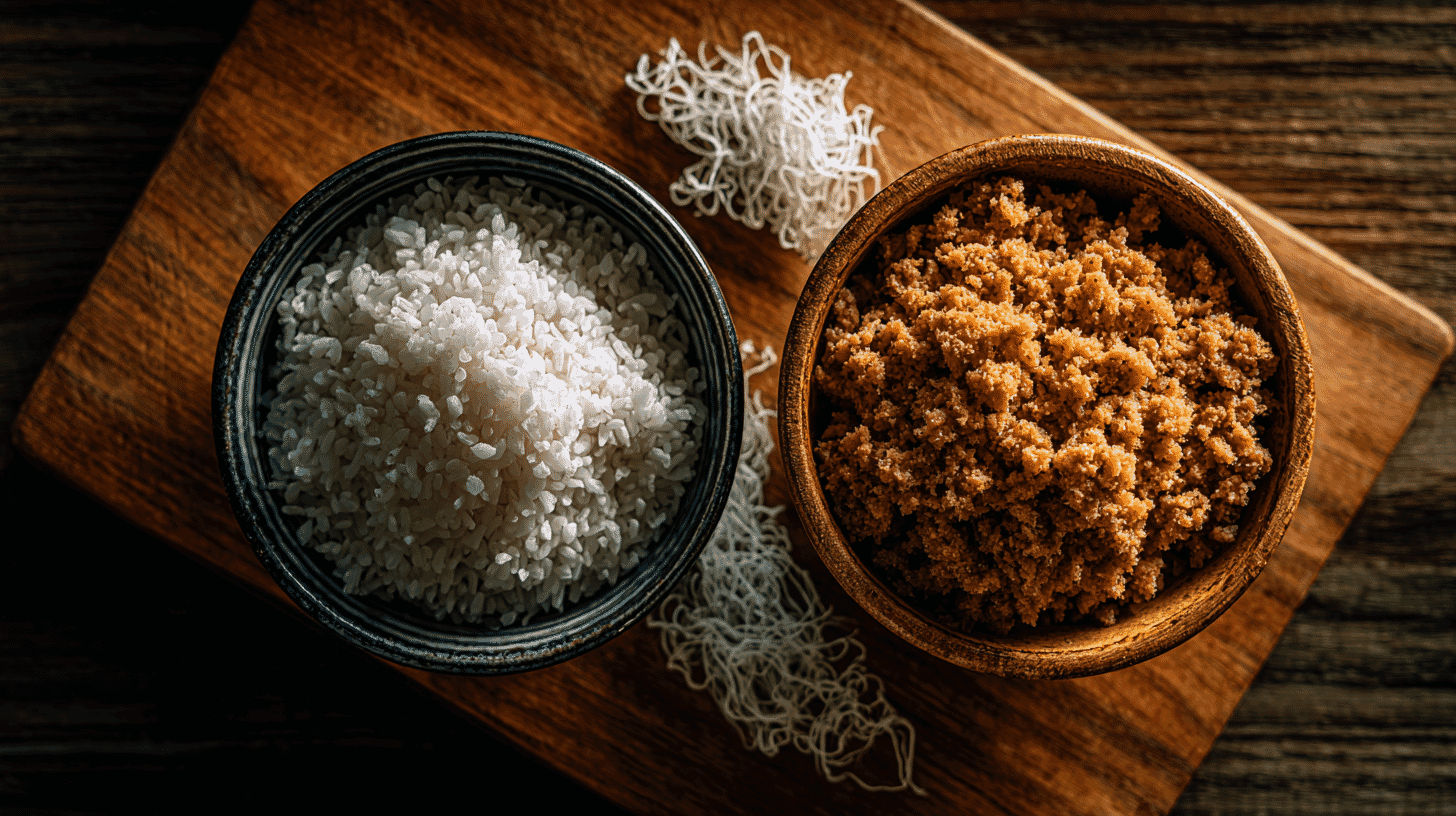
🍚 Take the same koji mold used to brew miso and soy sauce. Ferment rice with it. What comes out has the texture and savor of ground meat.
While the world's soy-dominated alt-meat sector stalls out, a Tokyo startup began mass production at its own factory in Tochigi in April 2026. The raw material is rice. Just not the rice you'd put in a bowl.
Making "Meat" Out of Rice
Agro Ludens, founded in 2021 and based in Tokyo's Chiyoda ward under CEO Kiyotaka Saga, brought its Nasu Plant online in April 2026. It sits in Nakatawara, Ohtawara, Tochigi Prefecture, and at roughly 800 square meters of floor space it is not large. But it holds saccharification tanks and solid-state fermenters, and targets annual output of 50 tons of mycoprotein plus 300 tons of rice-derived sugar liquid.
The process: saccharify the rice, draw off the starch as sugar liquid, then add koji mold to the protein that's left and let it ferment. What emerges is a high-protein solid with the texture of mince. It's a mycoprotein, the family of proteins grown from filamentous fungi like mushrooms and koji, and Agro Ludens holds the patents (JP 7264566 and 7441567). The brand is CoMeat.
According to The Japan Food Journal, the composition runs above 60% protein and around 3% fat, close to chicken breast. Because koji generates amino acids as it ferments, the beany note that dogs soy-based products doesn't really show up. The method is solid-state culture, the same thing Japanese breweries have been running for centuries, pointed at a food ingredient instead of a condiment.
The sugar liquid isn't waste either. It works as rice syrup for sweetening or brewing, and as feedstock for bioethanol. In June 2026, Agro Ludens and trading house Dai-Ichi Jitsugyo started up a large-scale demonstration line at Nasu that produces mycoprotein and bioethanol together. The two are sketching a commercial plant at 5,000 tons of mycoprotein and 10,000–20,000 kiloliters of bioethanol a year.
"We Don't Use Table Rice"
Tell a Japanese person you're making meat out of rice and the first thought is: so there'll be less rice to eat. The company's answer is unambiguous.
Kiko Atobe, the director who runs sales and communications, told the food industry paper Shokuhin Shimbun that processing-grade rice actually yields more mycoprotein and more sugar liquid than table rice does. The plan is to source high-yield processing varieties directly from farmers.
Policy then caught up with the plan. In March 2026, the Ministry of Agriculture, Forestry and Fisheries recognized mycoprotein as an approved use under its new-market rice program, meaning farmers growing rice destined for mycoprotein qualify for support. Giving farmers a reason to grow more rice outside the table-rice quota is not a small thing.
In July, a partnership with Chubu Electric Power and the farming corporation Yuzuriha Engei got underway. Yuzuriha grows rice on preserved farmland in Okuma, Fukushima, using water-saving dry direct seeding; Nasu turns the harvest into sugar liquid for biofuel, and the protein left after pressing becomes mycoprotein. Atobe framed it as finding a use for rice that was never meant for the dinner table.
Is There Too Little Rice, or Too Much?
Japan's rice picture has flipped twice in two years.
In summer 2024 the shelves emptied, in what got called the Reiwa Rice Riot. Bad weather, thin inventories and panic buying converged; farmgate prices for the 2024 crop jumped 64% year on year, and the 2025 crop added another 42%, pushing the average wholesale price to a record ¥35,812 per 60 kg of brown rice. Supermarket prices peaked at ¥4,416 per 5 kg in January 2026.
Now it's running backwards. Farmers saw the high prices and planted more, and the 2026 table-rice crop is projected at 7.32 million tons against demand of about 7.11 million. The ministry expects private inventories to hit as much as 2.71 million tons by the end of June 2027, far above the 1.8–2.0 million considered healthy. Supermarket prices have fallen every week; for the week ending July 5 the average was ¥3,458 per 5 kg, under ¥3,500 for the first time in about 18 months.
Zoom out and the shrinking side is demand. Per-capita rice consumption fell from about 111.7 kg a year in 1965 to about 51.1 kg in 2023, less than half in six decades. In bowls, that's five a day down to two. Japan's calorie-based food self-sufficiency sat at 38% again in fiscal 2024, unchanged, but rice is the one staple where self-sufficiency is essentially 100%. The country can grow it. Nobody's eating it.
Which makes "a new exit for rice" more urgent than growing more of it. Mycoprotein is one candidate exit. Bioethanol is another.
Why a Railway Bought Into Rice Farming
While one side hunts for exits, another is trying to protect the entrance.
On April 28, 2026, JR East established a subsidiary called JR East Toyosato Sosei. Backers include the major rice wholesaler Yamatane, the agriculture-focused staffing firm YUIME, and the three employees who pitched the idea, at ¥400 million in capital. It's the first company to emerge from ON1000, JR East's internal venture program, and it's based at LiSH, the business creation facility in Takanawa Gateway City.
The 17 prefectures in JR East's territory account for roughly half of Japan's rice acreage. Within a decade, about 670,000 hectares in that territory alone, and about 1.34 million hectares nationwide, roughly six times the land area of Tokyo, could end up with nobody to farm them. The new company will take equity stakes in farming corporations that have no successor, consolidate surrounding fields, and use JR East's Hako-byun rail freight service to link growers to markets. The target is 1,500 hectares under cultivation.
One outfit is looking for new uses for rice. The other is trying to keep the fields planted. Two ends of the same problem.
The Alt-Meat World Is in the Trough
The timing isn't exactly a tailwind.
Beyond Meat, the sector's face, closed at an all-time high of $234.90 on July 26, 2019, and then fell apart. In early July 2026 the stock traded below a dollar, more than 99% off the peak. A retail-driven squeeze lifted it from $0.50 to nearly $8 in October 2025, but it was back near $1 by December. Revenue kept sliding through Q1 2026, and Q2 guidance of $60–65 million came in under consensus. Management says it's aiming for 20%-plus gross margin and a positive annual EBITDA run rate in the second half of 2026.
The failure wasn't ideological. The products cost more than meat, wore the ultra-processed label, and didn't taste as good as people had been promised.
What Beyond Meat is pushing now is Beyond Steak Filet, made from mycelium and avocado oil. It launched on the company's own site in October 2025, became its best seller, hit retail at Wegmans and H-E-B at the end of June 2026, and rolled into Meijer in July. The company now styles itself "Beyond, The Plant Protein Company." From reassembling isolated soy and pea protein into meat, toward letting fungi build it. That's where the wheel is turning.
Letting the Fungus Do the Work
What makes mycoprotein different is where the protein comes from. Plant-based meat extracts protein from a crop and rebuilds it into a meat-like texture. Mycoprotein grows fibrous on its own as the fungus does, and the umami comes from the organism. Fewer processing steps also means an easier time with the ultra-processed critique.
Agro Ludens sits at an odd angle within that race: rice as the substrate, koji in solid-state culture as the method. Most international players ferment in liquid. Saga, the founder, started out as a biomass fuel researcher and stumbled into alt-meat while looking for something to do with the protein left over from making fuel out of rice. Chasing food and energy at once comes from that origin.
What Starts at 50 Tons
Fifty tons a year is a rounding error against Japan's meat market. Price, taste, and whether anyone actually buys it are all still open questions, and the 5,000-ton plant with Dai-Ichi Jitsugyo exists on paper.
But it's clear what this thing is aimed at. A crop the country can still grow and has stopped eating. An alt-meat category that hit the wall with soy. And fuel. Three problems intersecting at one point: koji. The part that's quietly funny is that Japan's edge here isn't new technology at all. It's the old kind, the sort that's been working inside brewery walls for centuries.
Is there a traditional crop in your country that people have stopped eating? Has anyone started turning it into something else yet?
References
- https://www.agroludens.com/news/20260318
- https://prtimes.jp/main/html/rd/p/000000013.000160560.html
- https://shokuhin.net/142128/2026/04/03/kakou/pbf/
- https://shokuhin.net/153133/2026/07/08/sonota/sdgs/
- https://www.maff.go.jp/j/press/kanbo/anpo/251010.html
- https://hojyokin-portal.jp/columns/kome_kakaku_suii
- https://www.jreast.co.jp/press/2026/20260428_ho02.pdf
- https://www.stocktitan.net/news/BYND/beyond-meat-launches-beyond-steak-filet-at-wegmans-and-h-e-k8qzuhuh6qps.html
- https://www.macrotrends.net/stocks/charts/BYND/beyond-meat/stock-price-history




Global Discussion
15 comments