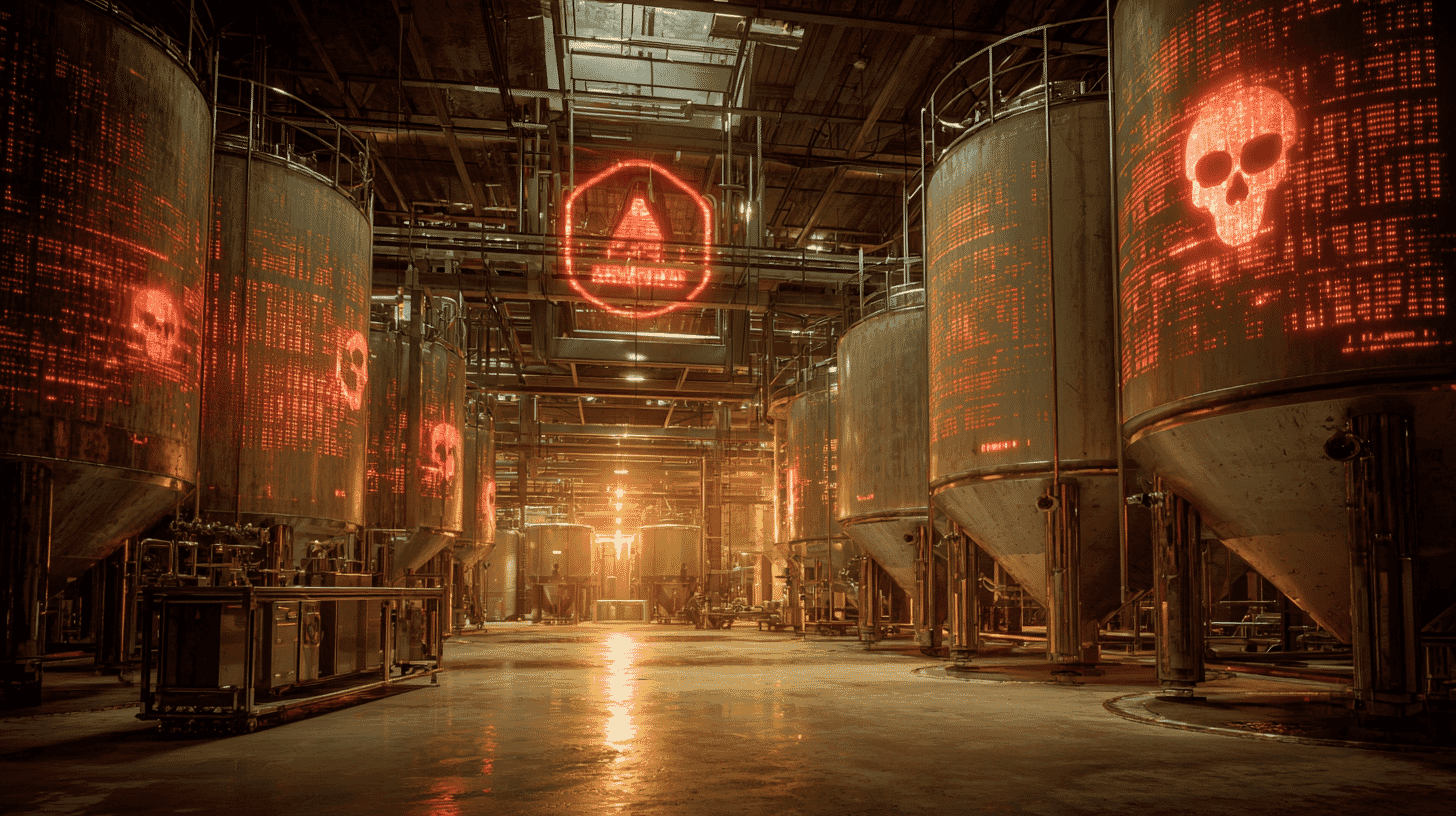
On September 29, 2025, Asahi Group Holdings, which commands approximately 40% of Japan's beer market, fell victim to a massive ransomware attack. The attack paralyzed the company's order and shipping systems, forcing the temporary shutdown of operations at around 30 domestic factories.
The damage extended into the crucial year-end sales season, with Asahi Beer's October-December sales falling nearly 20% compared to the same period a year earlier. The attack struck during the most important period for the beer industry, the oseibo (year-end gift-giving) season and the height of end-of-year party celebrations.
Timeline and Impact of the Cyberattack
Discovery and Initial Response
Around 7:00 AM on September 29, 2025, anomalies were detected in Asahi Group Holdings' systems. At 11:00 AM the company cut its network and isolated its data centre, which brought order and shipping operations across beer, beverages and food to a complete halt.
Investigation showed the attack was carried out by Qilin, a Russian-speaking ransomware group, which claimed responsibility on October 7 and said it had stolen about 27 gigabytes of data. Later investigation found that the intruders had entered roughly ten days before detection, using network equipment at a group site as their way in.
Business Impact
Sales Impact (Year-over-Year Comparison)
- Asahi Beer: Just under 20% decline (October-December cumulative)
- Asahi Soft Drinks: Approximately 30% decline (October-December cumulative)
- Asahi Group Foods: Approximately 10% decline (October-December cumulative)
The quarter proved particularly damaging. Despite the approaching New Year holiday, a peak demand season, the company was forced to delay shipments and restrict sales of year-end gift sets, leaving Asahi Beer's October-December sales down just under 20% year-over-year.
Potential Data Breach
At a press conference on November 27, Asahi Group disclosed that personal information of approximately 1.914 million individuals may have been compromised. This included data from approximately 1.52 million customers who had contacted customer service centers, approximately 275,000 current and former employees and their family members, and roughly 114,000 external business contacts.
Ripple Effects Across the Industry
Impact on Competitors
The surge in demand for alternative products forced Kirin Beer, Suntory, and Sapporo Breweries to temporarily restrict shipments of certain products. Each company canceled or limited sales of year-end beer gift sets and suspended launches of seasonal limited-edition products.
In October, combined beer sales volume for the three major competitors (excluding Asahi) increased 18% year-over-year. Kirin Beer's "Ichiban Shibori" and other flagship brands recorded strong sales during the shortage.
Impact on Distribution and Retail
Convenience stores and restaurants in Tokyo experienced prolonged shortages of Asahi products. Some restaurants, working through wholesalers, switched their draft beer taps and glassware to Sapporo and Kirin brands, raising concerns about long-term erosion of brand loyalty that took decades to build.
The State of Japanese Corporate Cybersecurity
Rising Ransomware Threats
According to the Information-technology Promotion Agency (IPA)'s "Top 10 Information Security Threats 2025," ransomware attacks ranked first among threats to organisations. It has held the top spot for five consecutive years since the 2021 edition, and has been on the list every year since 2016. The first half of 2025 saw a record 116 ransomware incidents reported domestically, with small and medium enterprises accounting for 77 cases, about two-thirds of all incidents.
Police agency surveys indicate that over 80% of ransomware infections occur via VPN devices or remote desktop connections, highlighting security vulnerabilities that have emerged with the proliferation of remote work.
Japan-Specific Challenges
Experts point to several structural issues in Japanese corporate cybersecurity practices.
Declining Language Barrier Protection: Japanese companies were once relatively insulated from overseas hackers due to the language barrier, but advances in AI technology have rapidly eroded this protection.
Lack of Practical Experience: Having experienced relatively few major attacks in the past, many Japanese companies lack expertise in responding to cyber incidents.
Talent Shortage: Japan faces a severe supply-demand gap in cybersecurity professionals, with training programs failing to keep pace with needs.
Legacy System Issues: Many companies continue operating with inadequately integrated legacy systems inherited through mergers and acquisitions, creating security vulnerabilities.
Asahi Group's Response and Prevention Measures
System Recovery Efforts
Asahi Group began gradually resuming system-based order processing in December, targeting normalised logistics by February 2026. A recovery plan spanning roughly five months from the attack is itself a measure of how deep the damage ran.
At a press conference on November 27, President Atsushi Katsuki said the company had put preventing further damage inside and outside the group first, containing the attack and securing safe communications while carefully restoring systems with outside specialists.
Update: Order processing resumed on the electronic ordering system on December 2, 2025 for Asahi Group Foods and December 3 for Asahi Breweries and Asahi Soft Drinks. Delivery lead-time restrictions cleared by February 2026 and logistics returned to normal. Shipments of the full product range resumed on April 7, 2026, roughly six months of supply constraints in total. Accounting was delayed too: the consolidated results for the year to December 2025 were not published until July 8, 2026, about five months behind schedule. Net profit fell 36.7% year on year to 121.5 billion yen. The operating profit hit is put at close to 40 billion yen, of which roughly 17 billion yen was direct incident cost, covering written-off inventory that could not ship, recovery labour, and cancelled advertising. The bulk of the damage was lost business, not ransom. Four executives including President Katsugi returned part of their pay, and an information security committee was established. For the year to December 2026 the company is guiding to record results: revenue of 3.22 trillion yen and net profit of 194 billion yen. (As of August 2026)
Enhanced Security Measures
The company is implementing the following measures:
- Fundamental review and upgrade of security systems
- Strengthened collaboration with external security experts
- Comprehensive security education for all employees
- Development of business continuity plans (BCP) for incident response
Lessons for Businesses
The attack on Asahi Group serves as a wake-up call for all Japanese corporations.
Recognition as a Management Issue: Cybersecurity is not merely an IT department concern but a risk fundamental to business operations that requires board-level attention.
Business Continuity Planning: Alternative measures and manual operation capabilities when systems fail are essential preparations.
Supply Chain-Wide Protection: Security measures must extend beyond the company itself to encompass the entire supply chain, including business partners.
Timely Disclosure: Transparent information sharing during incidents is crucial for maintaining stakeholder trust.
For Japanese companies to remain competitive in the global marketplace, investment in cybersecurity infrastructure and talent development is essential. How are companies in your country addressing cybersecurity measures and responding to large-scale cyberattacks? We'd love to hear your thoughts and experiences.
References
- https://www.nikkei.com/article/DGXZQOUC146NJ0U6A110C2000000/
- https://www.ipa.go.jp/security/10threats/10threats2025.html
- https://www.businessinsider.jp/article/2511-asahi-president-cyberattack-recovery-timeline/
- https://www.asahigroup-holdings.com/en/newsroom/detail/20251003-0204.html
- https://www.cnn.com/2025/10/08/business/japan-asahi-cyberattack-readiness-intl-hnk
- https://therecord.media/asahi-says-ransomware-incident-exposed-data
- https://www.bitdefender.com/en-us/blog/hotforsecurity/asahi-cyber-attack-spirals-into-massive-data-breach-impacting-almost-2-million-people
- https://www.inside.beer/news/detail/japan-asahi-cyberattack-cripples-supply-rivals-gain-ground









Global Discussion
15 comments