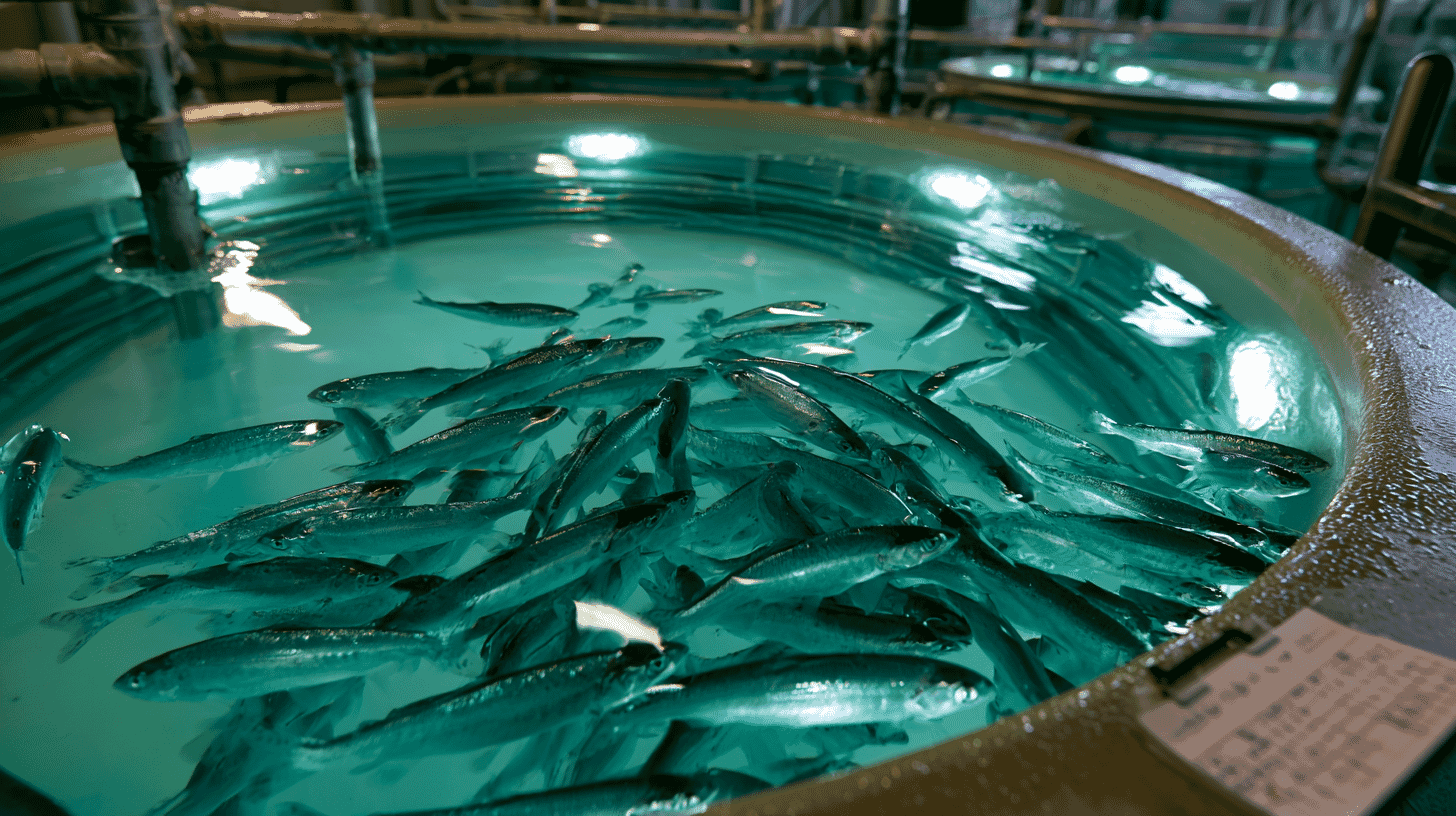
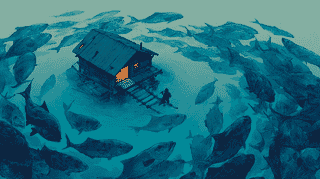
🐟 Murakami has been known as a salmon town since the Heian period. It has a salmon museum, a river fishery handed down since the Edo period, and reportedly more than a hundred salmon dishes. Last season that river gave up about 1,400 fish. The town's answer is a two-year research contract worth roughly $32,000: raise chum salmon on land, from parent to child to grandchild, without ever going back to the sea. Nobody has done it.
From 55,000 fish to 1,400
The Miomote River comes down out of the mountains of Niigata Prefecture and runs through Murakami to the Sea of Japan. Every autumn the local fishermen work it with iguriami, a drift-net method handed down since the Edo period.
There is not much left to catch. According to the Miomotegawa Keisan Fisheries Cooperative, the river yielded about 55,000 salmon in fiscal 2015. By fiscal 2023 the figure had fallen below 10,000. Last season, fiscal 2025, it was about 1,400. That is a drop of roughly 97.5 percent in a decade.
Hirata, the cooperative's deputy head, put it to the broadcaster BSN in the plainest possible terms: back when the river gave 40,000 or 50,000 fish, catching salmon every day was simply what happened. Since around 2024, he said, they still fish every day, and the daily count is one or two.
The shortage has spread past the fishery. Iyoboya Kaikan, the municipal salmon museum that Niigata Prefecture describes as the first of its kind in Japan, normally keeps more than a thousand live juveniles for visitors to watch. This year it has about a hundred. Ogawa, a section chief there, told BSN that a salmon museum that cannot display living salmon is not really meeting anyone's expectations, and that the tourism side of the city feels it too.
The sea changed first
Nobody in Murakami is blaming the river. The problem starts offshore.
Sea surface temperatures around Japan have risen 1.36 degrees Celsius per century through 2025, according to the Japan Meteorological Agency. The global ocean average over the same kind of window is 0.63 degrees. Japanese waters are warming at more than double the world rate.
Warm-water species moved north. Yellowtail, called buri, is the emblematic case: Hokkaido's catch surged in 2011 and passed 10,000 tonnes in both 2013 and 2015, and Hokkaido Research Organization scientists link that to the 14-degree isotherm, roughly the lower bound of yellowtail habitat, creeping steadily northward. Spanish mackerel followed the same route.
Japan does not wait for wild salmon. For well over a century it has raised fry in hatcheries and put them in rivers each spring. What those fry now swim out into was laid out by the Fisheries Research and Education Agency at a briefing in August 2026. The Oyashio current and its coastal branch are weakening and warm-water masses are appearing. The window of water temperature suitable for young salmon is getting shorter. Plankton they feed on is thinner. Warming pushes predator ranges into overlap with the fry, and predation pressure rises. The yellowtail damage that experts described to BSN sits inside that framework as one piece of it. The agency is careful, though: in the Sea of Japan sector off Hokkaido it rated the spring 2022 coastal environment as ordinary, said plainly that coastal conditions alone do not account for the collapse, and is now looking further offshore.
The agency publishes a "simple return rate," the share of released fry that come back four years later. In 1996 it was 4.52 percent nationwide. By 2024 it was down to 1.30 percent, and in 2025 to 0.66 percent, the lowest in a series that starts in 1989. Niigata Prefecture came in at 0.06 percent, its own record low. Release a thousand fry there and six come home.
National returns collapsed with it. The 2025 season brought 6.93 million fish, 39 percent of the previous year and again the lowest since 1989. Against the 88.79 million of 1996, that is under a tenth. The release side has shrunk too: hatcheries held 1.8 to 2 billion fry a year from the 1980s onward and put out 1.336 billion fry in spring 2023. On catch weight, the agency's tally from NPAFC statistics puts 1996 at an all-time high of 266,000 tonnes and 2025 at 17,000 tonnes. The Honshu Sea of Japan sector, which includes Murakami, saw total returns of 41,083 fish in 2025, 33 percent of the year before.
Chasing a world first on a $32,000 budget
Murakami went another way. From fiscal 2026, the city is spending 5.05 million yen, about $32,000, over two years on a research contract with Okayama University of Science, clear on the other side of the country. Sano, a section head in the city's forestry and fisheries division, told BSN that with no visible path back to healthy runs, trying aquaculture felt necessary.
Okayama's edge is a substance called kotekikankyosui, which translates roughly as "suitable environment water." It is artificial water in which potassium, sodium and the other elements fish actually need are tuned so that saltwater and freshwater species can live in the same tank. It uses a fraction of the salt of real seawater, which makes closed-loop land tanks cheaper to run and cuts disease and parasite risk. Associate professor Toshimasa Yamamoto, who developed it, has raised bluefin tuna, flounder and sockeye in the stuff.
The sockeye is the relevant precedent. In July 2023, Okayama University of Science, NTT East and the supermarket chain Ichii announced what they billed as the world's first commercially farmed sockeye grown entirely in the water, going from about 70 grams to 800 or 900 grams in eighteen months, with some fish over 1.2 kilograms, and selling them in Fukushima. Sockeye normally takes years to get there.
Chum is a harder animal. It migrates obsessively, and it can sicken from losing a few scales. It is also the salmon that matters most in Japan, the species behind most of the domestic catch, and no one has closed its cycle.

Source: Okayama University of Science
The fry from Murakami arrived at 8 to 9 centimeters and about 5 grams. They went into a 7-tonne tank, and on May 4, 2026, averaging 13 centimeters, they were moved to a 35-tonne one. 2,080 were alive at that point, averaging 23 grams by late May. As of August 15, 2026, roughly 2,000 fish were around 24 centimeters. The lab expects a kilogram inside a year and 1.5 to 3 kilograms in two.
Growing them is not the milestone, though. "Complete aquaculture" means closing the loop: parent, child, grandchild, never returning to the wild for eggs. The plan is to let some of the fish mature at around a kilogram, take their eggs, hatch them, and raise that generation until it spawns in turn. If the grandchildren make it, it is the first time anyone has closed the loop on chum salmon on land.
Raising chum on land is not itself new. In Kushiro, Hokkaido, a water-treatment firm from Shiga Prefecture called Willstage has been running a land-based chum trial on the site of a former Nippon Paper mill. Survival was poor, 10 to 20 percent according to the Hokkaido Shimbun, but the fish did reach around a kilogram. That is a grow-out experiment, though, not a loop closed from egg back to egg. The part beyond it is what Murakami and Okayama are aiming at.
The university's own announcement quotes him directly: "If complete aquaculture succeeds at our facility, the world changes," and, on raising the fish sustainably on land, "the impact on world fisheries would be beyond calculation."
His other reason is unglamorous. The town sits on abundant groundwater that stays between 13 and 14 degrees Celsius all year, which he describes as precisely the optimal growing temperature for chum. Chilling water is most of the operating cost in land-based farming. Murakami gets it free, out of the ground.

Source: Okayama University of Science
He has done a version of this before. In 2015 the center raised a few dozen chum, and one came out fatty enough to qualify as tokishirazu, the prized out-of-season grade, at 1.2 kilograms.
Norway spends a thousand times more. Alaska just bans it.
Land-based salmon is a global gold rush, and Japan is nowhere near the front of it. An industry report from November 2024 counted roughly 150 companies worldwide building or planning land-based salmon farms with a combined planned capacity of 3.5 million tonnes. Sixty-six of them are Norwegian, and Norway alone accounts for more than half the planned volume. Salmon Evolution's plant at Indre Harøy runs at 7,900 tonnes a year in phase one. In Chile, Cermaq has hired Akva Group to build a $32.5 million recirculating facility in Los Lagos, slated for 2026 when the contract was announced in February 2025 and set to lift the site to 14 million smolt a year, itself only phase two of a $100 million freshwater program.
That is more than a thousand times the entire Murakami budget, for one building.
But scale is not the whole story. Everything in Norway and Chile is Atlantic salmon, a fish domesticated over roughly half a century, with breeding programs, purpose-built feeds and disease protocols developed around it. Farming it on land is an engineering problem. Chum has none of that infrastructure. Closing its life cycle is a biology problem first.
Alaska went the opposite direction entirely. The state permanently banned finfish farming in 1990. Governor Mike Dunleavy introduced House Bill 111 on February 21, 2025 to loosen it, but the bill would permit only inland, closed-system waters, would require escape-proof barriers and sterile triploid fish that cannot reproduce, and would leave salmon farming prohibited outright. Three days later the House speaker and the chair of the House fisheries committee both came out against it, saying it erodes the spirit of the current ban. Alaska's answer to a warming ocean is to manage the wild run and refuse the alternative: the 2025 commercial harvest came to 194.8 million salmon worth about $541 million, of which chum accounted for roughly 20 million fish and $78 million.
One warming ocean: Norway and Chile answer it by industrializing, Alaska by legislating. Japan's answer is an experiment in a university tank, on a budget most people would spend on a used car.
This town already pulled off one world first
There is a reason Murakami reaches for aquaculture rather than giving up, and it is about 250 years old.
Aoto Buheiji, a samurai of the Murakami domain who lived from 1713 to 1788, worked out that salmon come back to the river where they were born. Acting on that, he had a side channel cut off the Miomote, a tanegawa, engineered to be an easier place to spawn. He died before it was finished. Iyoboya Kaikan and the city both describe what he built as the world's first natural propagation of salmon, and it is the reason the river kept producing fish for two more centuries.
So the town has stood at this exact spot before: the salmon disappearing, and someone proposing an idea that had never been tried anywhere. The difference is that Aoto worked with the river. This time the plan is to take the river out of the equation altogether.
Nothing is decided yet. Murakami says it will watch the research results and talk to local salmon businesses before committing to anything, and the grandchild generation is years away.
Fisheries everywhere are running into the same wall. If the run in your region collapsed, would you want the fish moved indoors, or would you rather spend the money on the water they came from? And would you buy a salmon that had never seen the sea?
References
- https://news.yahoo.co.jp/articles/7aa8b02fdfc1a1d8e956405ddd37215fcb14991e
- https://www.ous.ac.jp/topics/detail.php?id=6460
- https://www.ous.ac.jp/topics/detail.php?id=3740
- https://www.fra.go.jp/shigen/salmon/kaiki.html
- https://www.fra.go.jp/shigen/salmon/sakehou/files/r08sakehou_01.pdf
- https://kokushi.fra.go.jp/R05/R05_61_CHU.pdf
- https://kokushi.fra.go.jp/R06/R06_61_CHU.pdf
- https://www.data.jma.go.jp/kaiyou/data/shindan/a_1/japan_warm/japan_warm.html
- https://www.hro.or.jp/upload/41201/dayori94buri.pdf
- https://www.ntt-east.co.jp/release/detail/20230720_01.html
- https://www.hokkaido-np.co.jp/article/1174879/
- https://www.salmonbusiness.com/is-the-future-of-salmon-farming-on-land-planned-capacity-now-exceeds-3-5-million-tons-says-new-report/
- https://www.seafoodsource.com/news/aquaculture/akva-group-to-build-usd-32-5-million-ras-facility-for-cermaq-chile
- https://alaskabeacon.com/briefs/alaska-governor-proposes-lifting-states-longtime-ban-on-fish-farms/
- https://www.adfg.alaska.gov/index.cfm?adfg=pressreleases.pr&release=2025_11_04
- https://www.iyoboya.jp/aotobuheiji/
- https://www.pref.niigata.lg.jp/sec/murakami_kikaku/1356881187626.html
- https://salmonevolution.com/facilities/site-indre-haroy/
- https://gov.alaska.gov/governor-mike-dunleavy-introduces-legislation-to-allow-fish-farming-in-closed-systems-in-alaska/
- https://alaskabeacon.com/briefs/top-alaska-house-legislators-reject-plan-to-allow-fish-farms/



Global Discussion
4 comments