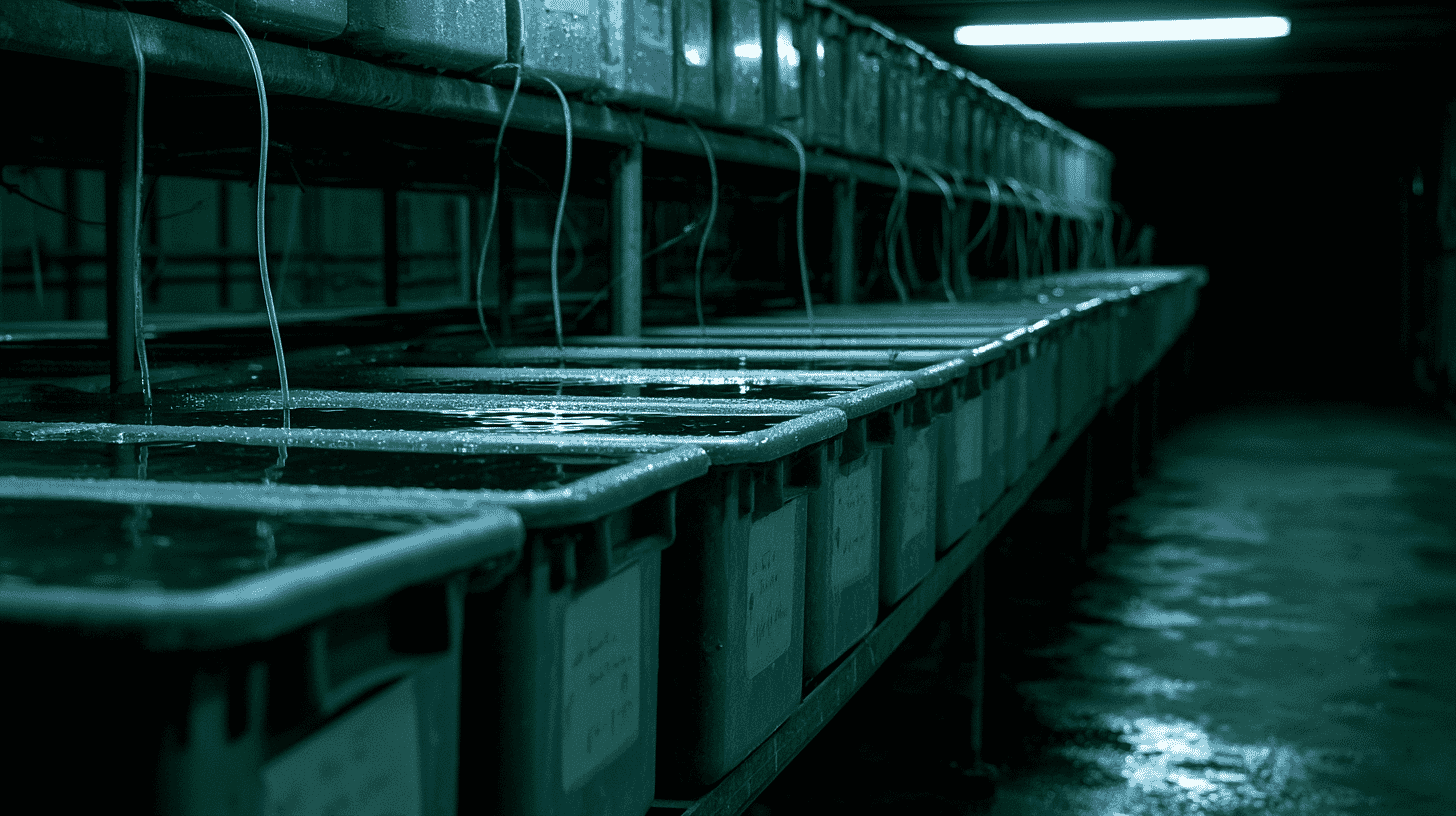
🦀 Put two of these crabs in one tank and, after a while, there is one. That is why a prefectural lab in Shizuoka has spent eight years raising them one animal to a box, more than 300 boxes at a time. On September 12, 2026, the broadcaster Shizuoka Asahi Television reported that the loop had finally closed: crabs hatched in the lab grew up and produced the next generation, which the station called a first in Japan for this species.
Raising them one to a box is not the new part of this work.
Five tonnes a year, out of one lake
Around Lake Hamana, in Shizuoka, people call it the douman crab, after the roundness of its shell; dou is a torso. Its standard Japanese name is toge-nokogirigazami and its scientific name is Scylla paramamosain, which puts it in the same genus as the crab in Singapore's chilli crab and the soft-shell crab farmed across the Mekong Delta. Plenty of readers outside Japan have eaten a relative of this animal without knowing it.
Its scarcity has a reason. The prefecture's own fisheries institute wrote in 2007 that only a handful of places land enough of these crabs to support a fishery, naming Lake Hamana alongside Urado Bay in Kochi and the Yaeyama Islands in Okinawa. More than 90 percent of what comes out of Lake Hamana is this one species. A large adult runs about 15 centimetres across the shell and around a kilogram, with reports of 20 centimetres and over two kilos.
Then there is the volume. The institute's Hamanako branch publishes an annual tally built from the fishing cooperative's records, and by that count the entire lake produced 4,970 kilograms of these crabs in 2025, against 6,676 the year before and a ten-year average of 5,780. The season runs May to December and lands late: November 2025 alone accounted for 1,760 kilograms.
That is the whole supply, and it has been for a long time. In 2007 the prefecture put the catch at five to six tonnes a year, and in its research report for fiscal 2024 the institute still described this stock as stable at a high level while most other species in the lake slipped, with the price per kilo trending up. Scarcity shows up on the receipt: one live male of 250 to 350 grams sells for 4,700 yen, about $31, through a Toyosu market online retailer.
The reason nobody farmed it
Douman crabs eat each other. A senior researcher at the institute told the broadcaster that they are extremely aggressive, that keeping them as a group means losing them to cannibalism, and that the lab therefore keeps one animal per box. Three hundred crabs means three hundred containers, each fed and cleaned on its own.
A crab grows by shedding its shell, and for a while afterwards it is soft and effectively defenceless. An FAO review of mud crab farming published in 2008 put it plainly: larger animals prey on smaller ones, and the losses are significant. Anything that molts in a crowd is food.
The crab condo is already a business
Individual boxes are standard practice in Southeast Asia, where they have a nickname. A 2024 report for the FFTC Agricultural Policy Platform describes a family in Hoang Tan, in Vietnam's Quang Yen, running 648 plastic boxes of 30 by 40 centimetres, one crab each, with more than 600 animals stocked and plans to reach 3,000. Survival across the 15 to 35 days before a molt runs 93 to 95 percent. Box-raised crabs fetch 650,000 to 700,000 dong a kilo, roughly $27 to $29, against 200,000 to 250,000 for crabs from the lagoon. In Singapore the same report found a grower keeping around 200 crabs in public housing flats.
The Vietnamese operation is fattening: buy a juvenile, house it alone until it sheds, sell it soft. The crab itself began life in the sea. That is how most of this industry works. The FAO review put wild collection at 95 percent of the Philippines' crab seed, even as China was already farming 111,423 tonnes a year as of 2005, and in March 2025 the FAO was still describing over-reliance on wild-caught juveniles as pressure on the species.
The Shizuoka institute says much the same in its own report, and says it as the reason the project exists: world demand is for the just-molted soft-shell crab, output in Southeast Asia has plateaued because it leans on wild stocks, and private companies have been asking for a method built on hatchery seed instead.
Boxes solved crowding decades ago.
What was missing was the parents
Lake Hamana was never naive about hatcheries. The 2007 article describes fishermen actively releasing juvenile crabs produced artificially at the prefecture's warm-water research centre in Omaezaki, and credits those releases with holding the catch up. Artificial juveniles have been going into this lake for a generation, and the centre was still at it in 2024, running six production cycles between May and September in 20-tonne and 80-tonne tanks.
But those juveniles came from egg-bearing females caught in the wild. Every cycle began by taking a mother out of the lake. Japanese has a term for the difference: kanzen yoshoku, full-cycle aquaculture, means raising the animal from egg to adult and having that adult spawn, with nothing brought in from outside. Japan has reached it with a short list of species. No crab was on the list.
Two things stood in the way, and the institute's report names both. The first is that the larvae die. Mass mortality from necrosis and from failed molts with overgrowth occurs routinely during seed production, and the report calls it the obstacle to producing at volume. That is the kind of problem that never announces a breakthrough. It just eats years.
The second was the calendar. A female can only be mated while her shell is still soft after she sheds, a window of a day or two according to a 2025 paper in Biology on the same genus, so breeding on purpose means knowing when each female is about to shed. The lab logged molt dates for 65 crabs raised from juveniles between 2020 and 2024. Above 60 millimetres of carapace width, animals went anywhere from about 40 days to more than 100 between molts, and two crabs of the same size could be far apart. What the lab did find was a tell: at soft-shell size, 80 to 110 millimetres, a crab goes off its food one to two weeks before it sheds. "To get them to mate, pinning down the molt is what matters," the researcher told the broadcaster.
The lab published its growth conditions in 2022. In 2025 it filmed a mating, which the researcher believes was a first in Japan. Ten of twelve pairs have since mated, and the target for this fiscal year is 20.
The other crab condo belongs to a clutch maker
The private companies asking for hatchery seed are not hypothetical. F.C.C., a Hamamatsu manufacturer whose main business is clutches for motorcycles and cars, describes in a document published by the Kanto Bureau of Economy, Trade and Industry its own individually housed, automated farming system for this crab. The company's name for the thing is kani manshon, a crab apartment block. It has been running prototype trials since 2023, with feeding, monitoring and cleaning automated, aimed at 200- to 300-gram soft-shell crab, which it notes is generally considered hard to produce. For now it says it is confirming demand through tastings.
A lagoon in Vietnam and a clutch factory in Hamamatsu have ended up with the same kind of rig and the same nickname. Hamamatsu brought its own automation to it.
No forecast of a lower price has come from anyone in this. The institute's order is seed supply first, commercialisation after; the company says it is still testing the market.
Meanwhile the season is on. At Uonami, a fish shop near the lake that opened in 1969, the crabs are steamed. Regulars drive in from Tokyo and Kanagawa every year, the shop says, and one customer came from Ehime, more or less the other end of the country, for an animal that exists in quantities of five tonnes.
Most countries have one of these: a food that stayed expensive because nobody could work out how to breed it. What is yours, and did anyone ever crack it?
References
- https://www.youtube.com/watch?v=O9t3CNDy90o
- https://news.yahoo.co.jp/articles/766d7b686c72b5e4f9b0b21c7a25a4f855ed6971
- https://fish-exp.pref.shizuoka.jp/03research/jigyou_pdf/2024.pdf
- https://fish-exp.pref.shizuoka.jp/04library/news/20070807.html
- https://fish-exp.pref.shizuoka.jp/hamanako/6_pro/pdf_hamana/hamana591.pdf
- https://www.kanto.meti.go.jp/seisaku/venture/data/kanto_startup_frontier02.pdf
- https://ap.fftc.org.tw/article/3524
- https://www.fao.org/4/i0254e/i0254e13.pdf
- https://www.fao.org/guidelines-sustainable-aquaculture/news---events/news/detail/Transitioning-to-sustainable-mud-crab-farming/en
- https://pmc.ncbi.nlm.nih.gov/articles/PMC12561672/
- https://www.city.hamamatsu.shizuoka.jp/foodpark/hamamatsu-foods/doumangani.html
- https://www.tsukijiichiba.com/user/product/40637
- https://osakana.suisankai.or.jp/s-growth/95
- https://www.godac.jamstec.go.jp/bismal/j/view/9012534





Global Discussion
0 comments