
🌋 Inside a geothermal power plant, water droplets riding in the steam keep slamming into blades turning at hundreds of metres per second. That those droplets eat into output has been known for years. The blade surface itself, at full operating speed, has stayed out of reach of direct observation.
A blade at 430 metres per second, caught on high-speed film
On August 4, 2026, Tohoku University and the Japan Agency for Marine-Earth Science and Technology (JAMSTEC) announced that they had filmed the behaviour of water droplets on a geothermal turbine blade under conditions close to those inside a working plant.
The corresponding author is Ippei Oshima, an assistant professor at Tohoku University's Institute of Fluid Science. His co-authors are Mikito Furuichi, a senior researcher at JAMSTEC, and Yuya Nakashima and Masahiro Sato of Fuji Electric. It was commissioned by NEDO, Japan's New Energy and Industrial Technology Development Organization, and the paper appeared in the fluid-experiment journal Experiments in Fluids on August 3, local time.
The rig used an actual geothermal turbine blade. Tip speeds ran from 30 up to 430 metres per second, which works out to roughly 1,548 kilometres per hour. Ambient pressure was held at 1 and 5 kilopascals, a near-vacuum that comfortably brackets real operating conditions. According to the announcement, these conditions sit well outside the speed range of the droplet-impact experiments done up to now, and catching the sequence from impact through to break-up at the blade tip in one piece is what makes the result new.
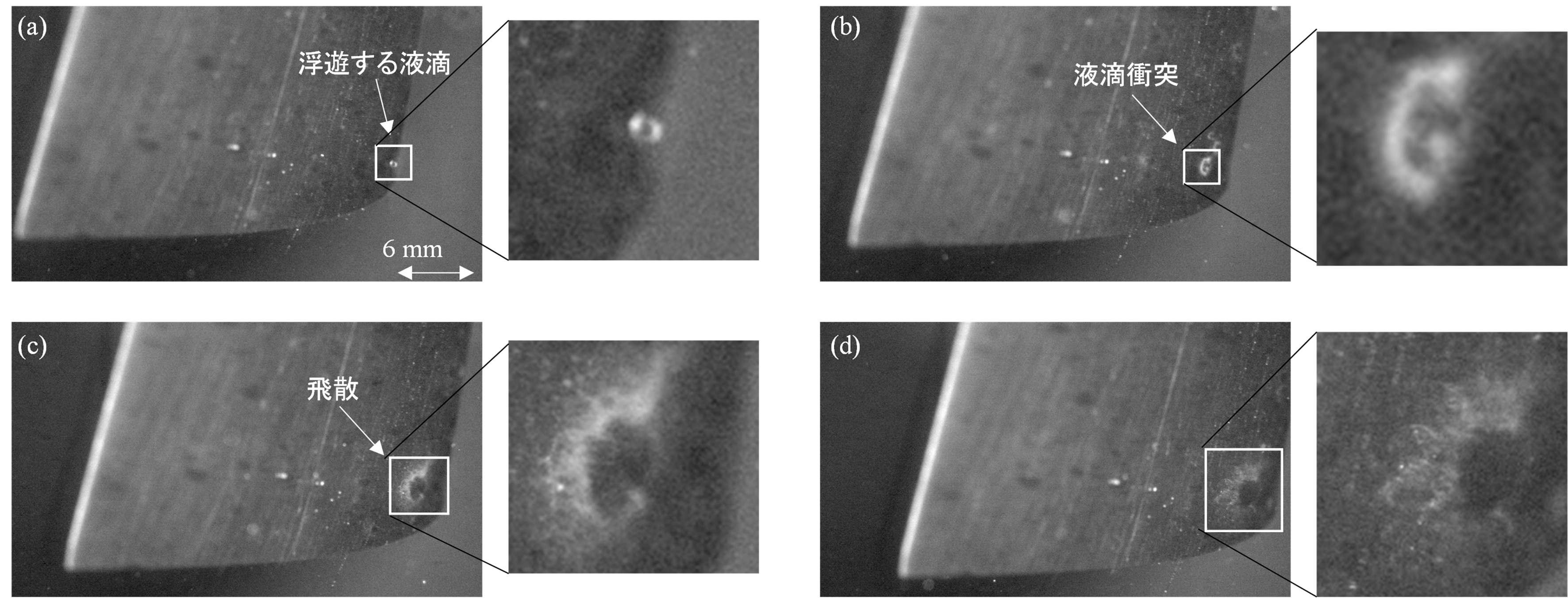
Source: Tohoku University
Wetness loss, the leak nobody can see
A geothermal plant spins its turbine on steam drawn from underground. That steam is not dry. It carries water droplets, and engineers call the mixture wet steam.
Droplets that cannot keep up with the flow crash into the rotating blades. Some scatter on impact. Most cling to the surface as films or threads of liquid. The energy the turbine loses in the process has a name, wetness loss, and the same impacts also chew away at the blades themselves.
The awkward part is access. The blade row sits inside a casing, and the space is both fast and nearly evacuated, so there is no window onto the process. Turbine designers have therefore leaned on numerical analysis and rules of thumb, without the visual data needed to check whether either was right.
What holds on a stationary wall did not hold on a spinning one
Splashing was the first thing to break with expectations. According to the announcement, earlier work in which droplets were fired at stationary walls found that lowering the ambient pressure suppresses splashing. On a fast-spinning blade, that suppression did not appear. At 1 kilopascal, a pressure within the range plants actually run at, droplets splashed clearly whether the blade surface was wet or dry. Knowledge built on stationary walls, in other words, may not transfer.
The shape of the liquid also came out differently. Large films had been assumed. In practice the films proved hard to sustain, and across most conditions the team instead saw slender ligaments and beads of liquid strung out in rows.
Those ligaments and bead-rows do not travel in straight lines. Centrifugal force pushes them outward, and the Coriolis force, the apparent force that deflects anything moving within a rotating system, bends their path. The same effect that curves a typhoon's circulation is at work here on a scale of millimetres. Liquid reaching the blade tip pools briefly under surface tension, gets drawn out into a thread by centrifugal force, then breaks into several droplets and flies off again.
The team also built a predictive model incorporating centrifugal force, Coriolis force and drag against the blade surface, and reproduced the observed direction of travel qualitatively.
The country that builds most of the world's geothermal turbines barely uses geothermal
Fuji Electric is a co-author of this paper and also one of the world's main suppliers of geothermal turbines.
The geothermal turbine is the heart of the plant, and Japanese manufacturers have held that market for decades. The Japan Geothermal Association states that Toshiba Energy Systems, Fuji Electric and Mitsubishi Heavy Industries together hold close to 70 percent of the world market. Fuji Electric's own accounting claims the top position since 2000 with a 36 percent share of orders, 84 units and 3,469 megawatts in total, based on data through November 20, 2019. The company's first machine was a 30-kilowatt unit delivered to a hot-spring resort in Hakone in 1960; by 1980 it was shipping a 35,000-kilowatt machine to Ahuachapán in El Salvador.
Japan's own geothermal fleet, meanwhile, has gone almost nowhere. ThinkGeoEnergy's tally puts Japanese installed capacity at 607 megawatts at the end of 2025, tenth worldwide, behind Kenya at 980 megawatts and Iceland at 808.
The resource is not the constraint. Japan's Agency for Natural Resources and Energy assesses conventional geothermal resources above 150 degrees Celsius at 23.47 gigawatts, and NEDO describes the country's geothermal potential as third largest in the world. Installed capacity amounts to less than 3 percent of that, and geothermal supplies roughly 0.2 percent of Japanese electricity demand, per JOGMEC figures for fiscal 2023.
Location explains a good deal of the gap. Much of the resource lies inside national and quasi-national parks or beneath hot-spring districts, so environmental assessment and negotiation with local stakeholders stretch out for years. Japan supplies blades to power plants around the world and has few places to spin its own.
Next: shroud geometry and where the drain goes
The visualization data doubles as validation material for numerical simulation. The team wants to feed the results into the design of the shroud, the structural component at the blade tip, and of the mechanisms that drain accumulated liquid out of the turbine. The goal is to shift judgments that have rested on experience onto physical grounds.
The application is not confined to geothermal. Steam turbines in thermal and nuclear plants, high-speed rotating machinery in general, and centrifugal atomizers that break liquids into fine sprays all obey the same mechanics.
As of August 2026, though, neither a figure for how much efficiency would improve nor a timetable for reaching a production machine has been given. What has changed so far is that a phenomenon nobody could observe is now observable.
Plenty of countries sit on hot rock. How much of the heat under yours actually gets used?
References
- https://www.tohoku.ac.jp/japanese/2026/08/press20260804-02-turbine.html
- https://www.jamstec.go.jp/j/about/press_release/20260804_2/
- https://link.springer.com/article/10.1007/s00348-026-04273-4
- https://www.fujielectric.co.jp/about/example/detail/solution_geothermal_power.html
- https://www.thinkgeoenergy.com/global-top-10-geothermal-power-countries-at-year-end-2025/
- https://www.enecho.meti.go.jp/category/resources_and_fuel/geothermal/society/r7_matome.pdf
- https://journal.jogmec.go.jp/geothermal/learn/plant-japan/index.html
- https://www.chinetsukyokai.com/information/sekai.html
- https://www.nedo.go.jp/activities/ZZJP_100066.html







Global Discussion
4 comments