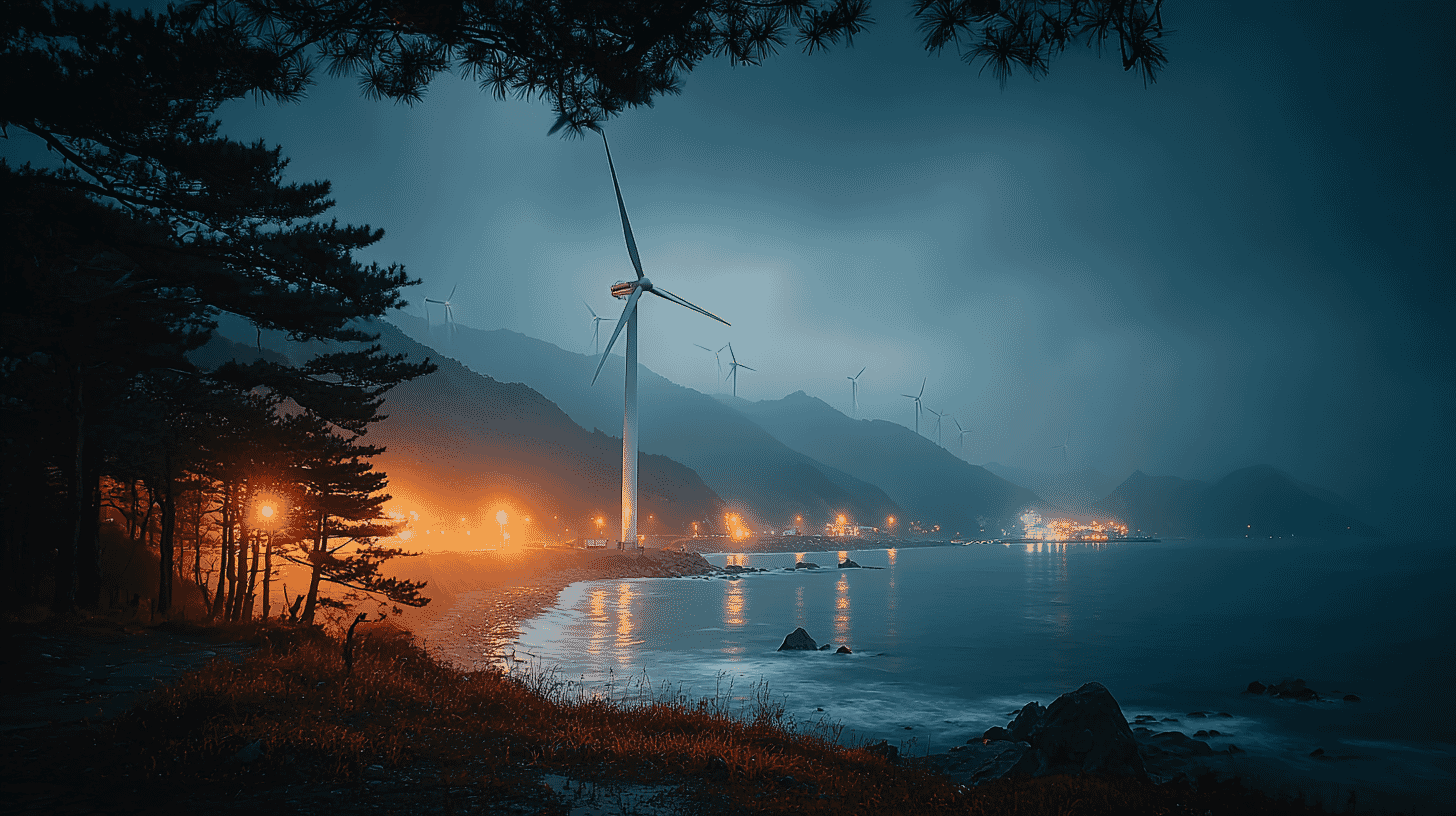
Japan built hundreds of wind turbines in a green energy rush. Now, 420 of them have been torn down, and the bill is staggering. As government subsidies expire and 20-year-old equipment wears out, municipalities across Japan face an impossible choice: spend millions on repairs for turbines that can no longer turn a profit, or spend millions more to tear them down. Here's what went wrong, and what it means for the future of wind power in Japan.
The Great Wind Turbine Retirement: 420+ Gone in a Decade
According to the Japan Wind Power Association (JWPA), a total of 425 wind turbines were decommissioned across Japan over the 10 years through fiscal year 2024. The pace has accelerated dramatically: roughly 80% of these retirements, 335 turbines, occurred in just the last five years, starting in 2020. In 2021 alone, 114 turbines were taken offline in a single year, followed by 46 to 77 per year since.
Two factors are colliding to create this wave of shutdowns.
The first is mechanical aging. Under international standards, large wind turbines are designed for a service life of about 20 years. Japan's wind construction boom took place in the early 2000s, spurred by the Kyoto Protocol and a surge of enthusiasm for renewables. Two decades later, that first generation of turbines has reached its physical limits.
The second is the expiration of Japan's Feed-in Tariff (FIT). Introduced in 2012, this government program guaranteed fixed electricity purchase prices for 20 years, making wind farms financially viable. As those 20-year contracts expire, the guaranteed price disappears and revenues drop by half or more, suddenly making continued operation unprofitable.
In short, Japan's early wind turbines are breaking down at the same time they're losing their main source of income.
The Numbers Behind the Pain
The financial reality facing Japanese municipalities is stark.
Daisen, Tottori Prefecture built a single 120-meter turbine in 2005 for approximately $2.9 million, envisioning it as a "symbol of environmental conservation." The 1,500 kW unit generated enough electricity for 450 households and brought in about $260,000 in fiscal 2024.
When its FIT contract expired in May 2025, projected revenue from June halved, and keeping the aging machine running meant more than $230,000 in repairs. The town pulled the plug and the turbine came down in October 2025. Demolition cost roughly $700,000, of which the town paid $310,000; the rest went to the company that won the auction for the land. Officials say the turbine served its purpose as a symbol. A local council member has argued that a smaller machine from the start would have survived.
Setana, Hokkaido was home to Japan's first offshore wind turbines, two units named Kazamidori installed in 2004 for ¥690 million (about $4.6 million) including national subsidies. They earned about $330,000 a year in electricity sales. Repeated breakdowns took both offline in 2023 and 2024, and with FIT revenue about to fall, the town gave up. Removal is set for fiscal 2026, with ¥40 million budgeted in June 2025 for survey and design work; the teardown itself is expected to cost around ¥400 million, or roughly $2.7 million. Lifetime sales minus construction and maintenance left a cumulative profit of about $280,000, which the demolition bill erases several times over.
Shonai, Yamagata Prefecture, a region known for one of Japan's three worst winds, spent approximately $990,000 to remove a turbine built in 2002, saying that keeping it running would have meant losses.
Why Japan's Wind Turbines Struggle to Turn a Profit
Several structural challenges make wind power particularly difficult in Japan compared to Europe or North America.
Typhoons and lightning: Japan faces multiple typhoons annually, along with frequent lightning strikes. Unlike Europe's steady westerly winds, Japan's turbulent weather causes severe damage to turbine components. There are documented cases of lightning strikes disabling turbines for months, with some facilities managing only about 10 operating days per year.
High humidity: Japan's hot, humid climate accelerates the degradation of electronic and mechanical components. Identical equipment that lasts 25-30 years in Northern Europe may deteriorate faster in Japan's environment.
Small-scale, scattered installations: Many turbines from the 2000s were municipal projects of one or two units built as green symbols rather than commercially optimized wind farms. Without the economies of scale that come with large wind farms, maintenance costs per unit are prohibitively high.
Foreign equipment dependency: The vast majority of wind turbines operating in Japan were manufactured overseas. When breakdowns occur, sourcing parts and arranging repairs involves international logistics, adding weeks or months of downtime and significant cost.
The Bigger Picture: Japan's Wind Sector Is Actually Growing
Despite the headline-grabbing retirements, Japan's wind power sector is actually on an upward trajectory.
As of December 2024, Japan's cumulative installed wind capacity reached 5,840.4 MW across 2,720 turbines. New installations that year hit a record 703.3 MW across 170 turbines at 23 sites, far outpacing the 40.3 MW and 50 turbines retired, for a net gain of 663 MW.
New turbines average 3.7 MW per unit, against the 1 to 1.5 MW machines of 20 years ago. Offshore is running too. The Ishikari Bay New Port project in Hokkaido, 14 turbines totaling about 100 MW, entered commercial operation in January 2024, and 33 turbines across Akita and Noshiro ports came online before that.
Japan's 7th Strategic Energy Plan targets wind at 4 to 8% of the 2040 energy mix, with a project pipeline goal of 15 GW of floating offshore wind by that year.
The momentum did not hold, though. Cumulative capacity reached 6,434.2 MW across 2,866 turbines by the end of 2025, but new installations fell to 625.0 MW and not a single offshore wind farm entered commercial operation that year. Good onshore sites are filling up, environmental assessments take years, and the offshore build-out that was supposed to carry the sector is running late.
A Global Challenge: What to Do with Aging Turbines
Japan is not alone in facing this reckoning. Worldwide, an estimated 275 GW of onshore wind capacity will hit 20 years of operation between 2023 and 2033. In Europe alone, over 34,000 turbines are expected to require end-of-life decisions by 2030, particularly in Germany, where thousands of turbines are losing government subsidy support.
However, the response differs significantly between Japan and other markets.
In Europe, lifetime extension (LTE) has become the go-to strategy. By upgrading key components such as blades, gearboxes, and control systems, operators can add up to 10 additional years of service life at a fraction of the cost of building new. In Denmark and Spain, turbines running 25-30 years are common, with mandatory third-party safety inspections for units past their design life.
Repowering, replacing old turbines with larger and more efficient models on the same site, is another major trend. Global annual repowering capacity is forecast to reach 19 GW by 2033, with China already emerging as the leader.
There is also a growing market for second-hand turbines, refurbished in Europe and North America and resold at a steep discount, which buys another eight to ten years of service.
Japan has begun developing policies to support repowering, but the domestic supply chain for end-of-life turbine management is still in its infancy.
Looking Ahead: From "Green Symbols" to Competitive Power
The wave of decommissioning marks the end of Japan's first chapter in wind energy, one built on subsidy-driven municipal projects that were environmental statements more than competitive power infrastructure.
The next chapter is already being written. With larger turbines, offshore wind development, and evolving support mechanisms like the FIP (Feed-in Premium) system, Japan's wind sector is transitioning from a subsidized experiment to a genuine pillar of the national energy strategy. The critical question is whether Japan can build the domestic maintenance infrastructure, regulatory frameworks, and supply chains to keep turbines productive for 30 or 40 years rather than 20, as Europe is learning to do.
Offshore is not a free ride either. On August 27, 2025, Mitsubishi Corporation formally withdrew from all three sea areas it had won in the first offshore wind auction, two off Akita and one off Choshi in Chiba. It had swept the 2021 auction with strikingly low bid prices; materials inflation, a weak yen, and higher rates then pushed construction costs to more than double the bid assumptions. Partner Chubu Electric Power expects a loss on the order of ¥17 billion. The three areas are set to be re-tendered, and the government is reworking the auction rules. Japan now has two open questions on the table at once: who funds decommissioning onshore, and how project economics get secured offshore.
Japan's wind power story is a reminder that building renewable infrastructure is only the beginning. The real work is sustaining it across decades of aging equipment, shifting policy, and changing economics. How does your country handle the "afterlife" of renewable energy projects? What happens when subsidies end and turbines grow old? We'd love to hear your perspective.
This article was published from reporting in early 2026. The 2025 installation figures and the aftermath of the first offshore auction were added as of July 2026.
References
- https://news.yahoo.co.jp/articles/d7474f7496f673b5b062c2fa8ff133cdc0bb16a5
- https://jwpa.jp/information/11062/
- https://windjournal.jp/123272/
- https://www.woodmac.com/news/opinion/the-big-question-for-onshore-wind-what-to-do-with-ageing-turbines/
- https://www.rabobank.com/knowledge/d011409804-beyond-design-life-what-to-do-with-aging-wind-turbines-in-europe
- https://www.nikkei.com/article/DGXZQOFC1037R0Q5A710C2000000/
- https://windjournal.jp/124665/
- https://wa.city.noshiro.lg.jp/wind/443/







Global Discussion
15 comments