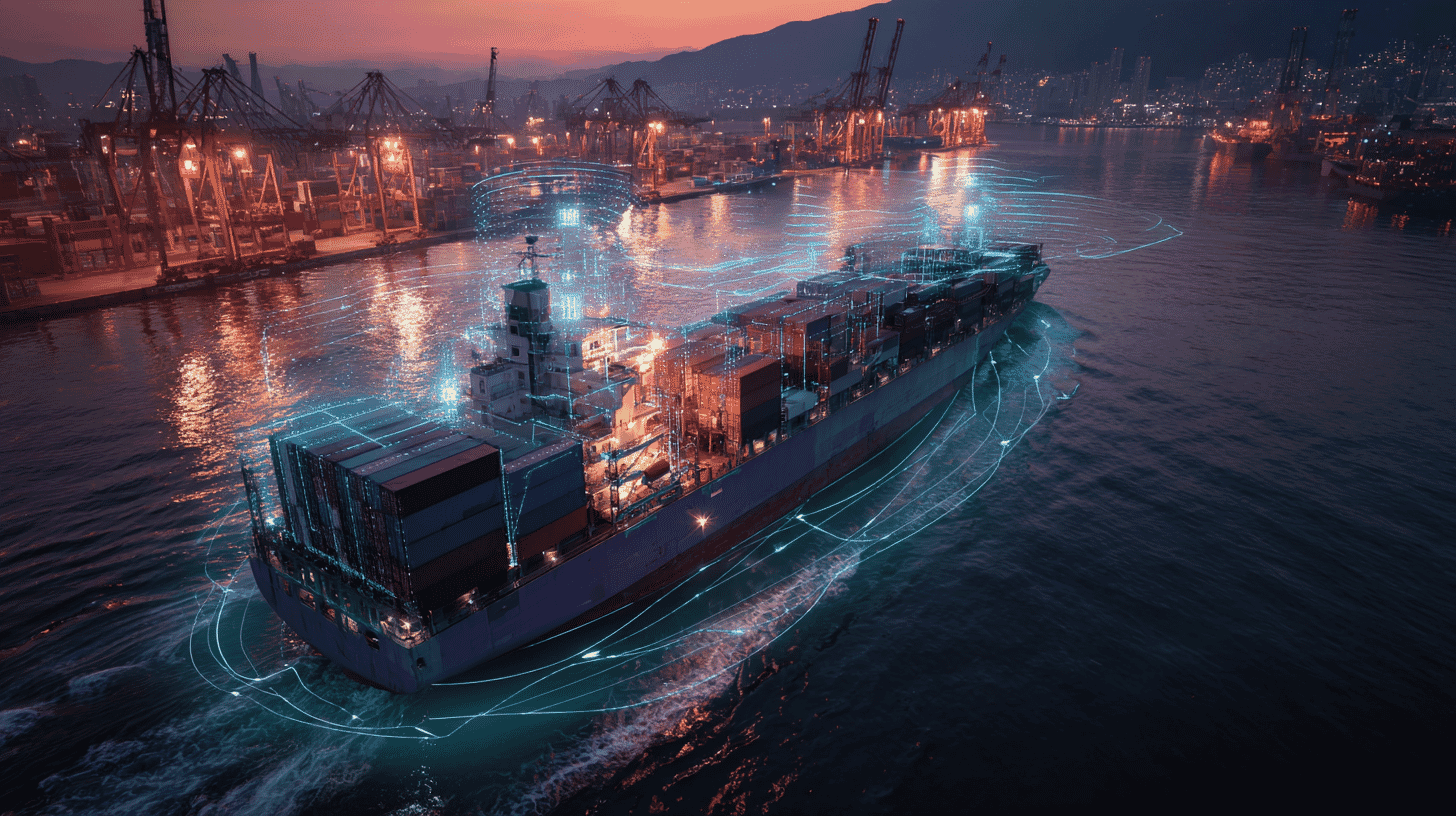
Set a destination, and AI picks the optimal route, dodges other ships, and docks at the port, all automatically. It sounds like science fiction, but this is now reality on a commercial shipping lane in Japan. The vessel "Genbu" is the world's first container ship with both bridge and engine room fully automated to enter commercial service. Born from Japan's deepening crew shortage crisis, here is the full story of a next-generation logistics breakthrough.
What Is the Autonomous Container Ship "Genbu"?
On January 30, 2026, at Kobe Port Terminal, the launch of commercial operations for the domestic container ship "Genbu" was officially announced. With a capacity of approximately 700 TEU (twenty-foot equivalent units), Genbu was developed under the second phase of the Nippon Foundation's unmanned vessel project "MEGURI2040."
What sets Genbu apart is that it was designed and built from scratch specifically for autonomous operation, not retrofitted from an existing vessel. Over roughly three years of development, Kyokuyo Shipyard in Shimonoseki, Yamaguchi Prefecture, constructed a hull and control system optimized as an integrated package for self-navigation. The vessel is managed by Echoes Inc. and operated by Suzuyo Marine Co., Ltd.
At the press conference, Mitsuyuki Unno, Managing Director of the Nippon Foundation, stated that Genbu is the world's first vessel to automate both bridge (navigation command) and engine room functions simultaneously.
How Autonomous Is It? AI Handles the Entire Voyage
Genbu's autonomous navigation system covers the full journey from departure to arrival.
Once a destination is set, an AI-powered system evaluates weather conditions and maritime traffic to select the optimal route. During the voyage, computer vision systems using radar and cameras identify surrounding vessels and obstacles in real time, making collision avoidance decisions and executing maneuvers automatically.
Particularly noteworthy is the automation of berthing and unberthing at port. These are considered among the most skill-intensive operations in seamanship, maneuvers that even veteran captains approach with heightened focus. Genbu's system handles these autonomously.
The engine and machinery sections also support remote monitoring and control from a shore-based support center, in addition to onboard bridge management. A hybrid satellite-mobile communication system ensures stable connectivity across all navigational zones.
Captain Tatsuya Endo, who serves as Genbu's master, shared his perspective: "The workload during each crew member's watch is significantly reduced. With autonomous navigation functions, you might only need one person on the bridge."
Why Japan Achieved This "World First"
While autonomous vessel development is advancing globally, several factors enabled Japan to lead the way in commercializing an autonomous container ship.
First, a robust industry-government-academia collaboration. More than 30 domestic companies joined the MEGURI2040 consortium. NTT Group contributed communication technology, Furuno Electric and EIZO provided sensor and imaging systems, Tokio Marine developed insurance frameworks, and the Mitsubishi Research Institute handled policy analysis, creating an open innovation structure combining diverse expertise.
Second, Japan's methodical approach to phased demonstration. During Phase 1 in 2022, five consortiums tested six demonstration vessels. They successfully navigated Tokyo Bay, one of the world's most congested maritime corridors, and completed an unmanned voyage of approximately 750 km over 18+ hours between Tomakomai, Hokkaido and Oarai, Ibaraki Prefecture. These findings directly informed the commercialization in Phase 2.
Third, Japan's existing strengths in ICT, AI, and image analysis technology. Japanese companies already operate at world-class levels in individual component technologies. The breakthrough was integrating these capabilities for maritime application.
Japan's Crew Shortage Crisis, The Social Imperative Behind Autonomy
Genbu's development is not merely a technological pursuit, it's a response to a structural crisis facing Japan's maritime industry.
Coastal shipping handles roughly 40% of Japan's domestic cargo transport and approximately 80% of basic industrial materials. Yet crew numbers have declined dramatically, from about 56,000 in 1990, with workers aged 50 and above now comprising roughly half of all crew members. The effective job-to-applicant ratio for maritime workers exceeds 4.0, far above the national average across all industries.
Compounding this, Japan's "2024 logistics problem", transportation capacity shortfalls resulting from overtime regulations for truck drivers, has increased calls for a modal shift from road to sea. But the maritime sector itself lacks sufficient personnel, creating a compounding challenge. With 99.7% of coastal shipping operators being small and medium enterprises, improving crew compensation and making large-scale capital investments remain structurally difficult.
Statistics indicating that 70–80% of maritime accidents stem from human error further underscore the safety benefits autonomous navigation technology could deliver.
"Olympia Dream Seto", Another World First
Prior to Genbu, MEGURI2040 produced another "world first." In December 2025, the passenger vessel "Olympia Dream Seto," operating between Shin-Okayama Port and Tonosho Port on Shodoshima Island, became the world's first passenger ship equipped with an autonomous navigation system to enter commercial service. Operated by International Ryobi Ferry, this 66-meter vessel with a capacity of 500 passengers also passed Japan's ship inspection as the nation's first certified "autonomous vessel."
Achieving autonomous operation, including automatic berthing and unberthing, in the Seto Inland Sea, a region dense with islands, reefs, and heavy vessel traffic, represents a significant technical accomplishment. It also directly addresses the social challenge of maintaining ferry services to inhabited islands.
How Does Genbu Compare to Norway's "Yara Birkeland"?
In autonomous container shipping, Norway's Yara Birkeland, developed by Yara International and Kongsberg Group, is also well known. This fully electric 120-TEU container ship began commercial operations in 2022, sailing approximately 13 km between Porsgrunn and Brevik, replacing 40,000 diesel truck trips annually as a zero-emission vessel.
However, Yara Birkeland primarily focuses on zero-emission propulsion as a short-distance feeder ship. Its autonomous certification trials were said to be aiming for completion in early 2026. In contrast, Genbu simultaneously automates both bridge and engine room operations and has entered commercial service on the longer Kobe-to-Tokyo route, representing a different approach, one centered on the commercialization of autonomous navigation technology itself.
Rather than competitors, these projects complement each other, one advancing electrification, the other advancing autonomy, together shaping the future of maritime transport.
What Comes Next, Four-Ship Simultaneous Autonomous Sailing and International Rule-Making
MEGURI2040's ultimate goal is to achieve unmanned operation for 50% of coastal vessels by 2040. Genbu's commercial launch is a critical milestone, but the project is still accelerating.
Planned in the near future is an experiment in which four demonstration vessels, including Genbu, will simultaneously operate under autonomous navigation. Demonstrating that a single shore-based support center can monitor and control multiple autonomous vessels at once is an essential step toward large-scale commercial deployment.
Operational data collected from Genbu's Kobe-to-Tokyo route will also feed into the development of rules governing autonomous vessels, both domestically and internationally. Managing Director Unno of the Nippon Foundation emphasized: "It's important that we engage in rule-making that leads not just domestically, but globally", a statement clearly aimed at shaping standards at the International Maritime Organization (IMO).
Autonomous technology is not about eliminating seafarers' jobs but about creating new ways of working. Shore-based support center operations offer crew members, who previously could not return home daily, the option of land-based employment, opening new pathways for talent acquisition in the maritime industry.
In Japan, autonomous ships are already moving real cargo on commercial routes, a world first. This achievement reflects not only technological sophistication but also a society confronting its demographic transformation head-on. In your country, what's the conversation around autonomous shipping and unmanned vessels?






Global Discussion
16 comments