
☀️ Over two months in spring 2026, Japan flipped a switch on perovskite solar. Rice paddies. Steep mountain tea fields. Skyscraper windows. Highway rest stops. Toyota's futuristic Woven City. And, on May 8, a brand-new world record. The race to commercialize Japan-invented next-gen solar cells by 2030 has suddenly become very, very real.
What happened in 60 days
Perovskite solar cells have been a slow-burn story for years. Then March 2026 hit, and Japan started lighting up demo sites like dominoes.
March 3, West Nippon Expressway Company (NEXCO West) becomes the first highway operator selected for a joint Ministry of Environment / METI subsidy program. A film-type perovskite array will be installed on the roof of an accessible parking space at Katsuragawa Parking Area (Meishin Expressway, Kyoto). Project cost: roughly ¥41 million (about $260,000).
March 10, Sankyo Tateyama (a major aluminum building-materials firm), Aisin (a Toyota Group component giant), and Yamashita Sekkei (an architecture firm) announce a co-developed "Indoor-Window Perovskite Solar Unit." Designed to retrofit onto the inside of existing windows in high-rise buildings, it targets the ZEB (net-zero-energy building) renovation market. Commercial launch planned for 2028, with a two-year pilot at a Lawson convenience store in Nagoya starting now.
March 24, A five-party consortium (Chiba University, Sekisui Solar Film, TERRA, Chiba Bank, Himawari Green Energy) announces that a 1,100-square-meter rice paddy at Chiba University's Kashiwanoha Campus will host a film-type perovskite "solar sharing" trial, growing rice underneath while generating electricity above.
April 27, The University of Electro-Communications and Shizuoka Prefecture install "suspension-bridge cylindrical solar modules" on a steep tea-field slope in Kikugawa City. The cylindrical shape lets light and wind pass through to the tea plants below, while the suspension-bridge mounting eliminates the need for heavy foundations.
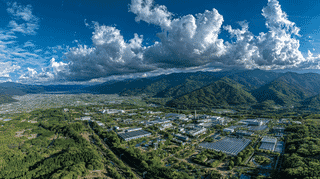
Late April, Toyota Group supplier Toyoda Gosei reveals a "Generate / Transmit / Store / Use" energy-cycle proposal for Toyota's Woven City (Susono, Shizuoka). The package combines perovskite solar with microwave wireless power transfer, hydrogen cartridges, and multifunctional poles. A backup-power vending machine pilot with DyDo Drinco is in the works.
May 8, Tokyo City University (Prof. Ryosuke Ishikawa's lab) and the National Institute of Advanced Industrial Science and Technology (AIST) announce that their 1-square-centimeter perovskite/CIGS tandem solar cell hit a third-party-measured 25.14% efficiency, a world record for that combination at that size. The previous mark was 24.6%, set by the Helmholtz-Zentrum Berlin.
May 11, A rice-planting ceremony is held at the Chiba paddy, kicking off the actual growing season under the perovskite panels.
In 60 days, Japan ran demos covering research labs, dense cities, working farmland, transportation infrastructure, and an experimental smart city. International observers covering renewables don't usually see this much movement from one country in one quarter.
Why is this all happening right now?
Three forces converged.
First: government push. Japan's 7th Strategic Energy Plan, finalized in 2025, set a binding national target of 20 GW of perovskite solar by 2040, equivalent to roughly 20 nuclear reactors' worth of capacity. METI committed to a 2030 commercialization timeline and a cost target of ¥14/kWh (about 9 cents/kWh). The Ministry of Environment and METI jointly launched the "Perovskite Solar Implementation Model Subsidy Program," and NEXCO West's selection is the first highway-sector adoption.
Second: iodine. The main ingredient in a perovskite solar cell is iodine, and Japan produces about 30% of the world's supply, second only to Chile, and harvested from underground brine in Chiba Prefecture. China dominates roughly 80% of the global silicon solar panel market. Japan's pitch is: we can make a solar cell from our own raw material, with our own technology, on our own soil. For an energy-importing island nation, that's not a nice-to-have; it's a strategic objective.
Third: nowhere left to put silicon panels. About 70% of Japan's land is mountainous. The flat, sunny, transmission-accessible sites for utility-scale solar are essentially gone. So the demos aren't random, they're aimed at every category of surface that silicon panels can't use: building walls, windows, rice paddies, tea-field slopes, highway shoulders. Lightweight, flexible perovskite is the only technology that fits.
The world record, explained
The Tokyo City University / AIST announcement deserves a closer look because it's not the kind of record you may have heard about.
The famous perovskite efficiency numbers (35%+ tandem with silicon) involve thick, rigid silicon wafers underneath. That works for rooftop panels, but it throws away the main reason anyone is excited about perovskite in the first place: it's supposed to be thin, light, and bendable.
A perovskite/CIGS tandem keeps both layers as thin films, preserving the flexibility advantage. The problem is efficiency: the long-standing best, 24.6%, belonged to the Helmholtz-Zentrum Berlin (HZB). Ishikawa's team developed a new "carrier recombination layer," essentially a barrier between the CIGS bottom cell and the perovskite top cell that improves the perovskite's crystallinity. Third-party measurement at AIST clocked 25.14%.
The current cells use glass substrates, but the process is compatible with flexible substrates. Translation: you may eventually be able to bond a 25%-efficient solar cell onto an EV body panel, a drone wing, or a curved skyscraper façade. Those use cases were science fiction five years ago.
The record did not last long. In July 2026, a team from HZB and Humboldt University of Berlin pushed the same perovskite/CIGS pairing to 25.5%, reclaiming the world best. Which is its own kind of signal: this field is now moving in increments of months.
The view from China, the UK, and the US
It's worth being honest that Japan isn't running alone in this race.
China: LONGi Green Energy hit 34.6% with a perovskite/silicon tandem in 2024. JinkoSolar, Trina Solar, and UtmoLight are all scaling production capacity. China's existing silicon manufacturing infrastructure and supply chain mean it can crash prices the moment commercial perovskite volumes start moving.
United Kingdom: Oxford PV began commercial shipments of perovskite/silicon tandem panels in 2024, targeting residential and commercial rooftops in Europe and North America.
United States: First Solar's CdTe thin-film position gives it a manufacturing base, and DOE-funded perovskite research at NREL and academic labs is substantial.
Japan's strategy explicitly avoids head-to-head price competition. It can't beat Chinese silicon-tandem volumes. So it's targeting the niches Chinese silicon panels physically cannot reach: lightweight film-type perovskite for retrofitting old buildings, agrivoltaics for working farmland, and integrated mobility applications. The March–May demo wave is that strategy made concrete.
What's still hard
A balanced view requires noting three real obstacles.
Durability: Current perovskite cells last around 10 years, versus 20–25 for silicon. Outdoor degradation from heat, humidity, and UV is the dominant unsolved problem. Sekisui Chemical has publicly committed to 20-year durability alongside its ¥14/kWh cost target by 2030, but the data isn't there yet.
Lead toxicity: The highest-efficiency perovskites use lead iodide, and a damaged or improperly disposed panel could leach lead into the environment. Lead-free alternatives (tin, bismuth) exist in research but lag in performance. Recycling infrastructure is also nascent.
Scaling from cells to modules: A 1 cm² laboratory cell at 25% efficiency does not automatically scale to a building-façade-sized module at 25% efficiency. Sekisui Chemical's planned 100 MW production line for 2027 will be one of the first real tests of whether lab numbers survive industrial manufacturing.
The 2030 roadmap
If you want to track the timeline rather than the demos:
- 2027, Sekisui Chemical's 100 MW film-type production line goes online
- 2028, Sankyo Tateyama's indoor-window unit hits the commercial market
- 2030, METI's target: ¥14/kWh or lower, GW-class domestic production capacity
- 2040, National target of 20 GW cumulative installations
If Japan hits even half of that timeline, 2026 will be remembered as the year the demos turned into a market.
Is your country experimenting with putting solar on farmland, building walls, or other non-rooftop surfaces? Could a Japan-style "innovation born from land scarcity" approach fit where you live?
References
- https://www.tcu.ac.jp/news/all/20260508-71091/ (Tokyo City University press release, May 8 2026)
- https://www.nikkei.com/article/DGXZQOCC101BT0Q6A510C2000000/ (Nikkei, Chiba rice-planting ceremony)
- https://www.uec.ac.jp/news/newsrelease/2026/20260427_7642.html (UEC press release, tea field)
- https://www.st-grp.co.jp/news/2026news/st20260310.html (Sankyo Tateyama, indoor window)
- https://prtimes.jp/main/html/rd/p/000000526.000016810.html (NEXCO West, Katsuragawa PA)
- https://news.yahoo.co.jp/articles/6636407fc7c08ff338a9a924da771b4e7c5d3428 (Toyoda Gosei, Woven City)
- https://news.yahoo.co.jp/articles/747e1706eea5bcd838a1dc272e60f555af2ab2e1 (UTokyo all-perovskite 30.2%)
- https://www.renewable-ei.org/activities/reports/20251029.php (Renewable Energy Institute, policy review)








Global Discussion
14 comments