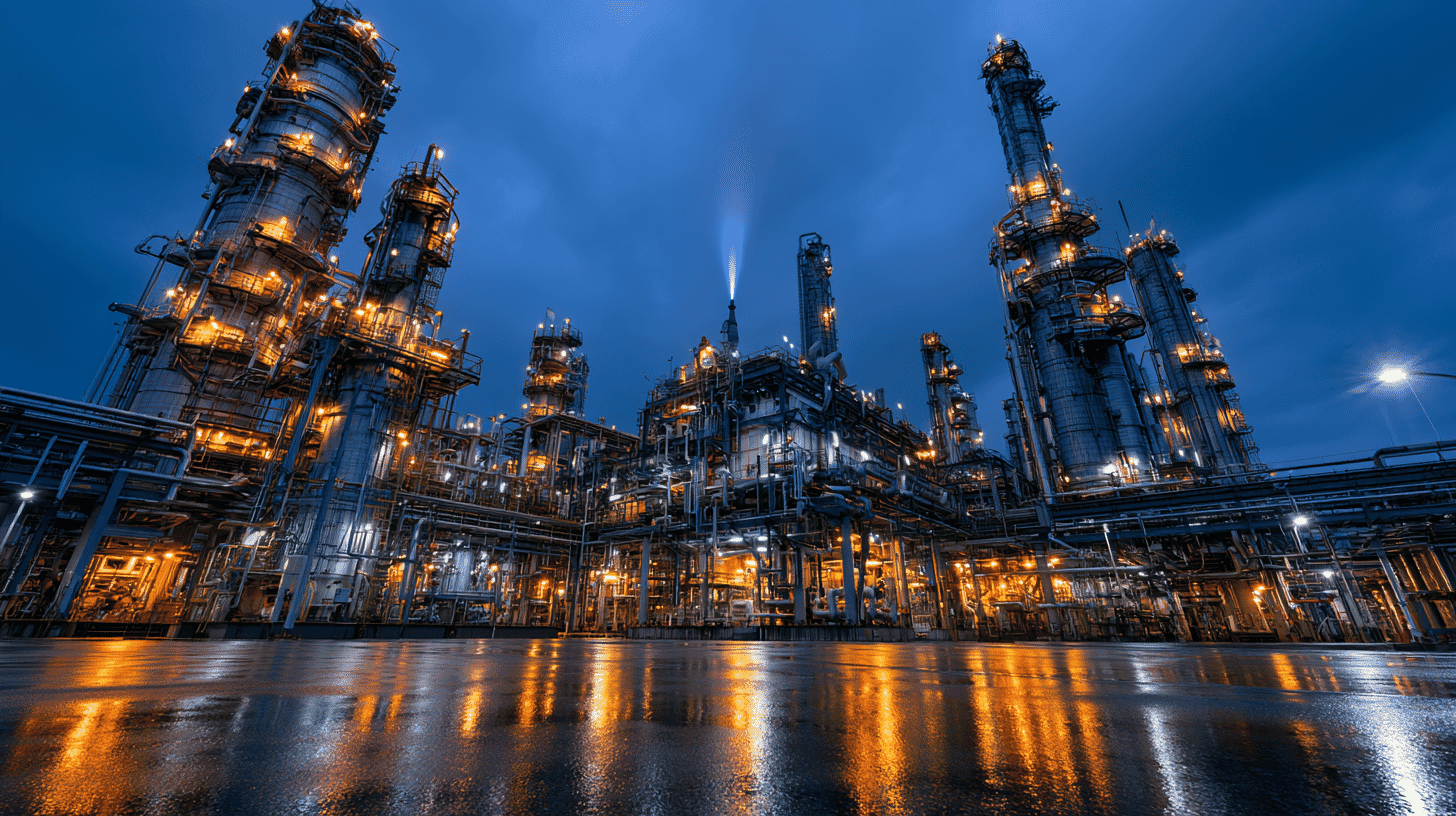
⚗️ Japan imports more than 60% of its naphtha, and roughly 70% of that flows through the Strait of Hormuz. Then, in late February, the strait closed. Three months later, a Japanese heavy-industry firm walked into its earnings briefing with an unusual pitch: forget the crude oil. Let's make naphtha from hydrogen instead.
Naphtha is the unglamorous backbone of the modern economy. Refineries pull it out of crude oil, and steam crackers turn it into ethylene and propylene, the building blocks of plastics, packaging, synthetic fibers, paints, adhesives, medical disposables, and most of the polymers in a phone, a car, or a hospital ward. When naphtha gets scarce, supply chains across half of consumer industry start to seize up.
That is exactly what has been happening to Japan since February 2026. Spot prices in Singapore breached $1,000 per metric ton by late March, a 60% spike from pre-crisis levels, before moderating somewhat but remaining 30–50% above pre-crisis levels into mid-May. The country also keeps almost no buffer: around 250 days worth of crude oil reserves, but only 20 days worth of naphtha.
It is into this very specific pressure point that Kawasaki Heavy Industries dropped its latest proposal.
What Kawasaki announced
At its earnings briefing on May 12, 2026, Kawasaki said it had started marketing a technology that produces naphtha, the same naphtha refineries normally extract from crude, using hydrogen as the feedstock. The company has not disclosed who it is pitching to.
President Yasuhiko Hashimoto framed it almost as a public-awareness problem rather than a technology problem. "Many people still don't realize that you can make gasoline or naphtha from hydrogen. We're showing it to various parties, and they're showing real interest," he told the briefing.
His argument for why this matters now is geopolitical, not chemical. With Middle East tensions still disrupting Hormuz shipping, Kawasaki argues that using natural-gas-derived hydrogen allows Japan to diversify procurement sources. A country that has anchored its plastics economy to one shipping lane could, in theory, anchor part of it to gas-rich countries with very different geography.
This isn't theoretical: there's already a plant
The reason analysts are paying attention is that Kawasaki isn't pitching a lab concept. The company already runs a commercial-scale version of the underlying technology.
In June 2019, Kawasaki finished building the world's first commercial gas-to-gasoline (GTG) plant for Turkmenistan's state-owned gas company, Turkmengaz. The complex sits in Ovadan-Depe, north of the capital Ashgabat. The contract was signed in 2014 and worth roughly 150 billion yen (about $950 million at today's rate of around 158 yen to the dollar). Kawasaki led the consortium with Turkish builder Rönesans, supported by trading house Sojitz.
The plant is not small. The $1.7-billion GTG complex is designed to process 1.785 billion cubic meters per year of natural gas to produce 600,000 tonnes/year of Euro 5-compliant A-92 (RON-92) gasoline as well as 115,000 tonnes per year of liquefied gas and 12,000 tonnes per year of diesel. The conversion engine inside it is licensed from Denmark's Topsoe: the TIGAS process, which goes from natural gas to methanol to gasoline. It is the only one of its kind in the world operating at commercial basis.
And crucially: a second unit, GTG-2, is moving from drawing board toward construction. A framework agreement for the GTG-2 plant was signed in April 2025 during the official visit of Turkmen President Serdar Berdimuhamedov to Japan.
The new pitch is essentially: take the catalysis and process know-how that already turns natural gas into pump-ready gasoline, dial the reaction conditions toward a shorter hydrocarbon chain, and produce naphtha and petrochemical feedstocks instead.
The chemistry, in plain English
The reaction family at the heart of this is Fischer-Tropsch synthesis (FTS), a chemistry that has been around since the 1920s. You start with synthesis gas (a mix of carbon monoxide and hydrogen), pass it over an iron- or cobalt-based catalyst at the right temperature and pressure, and you get long-chain hydrocarbons.
The clever part is that you can tune what comes out. A different mix of pressure, temperature, and catalyst yields different lengths of carbon chains: short chains give you gas, medium chains give you naphtha and gasoline, long chains give you diesel and waxes. By combining synthesis-gas processing know-how cultivated at Kawasaki's Turkmenistan GTG plant, efficient naphtha synthesis using hydrogen as the main feedstock is anticipated. The advantage is that relatively high-purity naphtha can be produced without depending on crude oil refining.
There's a key nuance worth flagging. In Kawasaki's current pitch, the carbon ultimately comes from natural gas: methane is reformed into syngas, then converted to liquids. This shifts the supply geography (you can source gas from places that are not the Persian Gulf), but it is not yet a carbon-neutral process. The same Fischer-Tropsch chemistry, however, can in principle accept CO₂ as a carbon source if paired with a reverse water-gas shift step or with electrolytic hydrogen, which is the direction "e-fuels" and carbon-recycled chemicals research is moving globally. Kawasaki has not publicly committed to a CO₂-feedstock version of the technology, but the path is conceptually open.
The catch
Now for the part that won't fit on a press release. Fischer-Tropsch synthesis is real, proven, and stubbornly expensive. Independent reviews of the technology list the same constraints again and again: overall process thermal efficiency is low compared to conventional crude oil refining (around 50–60% under ideal conditions), energy losses are significant, and consumption during the hydrogen and syngas production stages is large, which squeezes overall economics.
Catalysts degrade. Cobalt-based catalysts suffer from deactivation by produced water, while iron-based catalysts have high deactivation rates, requiring periodic catalyst replacement or regeneration, which increases operating costs. Reactors run hot and have to be designed around heat removal. Capital costs for commercial-scale plants are large. And the economics are exquisitely sensitive to feedstock prices: competitiveness declines easily in a low oil-price environment, given strong dependence on hydrogen prices and feedstock costs.
In other words: Kawasaki's pitch works best in exactly the world Japan is currently living in, where Middle East crude flows are unreliable and naphtha prices are elevated. In a world where oil settles back near $60 per barrel, the math gets much harder.
Why this fits the rest of Kawasaki's hydrogen play
The naphtha proposal is not a one-off. It sits inside the most expensive bet the company has made over the last decade: a wholesale move into the hydrogen value chain. Kawasaki has been working on hydrogen since 2010, and over the last few years it has been stacking the pieces of an international supply chain that is now starting to look commercial rather than experimental.
Kawasaki built the Suiso Frontier, the world's first liquefied hydrogen carrier, designed to ship cryogenically frozen H₂ internationally, which sailed 9,000 km from Australia to Kobe in 2022 carrying hydrogen produced from Latrobe Valley brown coal. The next step is much bigger. In January 2026, Kawasaki and its subsidiary Japan Suiso Energy signed a contract for the world's largest liquefied hydrogen carrier, with 40,000 cubic meters of cargo capacity. It will be built at the Sakaide shipyard for delivery within 2030, and is meant to underpin a commercial-scale international hydrogen supply chain. The pilot HESC project linked Japan to Australian gas reserves. A separate set of partnerships is building toward Europe and the Gulf: Daimler Truck, HHLA and Kawasaki Heavy Industries Launched Strategic Partnership to Establish Liquid Hydrogen Supply Chain for Europe in October 2025, alongside a Japan–Germany hydrogen cooperation memorandum signed in September 2025.
Meanwhile, Japan is also building its Middle East hydrogen relationships from the other direction. In 2024, the King Abdullah Petroleum Studies and Research Center (KAPSARC) and Japan's Institute of Energy Economics (IEEJ) signed an MoU to deepen collaboration across hydrogen, ammonia, CCUS, and carbon recycling. In 2020, Saudi Aramco, SABIC, and Japan's IEEJ successfully demonstrated the production and shipment of 40 tonnes of blue ammonia from Saudi Arabia to Japan. The UAE is doing similar work through ADNOC with Mitsui, INPEX and JOGMEC.
In that context, the hydrogen-to-naphtha pitch is the logical downstream piece. If Japan is going to import large volumes of hydrogen from Australia and the Gulf (paradoxically, partly from the same Middle East it is trying to decouple from), it needs something high-value to do with that hydrogen besides burn it in power stations. Turning it back into the basic chemicals the country was already importing solves two problems with one process.
The reality check
None of this happens overnight. Kawasaki has not announced a customer, a site, a target capacity, or a target year for a hydrogen-to-naphtha plant. The first commercial GTG plant in Turkmenistan took five years from contract signing to start-up. A plant tuned for naphtha and petrochemical feedstocks would need its own engineering, financing, and offtake agreements before anything gets built.
Japan also can't rebuild its petrochemical supply chain in a single news cycle. The country's existing crackers were designed around naphtha imports, and even the largest single hydrogen-to-naphtha plant Kawasaki could realistically deliver would cover a small fraction of national demand. Major Japanese chemical producers are already cutting output and declaring force majeure in response to the Hormuz shock. Those decisions are about the next quarter, not the next decade.
What changed on May 12 is more modest, and arguably more interesting. A heavy-industry company that already runs the world's only commercial gas-to-liquids plant of its kind told investors that the answer to "who needs this now?" is no longer hypothetical. The crisis built the customer base for them.
In Japan, the conversation has shifted very quickly from "do we need hydrogen?" to "how do we use the hydrogen we're about to start importing?" Hydrogen-to-naphtha is one possible answer, and Kawasaki is the first major player willing to put it on a slide deck.
Update (July 2026): A U.S.-Iran memorandum on June 18 pushed the Strait of Hormuz back toward reopening and crude prices fell. Attacks on commercial vessels and renewed U.S. strikes in early July brought the tension back, and Asian naphtha has rebounded roughly 24% from its June lows. The procurement risk has not gone away.
If your country imports oil, makes plastics, or just buys things wrapped in plastic, you are downstream of this question too. How is your industry thinking about getting petrochemicals without crude?
References
- https://www.nikkei.com/article/DGXZQOUC12B8J0S6A510C2000000/
- https://global.kawasaki.com/en/corp/newsroom/news/detail/?f=20190628_1858
- https://global.kawasaki.com/en/industrial_equipment/gtg_plant/index.html
- https://www.ogj.com/refining-processing/gas-processing/article/14182644/turkmenistan-japan-discuss-progress-on-second-turkmen-gtg-plant
- https://www.khitc.com/wp/af/kawasaki_fts/
- https://cen.acs.org/business/petrochemicals/Hormuz-Strait-pinch-worsens-Asian/104/web/2026/03
- https://www.theedgesingapore.com/news/japan/shortage-naphtha-threatens-supply-chain-chaos-japan
- https://hydrogencouncil.com/en/toward-a-new-era-of-hydrogen-energy-suiso-frontier-built-by-japans-kawasaki-heavy-industries/
- https://global.kawasaki.com/en/hydrogen/
- https://orfme.org/research/diplomacy-and-decarbonization-70-years-of-saudi-japan-energy-relations/
- https://www.guinnessworldrecords.com/world-records/577863-first-gas-to-gasoline-gtg-plant
- https://www.khi.co.jp/pressrelease/news_260106-1.pdf
- https://www.eia.gov/pressroom/releases/press590.php






Global Discussion
4 comments