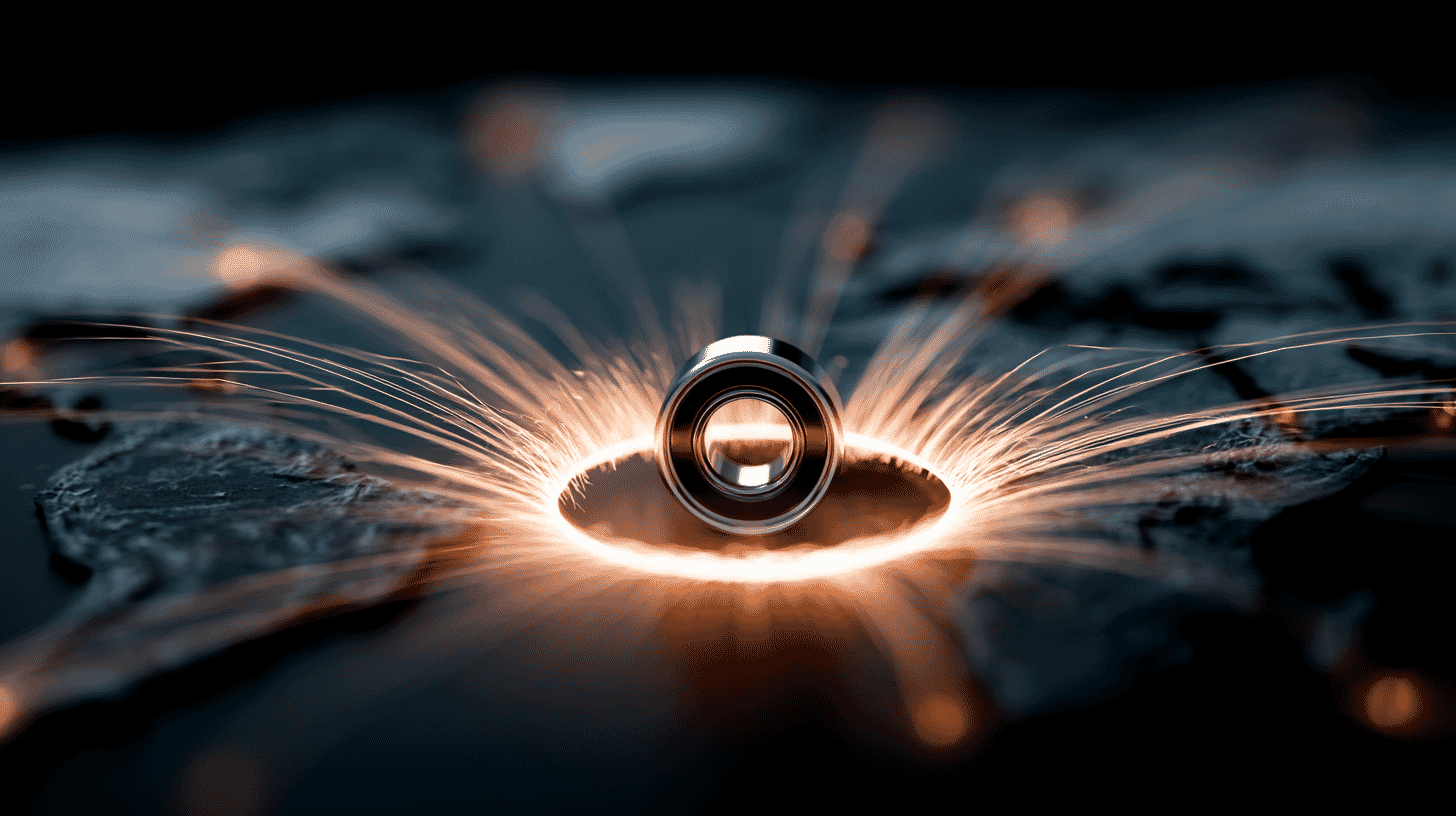
⚙️ Pinch a sesame seed between your fingers. Now imagine a ball bearing smaller than that: a metal ring with a hole through the middle just 0.6mm across, fitted with five steel balls each half a millimeter wide. Parts this small spin inside the hard drives that hold your photos, the joints of the robots that perform surgery, and the machines that build the semiconductor chips in your phone and laptop. Most of the world's bearings this tiny are reportedly made in one place: a 600-person factory in a town in Hokkaido that almost emptied out half a century ago.
The town the coal left behind
Ashibetsu sits near the middle of Hokkaido, in a wide river valley ringed by mountains. In the 1950s it was a coal town in full roar, with five major mining companies, a railway built to haul the coal out, and a population that climbed past 70,000.
Then Japan switched from coal to oil. One mine closed in 1963, then another, then the rest, until the last underground pit shut in 1992. The people left with the work. Today Ashibetsu has roughly 12,000 residents, less than a fifth of its peak. Whole settlements on the map are listed as having zero population.
It was into this emptying town, in 1969, that Eiichi Kobayashi, a Tokyo native, founded a company called Kitanihon Seiki to design and make ball bearings. Now past 90, he is still its chairman. The timing looks almost stubborn: setting up a precision-parts maker just as the place around it was being abandoned. The firm is still there, on a 21-hectare site, and it sells its bearings under a brand named after the old word for Hokkaido itself: EZO.
Why a small firm can't win the bearing game the normal way
A bearing is the small ring of balls or rollers that lets a wheel, a shaft, or a fan spin with almost no friction. They are everywhere, and the business of making them is enormous, worth around 58 billion dollars a year worldwide.
It is also a business owned by giants. Sweden's SKF, Germany's Schaeffler, the American firm Timken, and Japan's own big three (NSK, NTN and JTEKT) sit at the top, with Chinese makers like C&U and ZWZ pushing up from below on price. These companies run dozens of plants across the planet and turn out bearings by the hundreds of millions. A 600-person operation in a depopulating Hokkaido valley was never going to beat them at volume, or at cost.
So Kitanihon Seiki didn't try. Instead of fighting where scale decides the winner, it went somewhere scale stops helping at all: down into the very, very small.
Where size becomes a craft
The counterintuitive thing about bearings is that as they shrink, they don't just get harder to make in proportion; they get harder much faster. Every tolerance tightens. Every speck of grit, every fraction of a micron of roughness on a surface, becomes a problem you can no longer machine your way out of by brute force. Below a certain size, the work turns from manufacturing into something closer to a craft.
That is the territory Kitanihon Seiki chose to live in. Its smallest standard product has a bore of 0.6mm, an outer diameter of 2.5mm and a width of 1.0mm: a complete, functioning bearing roughly the footprint of a sesame seed. On the company's own account, the raceways the balls roll along are super-finished to a surface roughness measured in nanometers, around 0.01 of a micron. From a single basic design it offers about 1,300 standard models, which fan out into some 57,000 specifications once you factor in grades, clearances, lubricants and seals.
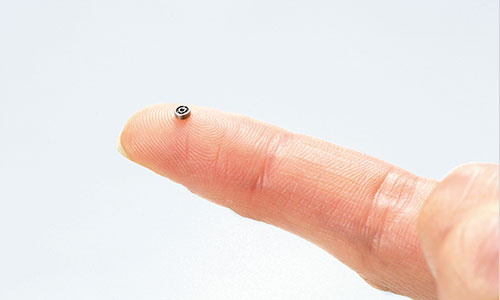
Source: Kitanihon Seiki
Profiles of the company report that even at 0.6mm, these bearings carry a basic static load rating of around 16 newtons and spin at up to roughly 142,000 revolutions per minute, numbers that are hard to picture until you remember the whole part is smaller than a grain of rice. The factory's monthly capacity runs to about 6.5 million units. It builds large lots on dedicated automatic assembly machines and handles the awkward small runs by hand, because at this scale a human still beats a robot at some of the fiddliest steps.
How you know it worked
By the usual measures, the strategy paid off. Industry profiles credit Kitanihon Seiki with roughly 70% of the global market for bearings with a bore under one millimeter. Its products reach more than 30 countries; overseas sales run to more than 80 percent of revenue, over half of that in Europe. They end up in places where failure isn't an option: surgical robots, IVF incubators, the peristaltic pumps that move fluids through medical equipment, hard-disk and optical drives, semiconductor production gear, aerospace hardware.
There's a stranger sign of success, too. On its own website the company runs a warning headed "STOP FAKE BEARINGS." Counterfeit EZO parts have turned up around the world, sold through unofficial channels, sometimes failing in use. Nobody bothers to fake a part that doesn't matter. The forgeries are, in their backwards way, a compliment.
The part you'll never see, doing a job you'd notice
Most of what Kitanihon Seiki makes will never be visible to the people who depend on it. That's the nature of a sub-millimeter bearing: it sits buried inside a machine, and you only learn it exists if it stops. If the firm's lines in Ashibetsu went dark, certain medical and precision devices simply couldn't be finished, not because no one else on earth can make a 0.6mm bearing, but because so much of the actual supply runs through this one valley that the rest of the chain has built itself around the assumption that it always will.
The bearing world is ruled by famous European and Japanese names you could look up in a minute. But its smallest links often trace back to places no one outside the trade has heard of: a former coal town, a brand named after the old word for an island, a few hundred people doing one thing better than anyone else. So the next time a machine hums to life in your hand, or a scanner glides past you in a hospital, it's worth asking what the tiniest spinning part inside it is, and who made it. In your country, would you even know where to begin looking?
References
- https://www.ezo-brg.co.jp/
- https://www.ezo-brg.co.jp/company/profile.html
- https://www.ezo-brg.co.jp/technology/technology.html
- https://share.j-treasure.com/kitanihonseiki-bearingu/
- https://www.cupid.or.jp/bearing/
- https://www.gminsights.com/industry-analysis/bearings-market-report
- https://ja.wikipedia.org/wiki/%E8%8A%A6%E5%88%A5%E5%B8%82
- https://3city.net/access/ashibetsu/





Global Discussion
0 comments