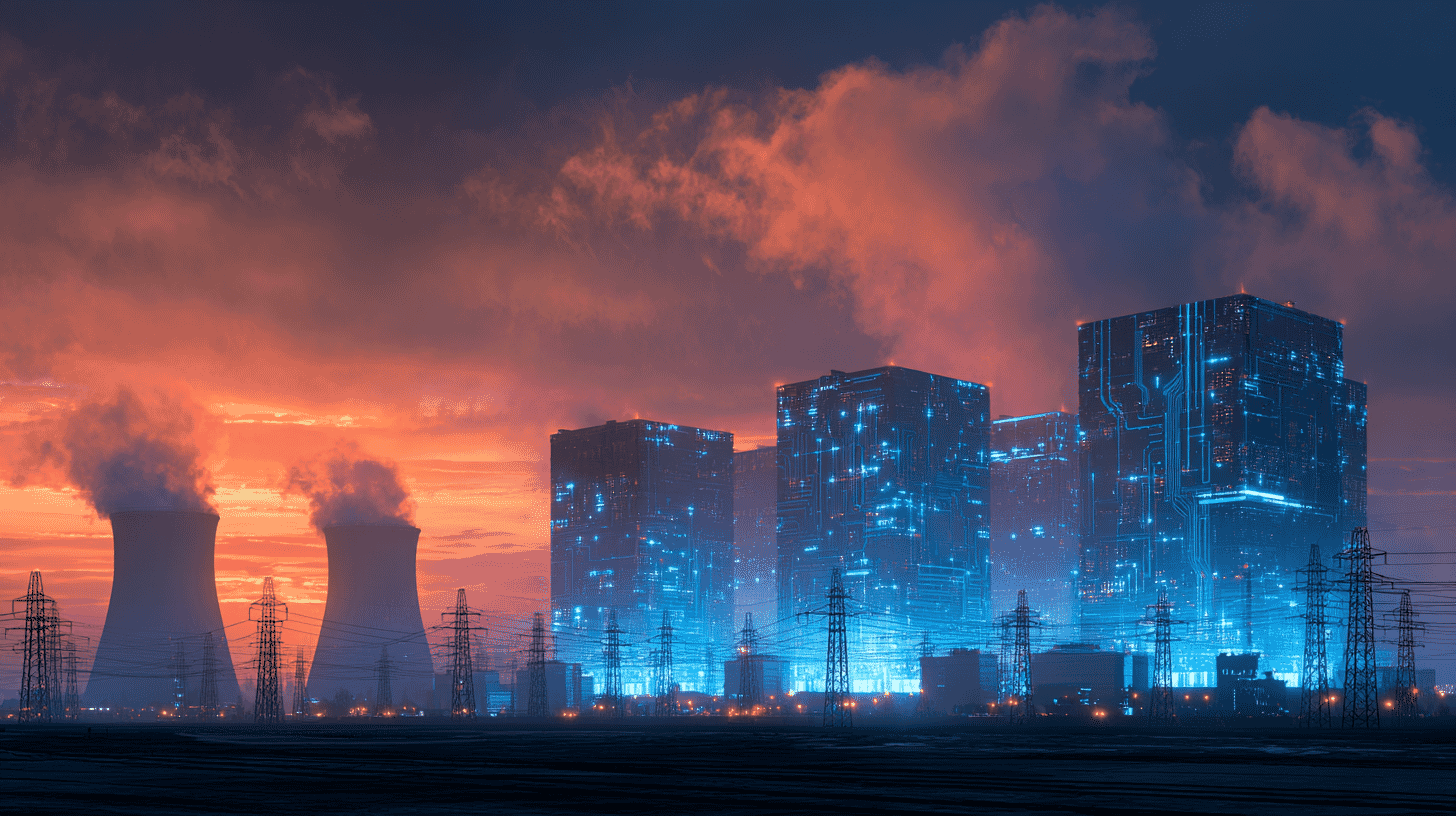
Is AI devouring the world's electricity? A single ChatGPT query consumes roughly 10 times more power than a Google search. If every Google search worldwide switched to AI, it would require the equivalent of Ireland's entire annual electricity output. Tech companies are no longer just buying power; they are investing billions to produce it. Here is how AI is triggering a global energy transformation.
The "Power Hunger" of AI: Just How Much Electricity Does It Consume?
The rapid spread of generative AI is fundamentally reshaping the global energy landscape. According to the International Energy Agency (IEA), combined electricity consumption from data centers, AI, and cryptocurrencies worldwide is projected to more than double from 460 terawatt-hours (TWh) in 2022 to as much as 1,050 TWh by 2026, roughly equivalent to Japan's entire annual electricity consumption.
Driving this surge is an unprecedented boom in AI data center construction. Meta plans at least $60 billion in capital expenditure for 2025, aiming to operate 1.3 million GPUs by year-end. Microsoft announced $80 billion in AI infrastructure spending for fiscal 2025. The power draw of individual GPU chips keeps climbing too: NVIDIA's latest Blackwell chip consumes approximately seven times more electricity than the A100 chip used to train early generative AI models.
The energy gap between traditional web services and generative AI is staggering. A single AI query uses about 10 times the electricity of a conventional Google search. If all of Google's searches (roughly 9 billion per day) shifted to an AI-based system, it would require an additional 29 TWh annually.
The Era of Tech Companies Becoming Power Companies
Alarmed by power shortages, tech giants are no longer just buying electricity; they are accelerating direct investment in the power business itself.
The most symbolic example is investment in restarting idle nuclear plants. Microsoft signed a 20-year power purchase agreement (PPA) with utility Constellation Energy. Constellation then announced plans to spend about $1.6 billion to restart Unit 1 at Three Mile Island, the plant known for its accident (a different reactor from Unit 2). Once restarted, it will supply 835 MW of carbon-free power for Microsoft's data centers.
Google has partnered with NextEra Energy to support restarting the Duane Arnold nuclear plant in Iowa, signing a 25-year PPA with commercial operation targeted for 2029.
Amazon has gone further, acquiring a data center directly connected to a nuclear plant and investing in developers of next-generation small modular reactors (SMRs) to secure long-term power infrastructure. It has also signed a memorandum with Dominion Energy on SMR development.
It isn't only individual companies. In 2025, AI and data center capital spending by the "Magnificent Seven" US tech giants reached about $414 billion, and it is forecast to exceed $430 billion in 2026. Across the IT industry, global data center capital spending is expected to reach $1.2 trillion by 2029.
Nuclear Makes a Comeback as "AI's Power Source"
Behind tech companies' interest in nuclear is the reality that renewables such as solar and wind alone cannot meet data centers' need for stable power 24 hours a day, 365 days a year.
Renewables are expanding quickly, but they are intermittent and weather-dependent, and cannot fully meet data centers' need for uninterrupted power. Natural gas turbines are expected to be the main source for now, but reliance on fossil fuels contradicts the carbon-neutral pledges of tech companies.
Nuclear has emerged as the solution. The US government has set a policy of quadrupling nuclear capacity by 2050 and has signed a strategic partnership with Westinghouse Electric for new reactor construction worth at least $80 billion.
Unlike conventional large plants, SMRs are compact, faster to build and could potentially be sited near data centers. Hyperscalers such as Google, Microsoft and Amazon are using their trillion-dollar balance sheets to secure every kind of power source, from nuclear to natural gas and solar.
Impact on Japan and the "Watt-Bit Integration" Strategy
Japan is far from immune to this global power demand surge. According to Wood Mackenzie, Japan's data center electricity consumption is projected to triple from 19 TWh in 2024 to 57–66 TWh by 2034. Peak power demand from data centers could reach 4–5% of Japan's total peak electricity demand by 2034. Japan's Organization for Cross-regional Coordination of Transmission Operators (OCCTO) forecasts that peak demand from new data centers and semiconductor factories could increase roughly 13-fold by 2034 compared to 2025 levels.
However, Japan faces challenges distinct from those in the United States. Data centers have concentrated in specific areas, particularly the Inzai-Shiroi district in Chiba Prefecture, where applications for grid connection now far exceed available capacity. Lengthy grid-connection timelines are increasingly at odds with business plans.
To address these challenges, the Japanese government unveiled the concept of "Watt-Bit Integration" (ワット・ビット連携) as part of the "GX 2040 Vision" approved by cabinet in February 2025. This innovative framework aims to integrate energy infrastructure (Watts) with information and communications technology (Bits) holistically.
In practice, this means strategically distributing data centers across regions rich in renewable energy and dynamically shifting AI computational workloads between regions based on real-time power supply conditions, a concept called "workload shifting." For example, during daylight hours, computing tasks could be concentrated at data centers in Kyushu where solar power is abundant, then shifted to Hokkaido or Tohoku at night when wind generation peaks. The University of Tokyo and Fujitsu launched a proof-of-concept experiment for this technology in January 2026.
SoftBank Group is constructing a large-scale AI data center in Tomakomai, Hokkaido, leveraging the region's cold climate for energy-efficient cooling and locally produced renewable energy. The facility is scheduled to open in fiscal 2026.
The Japanese government also announced plans to invest approximately $1.4 billion over five years starting in fiscal 2026, subsidizing up to 50% of investments in semiconductor plants and data centers that utilize 100% decarbonized power sources such as renewables and nuclear energy.
The "ESG Paradox" and Japan's Challenges
Japan, however, faces a structural dilemma. Global tech companies want clean energy for their data centers, but Japan currently lacks enough renewable supply, so data centers in the Tokyo area have to rely on coal- and LNG-fired power. This "ESG paradox" creates the irony that tech companies meant to be among the greenest in the world end up using some of the most carbon-intensive electricity in Japan.
Overcoming this requires securing stable baseload power by restarting nuclear plants, accelerating renewables and upgrading the grid all at once. AI is a key technology for Japan's industrial competitiveness, and building the power infrastructure behind it is no longer just energy policy but national economic strategy itself.
How is your country dealing with the power demands of the AI era?
References
- https://globalxetfs.co.jp/research/ai-hinges-on-rapid-electrification/index.html
- https://www.jogmec.go.jp/publish/plus_vol27.html
- https://www.enecho.meti.go.jp/about/special/johoteikyo/gxseisaku2025.html
- https://www.woodmac.com/ja/press-releases/japan-data-centers-power-demand/
- https://www.iaea.org/bulletin/data-centres-artificial-intelligence-and-cryptocurrencies-eye-advanced-nuclear-to-meet-growing-power-needs
- https://www.nga.org/publications/nga-nuclear-dispatch-powering-a-new-era-of-innovation/
- https://www.u-tokyo.ac.jp/focus/ja/press/z1313_00027.html







Global Discussion
15 comments