
On April 23, Japan's Prime Minister Sanae Takaichi welcomed five foodtech CEOs to her official residence. Why these five companies? The answer lies in the four food crises the world is now facing: climate-driven farmland collapse, the disappearance of wild fish stocks, explosive population growth, and the rapid shrinking of farming populations. Tokyo sees one solution in each of the five companies' technologies. This article decodes what Japan's "national-strategy foodtech" is really aiming at.
What Happened on April 23
According to a Prime Minister's Office announcement, PM Takaichi met with the executives of five "advanced agriculture, forestry, and fisheries companies" for roughly an hour at her official residence on April 23.
Opening the meeting, the Prime Minister noted that achieving a strong economy must go hand in hand with minimizing risk. She then declared that "without demand, no one will invest, conduct R&D, or produce, so the government must take the lead in opening up domestic and overseas demand," signaling her commitment to creating market pull for foodtech.
This was no ceremonial visit. Foodtech is one of 17 strategic sectors selected by the Takaichi administration's Japan Growth Strategy Headquarters, launched last November. With this summer's growth-strategy package now being finalized, the prime minister sitting down face-to-face with operating CEOs sends a clear political signal, and looking at the lineup invited, it becomes clear which global problems Tokyo is choosing to bet on.
The Four Food Crises the World Now Faces
Before diving into the five companies' technologies, it's worth laying out what the world is actually grappling with.
Crisis #1 is climate-driven farmland collapse. An estimated 52% of the world's agricultural land is already classified as degraded. Rising annual temperatures, more frequent extreme weather, shifting flowering dates, late-frost damage, and northward-migrating pests are upending established yield patterns. The World Food Programme's 2026 Global Outlook estimates that 318 million people are already facing crisis levels of hunger or worse.
Crisis #2 is ocean depletion. According to the FAO, the share of global fish stocks fished at biologically unsustainable levels has risen from about 10% in 1974 to 35.4% by 2019. Commercially valuable species like bluefin tuna, Chilean sea bass, and orange roughy have seen dramatic population declines compared with the 1960s.
Crisis #3 is population growth. UN projections place world population at 9.7 billion by 2050. Food demand is expected to grow by 59% to 98% over today's levels, a gap that current production methods have no realistic way to close.
Crisis #4 is the collapse of farming populations. Not just a Japanese problem. In Europe, the share of working population in agriculture fell from 5.4% in 1970 to 1.6% by 2004. The US, Japan, and South Korea share the same demographic structure.
The five companies invited to the PM's office each take a distinct technological approach to one or more of these crises.
Oishii Farm: Exporting "Agriculture Independent of Land and Climate"
The answer to Crisis #1 (climate and farmland) is embodied by Oishii Farm.
Founded in 2016 in the United States by Hiroki Koga, a Keio University graduate who earned his MBA at UC Berkeley, the company runs a vertical farm near New York that mass-produces premium Japanese strawberry varieties such as the "Omakase Berry."
What's striking is that this isn't simply "Japanese agriculture exported to America." In regions where farmland is degrading from climate change, plant factories can deliver produce at consistent quality, volume, and price year-round. Yields that would otherwise swing wildly with the weather are stabilized by replacing the volatile inputs with hardware and control software, that's the technical core of Oishii Farm.
Their proprietary system makes bee pollination viable indoors, expanding plant-factory crop options beyond the lettuce monoculture that has dominated the industry, into strawberries, tomatoes, and eventually melons. Initially priced at around $50 per pack to capture Michelin-starred chefs' attention, the price has since dropped to roughly $10 as production scaled. The berries now sell at Whole Foods and other premium grocers in hundreds of US stores. In 2024, the company raised about $126 million (around 20 billion yen, at roughly 159 yen per dollar).
For Tokyo, Oishii Farm is a proof-of-concept for "selling the entire plant-factory system overseas as a packaged export." Future customers are countries struggling with climate adaptation, the Middle East, Africa, Pacific island nations.
PlantX: "Growing Food Inside Cities" Through Hyper-Density Production
PlantX takes on the same Crisis #1 (climate and farmland) but with a different approach.
The Tokyo-based startup developed "Culture Machine," a fully sealed plant factory where each shelf has its own independent atmosphere. Software precisely controls 20-plus parameters, temperature, humidity, CO2 levels, photosynthesis rate, and more, pushing productivity per square meter to three to five times that of conventional plant factories.
Why does this matter? Urban populations worldwide are surging, and the food-mile distance from farm to plate keeps growing. PlantX's hyper-density technology makes "urban agriculture" viable in small footprints close to consumers. Tractor giant Kubota is an investor, and in 2025 the partnership opened a Kubota–PlantX marketing base in New York City.
What Tokyo sees in PlantX is the industrial-policy ambition of "Japan setting the global standard for artificial-light plant factories." The roughly 90% lettuce dependence in commercial plant factories today represents an opportunity: whoever solves diversification first becomes the platform supplier, the same way Japan dominated semiconductors and machine tools in earlier eras.
FRD Japan: "Growing Fish Where There Is No Sea": A Solution to Ocean Depletion
The answer to Crisis #2 (ocean depletion) comes from FRD Japan.
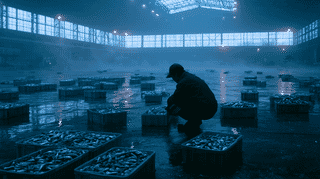
The company specializes in closed-loop recirculating land-based aquaculture. Rather than relying on the sea or rivers, fish are raised in inland facilities where the rearing water is highly purified and continuously recirculated. FRD Japan's proprietary water-treatment technology makes large-scale farming of species like salmon possible.
Why is this a solution to the global problem? Wild fish stocks are being caught faster than they can reproduce, there is no other path to increasing fish supply except aquaculture. But conventional sea-based aquaculture brings its own problems: rising sea temperatures, harmful algal blooms, fishery contamination, antibiotic use. Closed-loop land-based systems address all of these through engineering.
Japan's strength here is twofold: world-class water treatment technology, and the technical heritage that includes Kindai University's 2002 breakthrough in fully closed-cycle bluefin tuna farming. Landlocked countries, Switzerland, the Czech Republic, Central Asian nations, could now technically raise their own fish.
Regional Fish: "Redesigning the Fish Itself": The Frontier of Genome Editing
Regional Fish takes on both Crisis #2 (ocean depletion) and Crisis #3 (population growth).
Spun out of joint research between Kyoto University and Kindai University in 2019, the company uses genome editing to improve the farmed fish themselves. Three flagship products: the "22nd Century Sea Bream," with the myostatin gene knocked out to increase edible muscle by 1.2 to 1.6 times; the "22nd Century Tiger Pufferfish," with the leptin gene deactivated so it grows nearly 1.9 times faster; and the "22nd Century Flounder," engineered for heat tolerance.
The company completed regulatory notifications with Japan's Ministry of Health and Ministry of Agriculture in 2021, making these the first genome-edited animal food products in commercial circulation anywhere in the world.
What's striking is that while Europe has effectively shut the door on genome-edited animal food, Japan is leading the world in this domain. Under the EU's Novel Food Regulation, genome-edited products are treated as genetically modified, making market entry essentially impossible. Japan, by contrast, applied the scientific judgment that genome editing differs from genetic modification and permitted commercial circulation through a notification system.
This regulatory divergence opens a window for Japan to become "the global leader in genome-edited aquaculture." The fact that Regional Fish was invited to the PM's office is essentially a government declaration that Japan's distinctive regulatory stance will be wielded as a strategic weapon for growth.
Toko Tekko: "Filling Labor Gaps with Technology": Sustaining Existing Farms
The answer to Crisis #4 (the collapse of farming populations) comes from Akita-based Toko Tekko.
The only one of the five companies that emerged from traditional metalworking, Toko Tekko develops agricultural drones that integrate with satellite data, automating pinpoint pesticide spraying, growth diagnostics, and fertilizer application.
Why was this company invited? While plant factories and aquaculture create new methods of food production, Toko Tekko's technology answers a different question: how to maintain existing farmland with fewer people. It's defensive technology in the best sense.
This is a clear-eyed acknowledgment of Japan's reality. Japan had roughly 1.36 million principal farmworkers in 2020, with an average age over 67. That number could halve within a decade. Pushing plant-factory and aquaculture exports while figuring out how to keep existing farmland productive, without that two-track approach, food security simply doesn't add up.
What Toko Tekko demonstrates is a counterargument to the assumption that "foodtech equals cutting-edge startups only." A regional small-to-medium manufacturer, combining its tradition with satellite data, can build agricultural robotics at world-class levels. That, too, is part of the depth of Japanese foodtech.
Why "Opening Up Demand" Is the Heart of It
The problems these five companies tackle are universal food challenges. But however brilliant the technology, no business survives without buyers.
Israel's cultivated-meat company Aleph Farms is a cautionary example. Even after winning the world's first cultivated-beef approval in 2024, it has continued to struggle with pricing and mass production. Singapore approved cultivated chicken in 2020, but commercial restaurants soon withdrew. The lesson is the same in every case: regulation and technology aren't enough, without demand creation, nothing scales.
Takaichi's repeated emphasis on "opening up demand" is a direct response to this lesson. Export market development, government procurement, ODA-linked overseas deployment support, engagement with international standard-setting, all are policy levers for the state to pull on the demand side.
At the fourth Japan Growth Strategy Council meeting on April 22, the government made it explicit: Japan suffers from a chronic shortfall in domestic investment that must be aggressively addressed, framed through two complementary axes, "crisis-management investment" to minimize risk, and "growth investment" to nurture frontier technology.
Why Now, Why These Five: The "Winning Categories" Japan Has Chosen
In the West, the foodtech conversation centers on alternative meat, cultivated meat, and precision fermentation. Japan, this time, did not choose to compete on that ground.
The reason is clear. Japan, as these five companies illustrate, has a different stack of accumulated strengths: plant factories (research dating to the 1980s), water treatment (world-class), genome editing (regulatory advantage), precision-control manufacturing (the manufacturing tradition), and satellite data utilization (built on space-related technology). Combined, these open a "winning category" on a different axis from the US and Europe.
The Ministry of Agriculture has set a target of 30% global market share by 2040 in both plant factories and land-based aquaculture, with a public-private investment roadmap due between April and May 2026. On March 25, the agriculture ministry hosted ambassadors from 60 countries to showcase these technologies. The ambassador from the Federated States of Micronesia reportedly praised the ability to grow vegetables without consuming massive amounts of land.
"Win in the categories where we can win, rather than competing in every category", the April 23 meeting was the moment that strategy was given a face, in the form of five specific companies.
For investors and policy watchers wanting deeper detail on three of the five, Regional Fish, FRD Japan, and Oishii Farm, including funding history, business models, and major backers, we recommend our companion piece on Japan's foodtech hidden gems, which also covers two additional rising names: Chitose Bio Evolution and UMITRON.
What's It Like in Your Country?
Climate change, ocean depletion, population growth, and shrinking farmer populations are universal challenges, but the way each country tackles them is different.
In your country, how widespread are plant factories and land-based aquaculture? Is genome-edited food legally permitted? How does your government position food security in its industrial strategy? We'd love to hear from you.
References
- https://www.kantei.go.jp/jp/105/actions/202604/23menkai.html
- https://foodtech-japan.com/2026/04/27/japan-growth-strategy-5/
- https://www.jiji.com/jc/article?k=2026042301017&g=eco
- https://foodtech-japan.com/2026/04/06/japan-growth-strategy-3/
- https://www.wfp.org/global-hunger-crisis
- https://earth.org/the-future-of-sustainable-fishing-more-oversight-and-lower-yields/








Global Discussion
14 comments