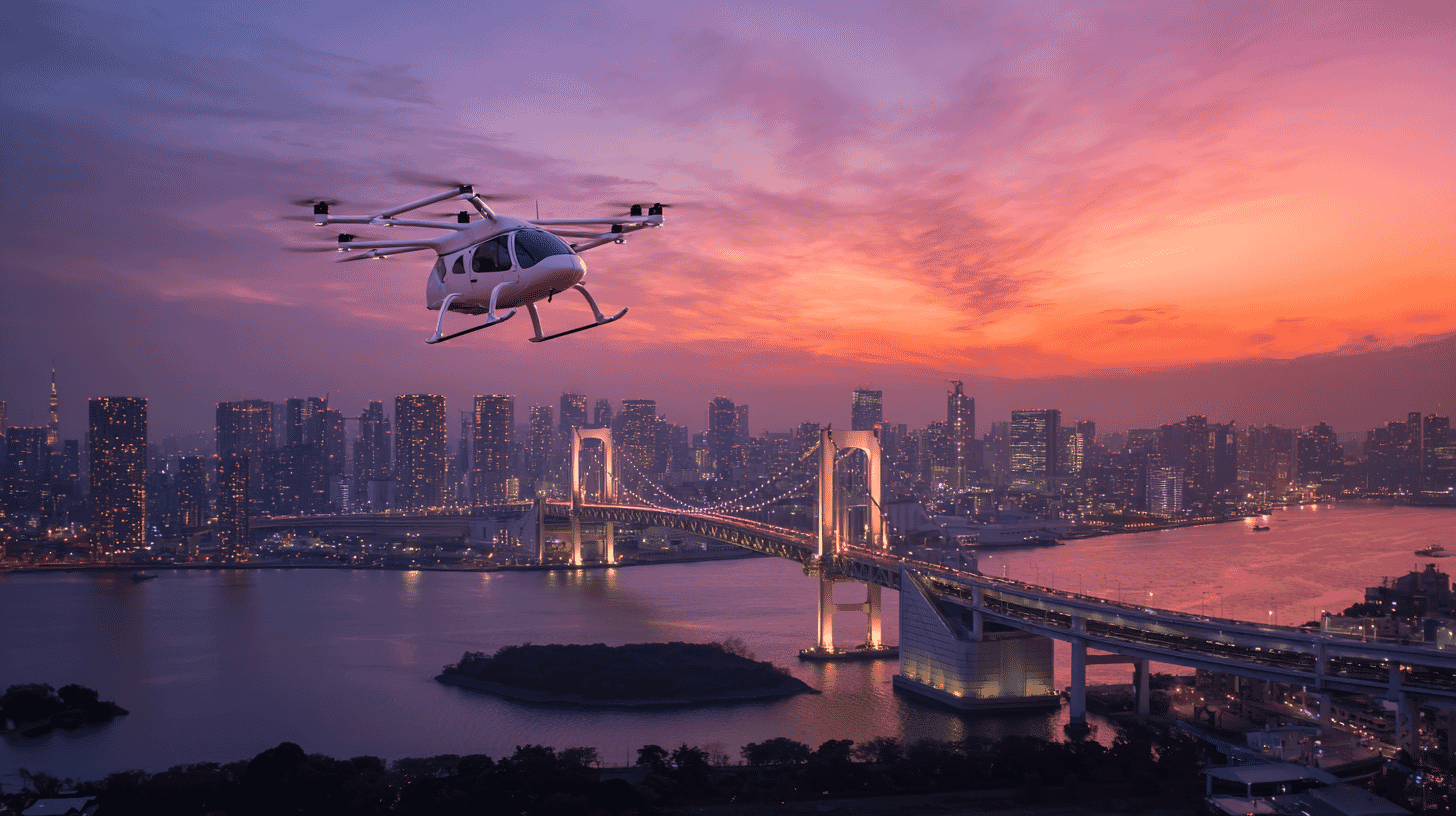
No ticket counters, no boarding passes. Show your face and go, in under five minutes. Tokyo just ran a trial combining a domestic electric aircraft with facial recognition boarding, and the interesting part wasn't the aircraft.
Japan's Domestic eVTOL Takes Flight Over Tokyo
From February 24 to 28, 2026, real estate group Mitsubishi Estate, trading house Kanematsu, eVTOL developer SkyDrive (based in Toyota City, Aichi Prefecture) and the Tokyo Metropolitan Government conducted an operational-scenario flight demonstration of a "flying car" at Tokyo Big Sight. It ran under a Tokyo subsidy program on building business models for flying-car services, awarded to the group in June 2025.
SkyDrive's domestically developed aircraft, the "SKYDRIVE" (model SD-05), flew in Tokyo for the first time. No pilot was aboard: the compact multicopter-type eVTOL lifted off from a temporary vertiport in a parking area under automated control and remote piloting, circled out over the water, and returned. The flight lasted about 3 minutes and 30 seconds, reaching a maximum altitude of 43 feet (13 meters) and covering roughly 500 feet (150 meters).
Flights ran twice daily across the five days, at 9:30 a.m. and 12:05 p.m., free to watch. The airframe was the same model flown publicly at the 2025 Osaka-Kansai Expo and at the Osaka Port vertiport.
Face-Scan Boarding: The Five-Minute Terminal Experience
The point of the trial wasn't the flight. It was the full-service terminal operation built alongside it, designed to simulate real commercial conditions.
The consortium set up a trailer-type mobile passenger terminal covering about 580 square feet (54 square meters). Inside, passengers moved through a security screening area and lounge, completing every step, from reservation confirmation to check-in, security check, and boarding gate, using facial recognition alone. No paper tickets, no manual ID checks.
The target: complete the entire boarding process in under five minutes, with a user experience more like hailing a taxi than catching a flight.
The terminal also housed a control room where operators monitored passenger data, takeoff and landing operations, and air traffic within a 2.5-mile (4 km) radius in real time. Flight data was fed into an airspace monitoring system that rendered the aircraft's route visually. The system was built with technology from UK-based vertiport developer Skyports, in which Kanematsu holds an equity stake.
Pre-selected public monitors went through the complete boarding experience and provided feedback on passenger flow and procedures.
A representative from Mitsubishi Estate put it plainly: social deployment of flying cars requires terminals that play the role airports play for conventional aviation.
SkyDrive vs. the World: How Japan's eVTOL Compares
SkyDrive's SD-05 occupies a unique niche in the global eVTOL landscape. It's a three-seat multicopter (one pilot, two passengers) powered by 12 electric motors, with a cruising speed of 62 mph (100 km/h) and a range of about 9 miles (15 km). The company describes it as "the world's most compact eVTOL," designed specifically for dense urban environments where space is at a premium.
Manufacturing draws on a roster of partners: Suzuki Motor handles production, Toray provides body and rotor frame materials, and French firm Thales supplies the flight controller. SkyDrive is targeting commercial flights in 2028.
The global field looks different.
Joby Aviation (USA) is arguably the front-runner. Its S4 seats five (one pilot, four passengers) and cruises at roughly 200 mph (320 km/h), more than three times SkyDrive's speed. Backed by approximately $500 million from Toyota, Joby is working through the FAA's type certification process and targeting a commercial launch in Dubai in 2026, with US operations to follow. In Japan, it has partnered with ANA Holdings.
Archer Aviation (USA) is developing the "Midnight" eVTOL in partnership with Delta Air Lines, targeting New York and Los Angeles markets. The company is also building operational infrastructure in Abu Dhabi, UAE, with plans to launch commercial service there in 2026.
Meanwhile, European competitors have hit turbulence. Germany's Lilium filed for insolvency in October 2024 and again in February 2025, effectively shutting down operations. Fellow German developer Volocopter entered bankruptcy proceedings in December 2024. In a business where certification costs enormous capital before any revenue arrives, funding runs out before the technology does.
SkyDrive's position is the compact one. It loses to Joby on speed and range and wins on being able to land in a tight urban space. That is the bet: what a dense Asian city needs from an eVTOL is not what works across the open distances of Dubai or suburban America.
Tokyo's Air Mobility Roadmap: Commercial Flights by 2030
The Tokyo Metropolitan Government has funded private-sector business model work on flying cars since fiscal 2022, and in fiscal 2025 launched its "Flying Car Implementation Project," aiming for commercial operations in urban areas by 2030. Mitsubishi Estate and Kanematsu have been at this since 2022, including technical trials of a helicopter route linking the roof of the Shin-Marunouchi Building with the waterfront. The Big Sight demonstration sits on that line.
At the national level, Japan's Ministry of Economy, Trade and Industry (METI) and Ministry of Land, Infrastructure, Transport and Tourism (MLIT) have a phased implementation plan, now in the post-Expo phase of expanding commercial operations.
Japan's aviation regulators have based their airworthiness standards on the same framework used by the FAA and EASA, which leaves room for mutual recognition with international authorities.
Challenges Ahead: Infrastructure, Perception, and Cost
Despite the technological progress, several hurdles remain before air taxis become part of daily urban life.
Infrastructure is perhaps the biggest challenge. Vertiports need to be located in convenient city-center locations to offer genuine utility. Industry insiders acknowledge that without accessible downtown landing pads, eVTOL services risk becoming little more than novelty demonstrations.
Public perception presents another obstacle. In Japan, the term "flying car" (sora tobu kuruma) draws persistent criticism because the aircraft look nothing like cars, and some worry the misleading name attaches a vague negative impression to the technology. Internationally, "air taxi," "eVTOL," and "urban air mobility" are still competing for the same job.
Cost remains an open question. Neither SkyDrive nor its competitors have announced specific ticket prices for commercial service. For eVTOLs to achieve their promise of becoming everyday transportation rather than luxury services, pricing will need to approach levels competitive with premium ground transport options.
Still, the Tokyo demonstration marks a shift from proving that electric aircraft can fly to showing they can run as part of a service. Three minutes thirty seconds, 43 feet up, 500 feet across. As flight numbers go, that is unremarkable. But what was being tested was the integration of automated flight, facial recognition boarding, mobile terminal operations, and airspace monitoring, not the airframe. That order is the right one.
How does your country view "flying cars"?
References
- https://xtech.nikkei.com/atcl/nxt/column/18/02892/022700044/
- https://drone-journal.impress.co.jp/docs/special/1188251.html
- https://www.metro.tokyo.lg.jp/information/press/2026/02/2026020319
- https://drone.jp/news/20260204154053125878.html
- https://jidounten-lab.com/u_58342
- https://gulfnews.com/business/aviation/flying-taxis-are-almost-here-last-hurdles-for-joby-archer-amid-evtol-certification-drive-1.500472861






Global Discussion
16 comments