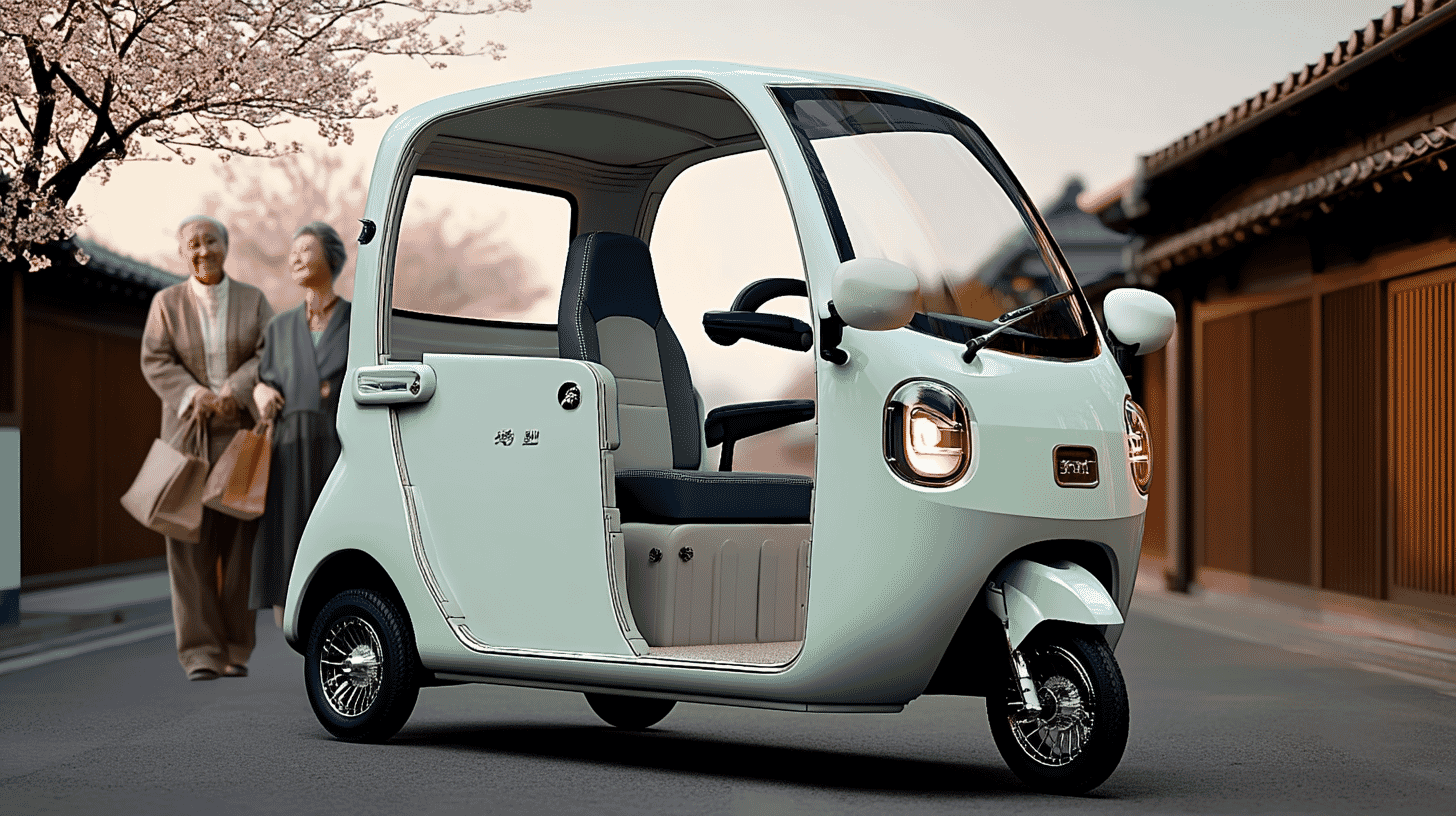
Imagine a roofed electric vehicle that seats three people, costs less than $4,000, needs no vehicle inspection, and charges from a regular wall outlet. In Japan, where aging demographics are creating millions of "mobility refugees" who can no longer drive, a compact three-wheeler called the Vivel Trike is quietly becoming a lifeline. With 300 units sold and inquiries doubling year-over-year, this tiny EV may signal a broader shift in how Japan reimagines transportation for its graying society.
A $3,900 Electric Tuk-Tuk Built for Japan's Aging Streets
In October 2023, a small company called Bubble Inc. (株式会社バブル), based in Isehara, Kanagawa Prefecture, began selling an unusual vehicle: the Vivel Trike (ビベルトライク), a roofed, three-wheeled electric vehicle that looks remarkably like the tuk-tuks you'd find on the streets of Bangkok or Manila, but engineered specifically for Japan's roads and regulations.
The vehicle comes in four model variations. The entry-level ST1500 starts at approximately $3,900 (590,000 yen), while the top-tier Li2000, equipped with a lithium-ion battery capable of over 100 km (62 miles) on a single charge, runs about $5,300 (800,000 yen). The newest addition, the COCO series launched in October 2025, features a retro-inspired rounded design with seven color options and is priced from roughly $5,000 to $5,800 (760,000 to 880,000 yen) with upgraded safety features including foot-operated disc brakes and a standard backup camera with monitor.
All models share a compact footprint, roughly 2.3 meters long and just over 1 meter wide, significantly smaller than even Japan's famously tiny kei cars (lightweight vehicles). They seat up to three people, feature a small trunk, and come with a roof that shields riders from rain and sun.
Here's what makes them particularly appealing under Japanese law: the Vivel Trike is classified as a "trike" (トライク), which falls under the legal category of a standard automobile. This means anyone with a regular Japanese driver's license can operate one, no motorcycle license needed. Crucially, trikes are exempt from Japan's mandatory shaken (車検) vehicle inspection system, which typically costs car owners $650 to $1,300 every two years. There's also no legal requirement for a garage certificate (shakoshomei), and helmets are not mandatory (though the manufacturer recommends wearing one).
Running costs are remarkably low. Bubble Inc. claims the Vivel Trike achieves energy costs of approximately $1 per 100 km, a fraction of what gasoline-powered vehicles consume.
300 Units and Counting: Who's Buying?
As of early 2026, the Vivel Trike series, including the standard Vivel Trike, the COCO series, and the Vivel Truck (a cargo-oriented variant), has surpassed 300 cumulative units sold. While that number might seem modest by automotive industry standards, the growth trajectory tells a compelling story. In the most recent six-month period, both inquiries and completed sales more than doubled compared to the same period the previous year.
The buyer profile is evolving beyond what the company initially expected. Three distinct customer segments have emerged.
The first and most prominent group consists of elderly individuals and their families. Many buyers are seniors who use the trike for daily errands, grocery shopping, medical appointments, visiting friends. But a growing number of purchases are being initiated by adult children concerned about their aging parents' mobility. In Japanese culture, the concept of oyakōkō (親孝行, filial piety) runs deep, and buying a safer, easier-to-operate vehicle for a parent represents a modern expression of this value.
The second segment is families, particularly in suburban and rural areas where public transportation is sparse. The three-person capacity and weather protection make it a practical second vehicle for short-distance trips.
The third and fastest-growing segment is corporate and institutional buyers. Golf courses are using them for on-site transportation. Businesses are deploying them for local deliveries and facility management. Nursing homes and care facilities are exploring them for resident transport within campuses.
A notable trend is word-of-mouth driving sales: existing owners are referring new buyers, suggesting genuine satisfaction rather than mere curiosity.
Japan's "Mobility Refugee" Crisis
To understand why a vehicle like the Vivel Trike resonates so deeply, you need to understand the mobility crisis quietly unfolding across Japan.
Japan is the world's oldest major society. Roughly 29% of the population is over 65, and that percentage continues to climb. In rural prefectures, the figure exceeds 35%. As these residents age, many face a painful choice that Japanese society has come to call the menkyohennou jirenma (免許返納ジレンマ), the "license surrender dilemma."
On one side, high-profile accidents involving elderly drivers have led to intense public pressure for seniors to voluntarily surrender their licenses. The 2019 Ikebukuro incident, where an 87-year-old driver killed a mother and her young daughter, became a watershed moment that still reverberates through Japanese society.
On the other side, surrendering a license in rural Japan effectively means surrendering independence. A 2025 survey of women aged 50-87 found that among those 70 and older, about 21% had already returned their licenses. But many reported that life after surrender meant fewer trips to the doctor, difficulty buying groceries, and a significant reduction in social interaction. Research suggests that seniors who stop driving face elevated risks of cognitive decline, physical deterioration, and depression, the very conditions that license surrender is meant to prevent.
This creates what mobility researchers call a structural contradiction: the policy designed to protect public safety inadvertently endangers the health and well-being of the very population it aims to help.
Public transportation offers limited relief. Bus routes in rural areas continue to be cut due to driver shortages and declining ridership. Train stations can be kilometers away. Taxi services, while available, are expensive for daily use and are themselves facing driver shortages.
Into this gap, vehicles like the Vivel Trike offer a middle path. They're simpler to operate than a car (steering is done via handlebars, similar to a bicycle), more stable than a two-wheeled scooter, and more weather-protected than a mobility scooter. They can carry a passenger or groceries. And at a top speed of 45-60 km/h depending on the model, they're fast enough for suburban roads but slow enough to feel manageable.
Tuk-Tuks Go Global, But Japan's Version Is Different
Electric tuk-tuks are a global phenomenon. The worldwide electric tuk-tuk market is valued at roughly $2.5 billion in 2025 and is projected to grow at 8-12% annually through the end of the decade. Most of that growth is concentrated in South and Southeast Asia, India, the Philippines, Indonesia, Thailand, where tuk-tuks have been a transportation staple for decades and electrification represents a natural evolution.
Japan's relationship with tuk-tuks is fundamentally different. Here, they're not replacing existing tuk-tuks; they're creating an entirely new vehicle category that fills a gap between cars and mobility scooters. The Vivel Trike isn't competing with Toyota or Honda, it's competing with the decision to stop driving entirely.
This context also explains Bubble Inc.'s emphasis on dealer networks and in-person consultations. The company has been expanding its network of regional dealers who can demonstrate vehicles in person, answer questions face-to-face, and provide after-sales support. For elderly buyers, many of whom are wary of online purchases and unfamiliar vehicle types, this human touch has proven essential. Every vehicle undergoes final assembly and inspection at Bubble's headquarters, with brakes, electrical systems, and driving performance checked individually before delivery. The company appears to be prioritizing trust and reliability over rapid scaling.
The 2025 Model: Evolving With Its Users
The May 2025 model update reflected direct feedback from owners. Key improvements included compatibility with Japan's growing network of EV charging stations (via a standard charging connector), the addition of a handbrake, rain-guard side covers as standard equipment, and a USB Power Delivery charging port for devices.
The COCO series, meanwhile, represents a deliberate push to broaden the vehicle's appeal beyond the "mobility solution for seniors" positioning. With its retro-inspired rounded headlights, seven cheerful color options, and a tagline of "make your commute cuter and more you," it targets younger users, women, and anyone who wants a fun, eco-friendly runabout without the cost and complexity of a car.
What This Tells Us About Japan's Mobility Future
The Vivel Trike's 300-unit milestone is a small number in absolute terms, but it represents something significant in Japan's transportation landscape. It demonstrates that there's genuine market demand for vehicles that exist between traditional categories, not quite a car, not quite a motorcycle, not quite a mobility scooter.
Japan's regulatory framework, which classifies trikes as automobiles and exempts them from vehicle inspections, has inadvertently created a favorable environment for this kind of innovation. Whether policymakers will continue to support this category, or eventually impose stricter regulations as adoption grows, remains to be seen.
For now, the Vivel Trike stands as a small but telling example of how Japan's aging society is generating unique mobility needs that conventional automakers have been slow to address. The solutions, it turns out, may not come from the country's automotive giants, but from small companies willing to think outside the (very small) box.
In your country, how do elderly people maintain their independence when they can no longer drive? Are there alternative vehicles or transportation systems that fill this gap?







Global Discussion
15 comments