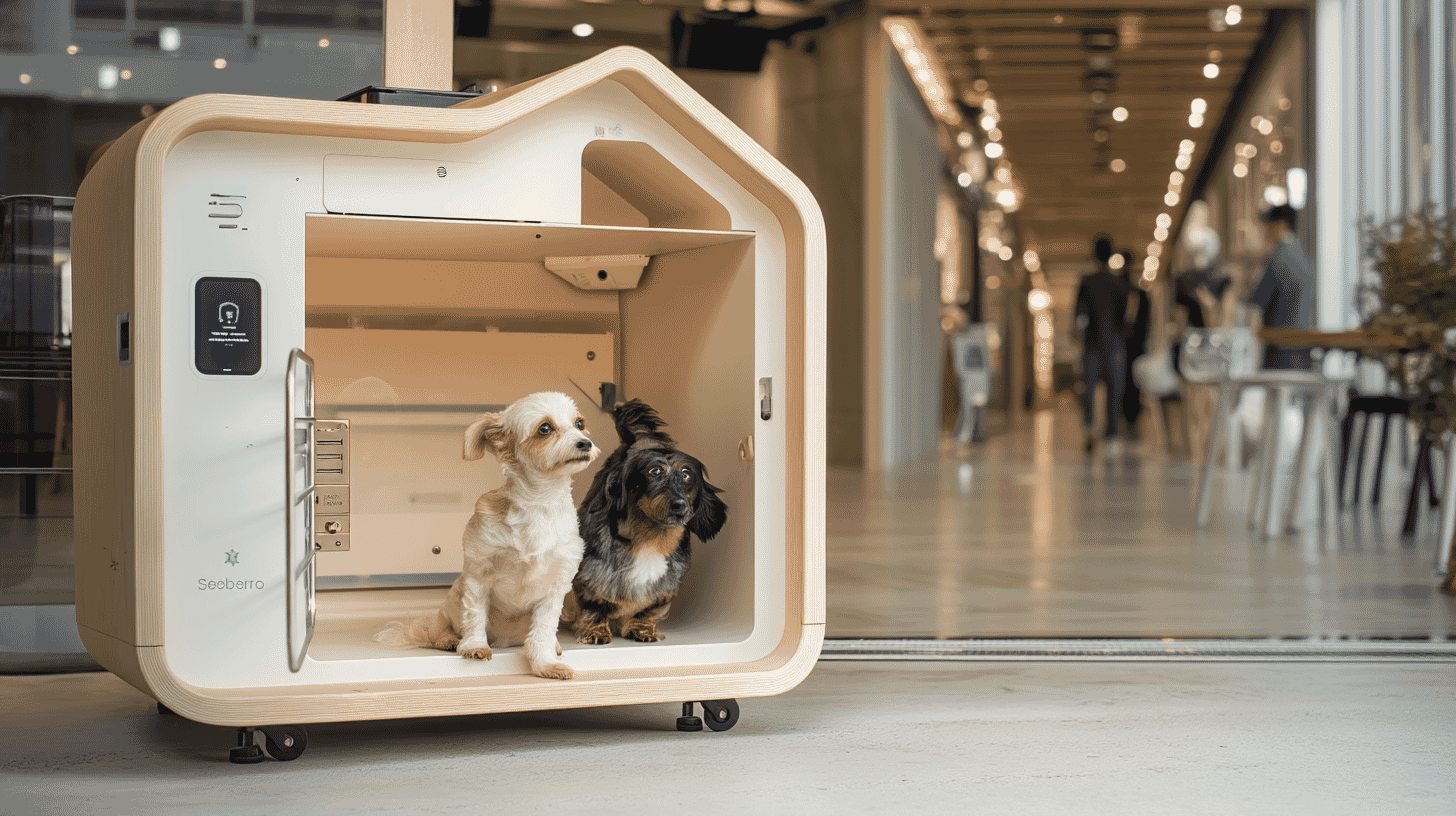
In Japan you can't bring your dog into most cafes, restaurants or stores. But you can park them: a climate-controlled smart pod with a smart lock, monitoring camera and calming music, for ¥30 a minute (about $0.19). It's called WanPod, and 30 of them are rolling out across facilities around Tokyo from summer 2026. The trial data suggests it might solve a very specific Japanese problem.
The Japanese Pet Paradox
A strange contradiction defines pet life in Japan: pets are increasingly treated as full family members, yet you can take them almost nowhere.
The numbers tell the story. Private forecasts put Japan's pet-related market at roughly ¥1.86 trillion (about $12 billion) in fiscal 2026, and the country keeps more dogs and cats (roughly 15.9 million combined) than it has children under 15. Gotemba Premium Outlets, with its view of Mount Fuji, now has around 150 of its 290 brands accepting pets indoors, plus leash hooks, paw-washing stations and pet carts.
And yet cafes mostly say no. Restaurants generally say no. Supermarkets, department stores, cosmetics counters, fitting rooms: overwhelmingly off-limits. Even at the most pet-friendly malls, roughly half the stores still don't allow dogs inside.
The result is a friction every Japanese dog owner knows well. You go out together, you can do most things together, and then every 30 minutes something comes up that you can't. The toilet. The cafe with friends. The fitting room. The cosmetics counter that needs both hands. Lunch.
The Old Solution: Tying Up Outside
Until now the default answer has been the leash hook (リードフック, rīdo fukku), a metal ring bolted to the wall outside a store where you tie your dog while you go in. Many Japanese commercial facilities provide them, usually near entrances or rest areas.
The problems are obvious to anyone who has used one:
- Heat and cold exposure: Japanese summers regularly hit 35°C (95°F) with brutal humidity; winters bring biting wind. Tying a dog outside in either is genuinely dangerous.
- Stranger interactions: Curious passersby try to pet the dog, kids run up and startle them, the dog barks at someone afraid of dogs.
- Tangled leashes, escapes, theft: All real risks documented in news reports over the years.
- Stress on the dog: Watching strangers walk past while waiting for an owner is not a peaceful experience.
- Stress on dog-averse passersby: A barking unattended dog at a mall entrance creates discomfort for the meaningful share of Japanese shoppers who are uncomfortable around dogs.
The underlying problem is that the leash hook answers a 21st-century need with 1970s hardware.
Enter the Smart Dog Pod
WanPod is a sharing service for compact, climate-controlled private suites where dogs wait safely while their owners shop, eat or use the bathroom. You rent one for 30 to 90 minutes at a time, no longer.
What's inside the pod:
- Smart electronic lock controlled exclusively through the registered owner's smartphone app. No staff intervention needed; only you can open it.
- Air conditioning with remote temperature adjustment from the app, which matters given Japan's temperature extremes. The 2026 model lets each owner set a preferred temperature rather than relying on one central setting.
- Monitoring camera with audio: Watch your dog from anywhere in the mall, and as of the 2026 update hear them too, which matters for owners worried about distress sounds a camera would miss.
- Liquid-crystal privacy curtain: An adjustable-transparency window, dimmable from the app. Useful for shielding excitable dogs from stimulation, and for reducing the strain on dog-averse passersby.
- Calming music player: Designed specifically to reduce separation stress during alone time.
- Environmental sensors: Continuously monitor temperature, humidity, and other conditions inside the pod.
Pricing is ¥30 per minute (about $0.19) with a 90-minute maximum, and the first 30 minutes are free as a familiarization run. The service is aimed at owners of small and medium-sized dogs. It is membership-only, with mandatory identity verification and penalty fees for misuse.
The positioning is deliberately narrow: a 30-minute to one-hour solution, not a pet hotel and not a daycare. It fills the specific gap of "I need somewhere safe for my dog right now."
What the Trial Data Actually Showed
A year-long trial across eight commercial facilities in the greater Tokyo area, running from November 2024 through October 2025, produced striking numbers:
- 1,014 total uses
- 0 accidents
- 0 cleanliness violations
- 89% customer satisfaction
- 91% intent to use again
- Average use duration: about 50 minutes
The zero-accident, zero-cleanliness-violation numbers are the most telling. Asahi Kasei Homes credits the combination of mandatory identity verification, membership-only access and penalty fees for producing unusually high user discipline. More than 90% of dogs stayed calm through the wait.
But the data that's making facility operators pay attention is the retail impact:
- 80% of users said their facility stays became longer (average extension: 76 minutes)
- 98% of users engaged in shopping during the rental, spending an average of ¥9,239 (~$59) per session
- 1 in 4 users said they would have left the facility entirely if the pod hadn't been available
A safe place to park your dog increases dwell time and per-visit spending. That is not a feel-good outcome but a hard-cash retail metric, and it is why malls and outlets are suddenly interested.
Three sets of interests, satisfied at once
WanPod's real innovation isn't the hardware. It's the alignment of three things that couldn't previously be solved together.
For owners: A way to take part in normal commercial life, lunch and fitting rooms and cosmetics counters, without leaving the dog at home or accepting the leash-hook risks. The app lets owners actually monitor rather than hope, and intervene if needed.
For dogs: A climate-controlled, quiet, private space instead of hot pavement, cold wind or the foot traffic of a public entryway. Calming music and adjustable privacy cut the stress factors that make leash-hook waiting hard on animals.
For everyone else: The pod removes the sight and sound of an unattended dog from common areas. Shoppers who are afraid of dogs, or simply uncomfortable around them, have always been a quietly underserved group in pet-friendly facility design.
That last point is where WanPod feels distinctly Japanese. Asahi Kasei Homes doesn't say "pet-friendly." It says "pet coexistence society" (ペット共生社会, petto kyōsei shakai), a phrase that explicitly includes people who would rather not encounter a dog. The curtain that goes opaque on demand is a small example of design that puts non-owners' comfort on equal footing with owners' convenience.
What's coming this summer
Thirty units will go into commercial and tourism facilities within a two-hour radius of Tokyo for a one-year trial, building on partnerships with Mitsubishi Estate Simon, which runs Gotemba Premium Outlets, and Aeon Pet, Japan's largest pet retail chain.
The first piece is already live. On July 1, 2026, a WanPod went into EXPASA Ashigara on the inbound Tomei Expressway, the first installation at a Japanese highway service area, run jointly with Chunichi Excis. That one is free for up to 60 minutes as a public-benefit trial. Given how many hot-car incidents happen at service areas each summer, the use case is easy to read.
The expansion model is interesting in itself. The facility provides floor space; installation, operations, customer service and app management all sit with Asahi Kasei Homes. For a mall owner it is effectively a free amenity that demonstrably lifts spending, which is a hard offer to refuse. Recruitment of additional sites is still open.
What's Still Unresolved
WanPod isn't without legitimate concerns.
Separation anxiety: Dogs with serious attachment issues are not suitable users. A camera lets owners see distress; it doesn't let them reach the dog fast enough if real panic sets in. Assessing your own dog's temperament honestly comes first.
Pricing: At ¥30 per minute an hour costs ¥1,800 (about $11.50). Cheaper than a daycare drop-off, expensive for a bathroom break. The free first 30 minutes offsets some of it, but repeat use adds up.
Edge cases: How does the system behave during a power outage? An AC failure on a hot day? A fire alarm? Those details aren't in the public materials, and they matter.
Scale: Thirty units spread across greater Tokyo's commercial real estate is still a pilot. Infrastructure would need an order of magnitude more.
The deeper question: Some argue the right answer to "dogs can't enter shops" isn't a better waiting box but changing the no-dogs rules, as much of Europe has. WanPod is a technical workaround for a social-norms problem, not a fix for the restriction itself.
Still, a workaround that makes dogs safer, owners calmer and facilities more profitable is a step forward on its own terms.
What's It Like in Your Country?
The picture varies dramatically. Dogs under tables in Parisian cafes. Dogs riding the Berlin U-Bahn. Dogs nowhere near American shopping malls, with hot-car warnings every summer. Dogs as luxury accessories in some places, working partners in others, and not-quite-accepted family members elsewhere.
A climate-controlled, app-locked pod inside a Japanese mall, billed by the minute, with an 89% satisfaction rate and zero accidents on record. Hospitality engineering at its finest, or pet care over-engineered to a parodic extreme?
How do dog-owning shoppers manage where you live? And honestly, would you use a WanPod if one appeared at your local mall this weekend?
References
- https://www.asahi-kasei.co.jp/j-koho/press/20260417/index/
- https://www.asahi-kasei.co.jp/j-koho/press/20240304/index/
- https://www.asahi-kasei.co.jp/j-koho/press/20241015/index/
- https://www.asahi-kasei.co.jp/j-koho/press/20260618/index/
- https://wanpod.jp/
- https://www.statista.com/topics/8280/pet-industry-in-japan/




Global Discussion
14 comments