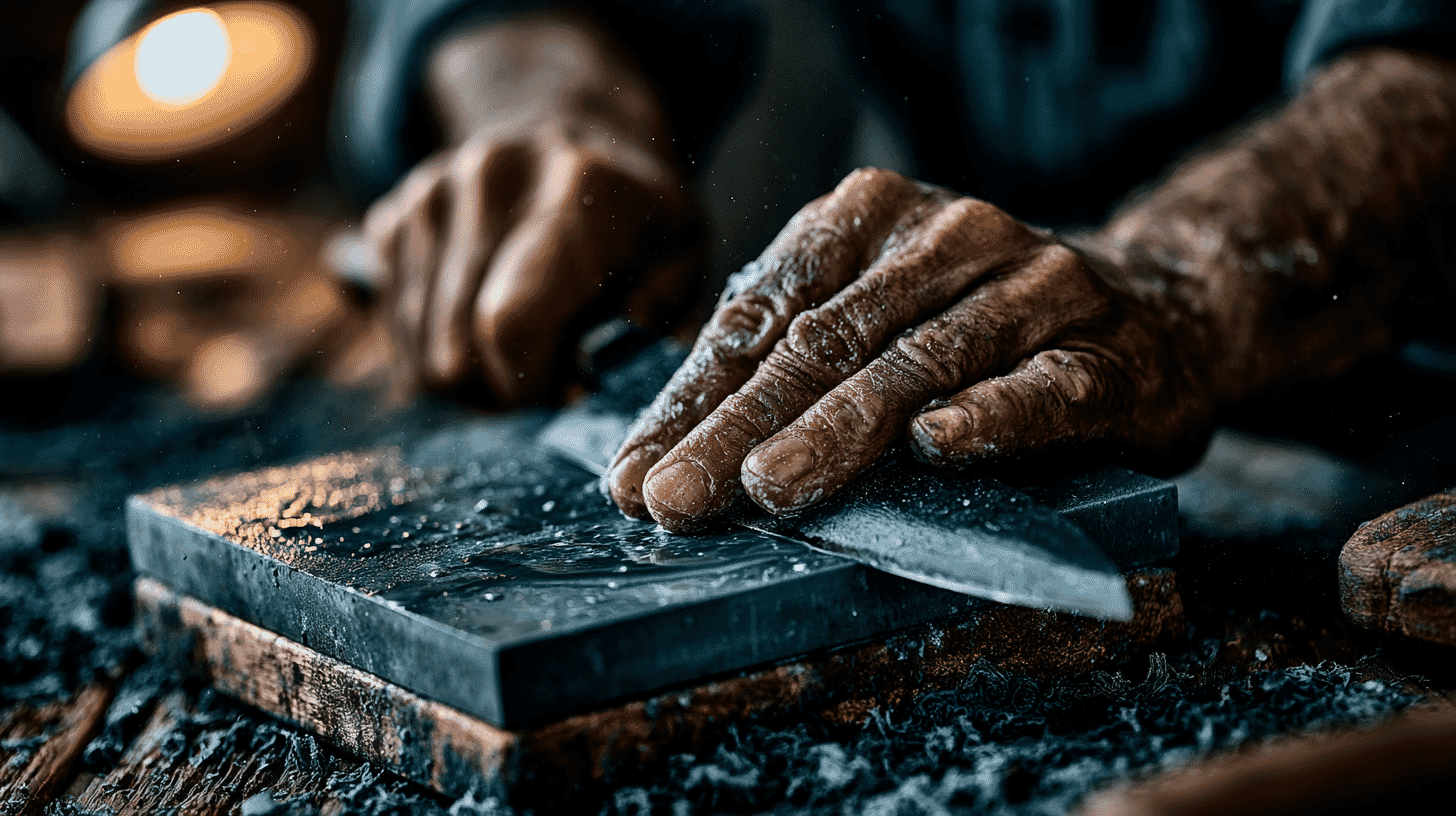
🔪 Tourists are flying home with Japanese knives wedged into their suitcases, and the people who make them are posting their best numbers ever. But there's a layer of this world that no amount of cash and no tourist itinerary can reach: a place where some of the planet's best chefs put their name on a list and wait years for a single blade. Here are three names that command that wait.
Record profits, and the world behind them
Walk into Tower Knives in Osaka or Tokyo and you'll hear it straight from the man at the counter. Björn Heiberg, who runs the specialist shop, says he does almost no overseas advertising. Foreign visitors simply try a blade in the store, feel the difference, and walk out with one.
The accountants agree. Tokyo Shoko Research looked at 38 kitchen-knife makers it could track over five straight years and found that in the most recent fiscal year (September 2024 to August 2025) their combined sales hit ¥16.733 billion, about $105 million at 160 yen to the dollar, up 2.5 percent, while profit came to ¥623 million, up 44.5 percent. Both were all-time highs. The survey was published in March 2026. The firm's Yudai Kobayashi credits pandemic home-cooking, Japan's hometown-tax gift programs, and exports riding the global wave of Japanese food.
For most tourists the gateway is a santoku: a double-edged, do-it-all blade that, as Heiberg points out, handles nearly every job in a home kitchen on its own. So why the fuss? Japanese knives often use high-carbon steel, the same lineage as the Japanese sword. A pure-steel honyaki blade takes a terrifyingly fine edge, but drop it or force it against a bone and it can chip like glass. European knives lean on softer steel, around 0.3 to 0.5 percent carbon, that shrugs off rough handling. Heiberg says some first-timers treat a knife as something you bang down hard; when that happens he tells them plainly this blade isn't for them. Show them the right motion, though, and they're stunned at how little force it takes.
(Getting one home is usually no drama, checked luggage and packed snugly, though rules shift by country. In China, Heiberg notes, a knife that sailed through the airport can still be stopped at a later subway or bus inspection.)
Money won't move you to the front of the line
Here's the part the buying spree never shows you. Above the racks of beautiful production knives sits a smaller, quieter world where the bottleneck isn't price. It's a single maker's two hands and the number of hours in a day. The clients are often professional chefs, and the only accepted currency is patience.
One myth to retire first: there is no "Living National Treasure" for kitchen knives. Japan's highest craft honor in the world of blades goes to swordsmiths, not to the people who forge what you cook with. Kitchen-knife artisans sit in an entirely different system of recognition, and the real prestige here was never a government title anyway. It's the length of the waiting list.
Three names, three corners of the country.
The sharpener of Saga: "Don't grind it away"
In a workshop in Miyaki, Saga, Katsumi Sakashita, now in his early 80s, has spent more than half a century at a whetstone. He's self-taught, and he does the whole job himself: setting the edge, sharpening, fitting the handle. NHK built a documentary episode around him. By the account in his own book the reservation list runs into the hundreds, and profiles of his work describe a roughly two-year wait just to have a blade sharpened. Michelin-starred chefs mail him their knives and get in line.
His philosophy lands like a riddle: don't sharpen, don't wear it down. The point is restraint. Most people grind away far too much metal; Sakashita reads the tiny nicks along an edge the way you'd read handwriting, learning the owner's habits, then shapes a faint hollow he calls an "air passage" so food releases cleanly off the blade. A knife, he likes to say, is a circle, and a great edge is mostly about doing less, which turns out to be the one thing almost nobody has the patience for.
A single blade from Tsukiji: the knife chefs raise
In Tokyo's Tsukiji, the atelier known as Nenohi makes each knife by hand for professional kitchens at home and abroad. A custom order takes anywhere from six months to two years. There's almost no ornament; what looks like styling is really function: the balance, the way the spine meets the hand, how cleanly the food falls away. The workshop's mottos translate roughly as "one craft, one step forward" and "for Nenohi, there is no finished," a flat refusal to ever call a blade the last word. A chef doesn't just buy a Nenohi. Across years of use, re-grinding, and rehandling, they raise one.
The three-year wait in Echizen
Out in Echizen, Fukui, Yu Kurosaki (born 1979) trained for twelve years under another smith before striking out on his own. He's a certified traditional craftsman, and abroad his blades go by a single phrase: Kurosaki Knives. A 2025 profile put his order book at around 10,000 knives, with deliveries stretching as long as three years. His customers run washoku, French, and Spanish kitchens across North America and Europe. His signature is the tsuchime, a hammered, dimpled finish that's both instantly recognizable and quietly useful, since the texture keeps food from clinging to the steel. A single Kurosaki runs into the tens of thousands of yen, a few hundred dollars, assuming you're content to wait out the calendar.
So why wait at all?
Here's the honest part. A santoku from a good shop will out-cut almost anyone's technique; you do not need a three-year blade to get dinner on the table. So what are these chefs actually buying with their patience?
Some of it is real: edge geometry and balance that genuinely change how a fish, or a tomato, comes apart under the hand. Some of it is the relationship: a maker who will reshape that exact knife to that exact grip for the next thirty years. And some of it is just the fact that a few things can't be rushed, whatever your budget. In a world wired for next-day everything, a line you can only reach by waiting becomes its own strange luxury.
In Japan, the front of this particular line isn't for sale. Is there something like it where you live? A maker, a craft, a name where money alone won't bump you up, and the only way in is to wait your turn?

Global Discussion
4 comments