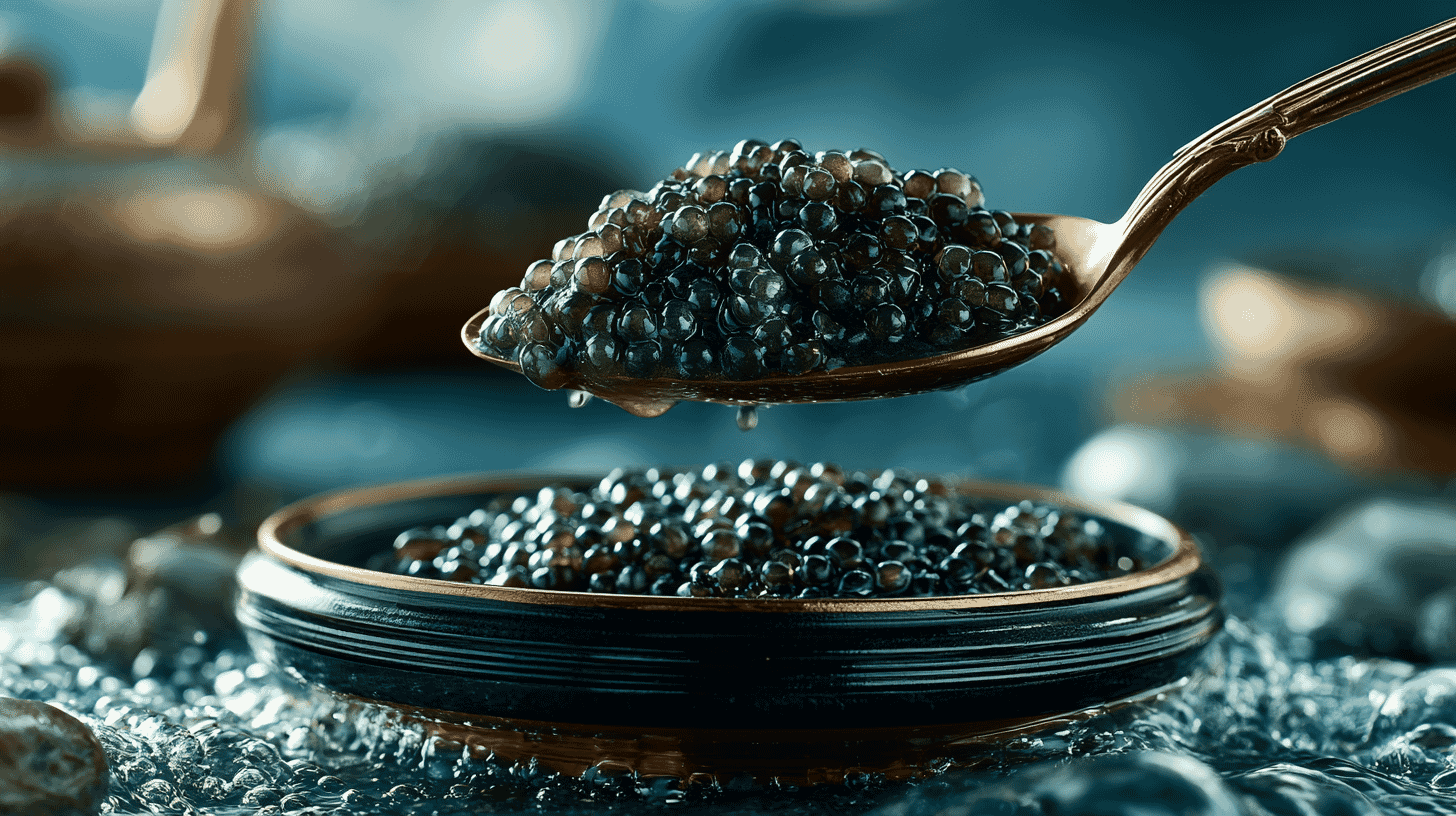
🥄 The world's most prestigious caviar has historically come from one sea. Japan does not border that sea, has never bordered that sea, and never will. And yet a small company in a landlocked Japanese prefecture is now openly chasing the title of "world's best caviar." And the strange thing is, the rules of the game have shifted just enough that this isn't absurd anymore.
For most of the last century, asking "where does the best caviar come from?" had a single answer: the Caspian Sea. Russia and Iran built the entire mythology of the food around that body of water, around wild sturgeon that took 15 to 25 years to mature, around a luxury culture that priced a single tin of beluga roe at thousands of dollars. Geography was destiny. If you weren't on the Caspian, you weren't in the conversation.
That sentence is no longer true in 2026. And the reason it's no longer true is what makes the Japanese story interesting.
How "best caviar" stopped meaning "Caspian caviar"
The shift began in 2006, when CITES, the international treaty governing trade in endangered species, sharply tightened restrictions on wild sturgeon harvesting after decades of overfishing collapsed Caspian stocks. Russia, Iran, and other Caspian states saw their exports curtailed, and a window opened for countries with the patience and capital to farm sturgeon instead of catching them.
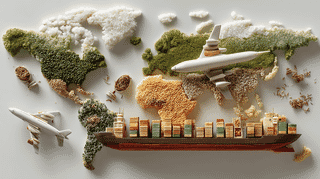
China walked through that window faster than anyone expected. Today China accounts for over 60% of the world's farmed caviar production, with companies like Kaluga Queen producing hundreds of tons annually. By 2024 trade data, China ($98.1 million), Italy ($21.9 million) and France ($21.4 million) were the world's top caviar exporters, none of them historically associated with the food at all.
Two more things accelerated the geographic reshuffle. First, CITES rules pushed the market overwhelmingly toward farmed product, which by 2025 accounted for 92.82% of total caviar volume worldwide. Wild Caspian beluga, the textbook definition of luxury, became a vanishingly small slice of what people actually eat. Second, Russia's invasion of Ukraine in 2022 triggered import bans: the UK explicitly banned Russian caviar imports under sanctions in 2022, and the US moved against Russian luxury imports including caviar the same year. The brand "Russian caviar" survives in marketing copy, but actual Russian product has largely vanished from Western shelves.
What replaced it is something new. In 2026, the trade press talks about "precision farming": closed-loop recirculating aquaculture systems (RAS) where producers regulate water temperature, oxygen levels, and mineral balance with laboratory precision, producing consistent roe with predictable salinity and firm membranes. Italy, France, and California are leading this shift, and chefs increasingly prefer farmed caviar over wild because it offers better consistency and cleaner flavor. The prestige has migrated from the body of water to the engineering.
This is the crack Japan is now stepping into.
Japan's quiet 40-year setup
Japan's caviar story is older than most people realize. It started in 1983, when Miyazaki Prefecture quietly imported bester sturgeon from the Soviet Union and began experimental breeding at its fisheries research station. The research took three decades. By 2004 the team had achieved closed-cycle farming of the white sturgeon; by 2013, after thirty years of work, the first product hit the market under the name Miyazaki Caviar 1983.
It is not a small operation. Miyazaki Caviar 1983 has been served on ANA international first-class flights for four consecutive years, used at the 2016 G7 Ise-Shima Summit's official dinner, and exported since 2017 to restaurants in New York, Las Vegas, and Hong Kong. The signature product uses freshly harvested eggs cured only with rock salt and aged using a Japanese take on European maturation methods. Judged by French Michelin-trained chefs, the result was deemed competitive on flavor, aroma, and finish.
But Miyazaki was always playing the European game on European terms: traditional curing, mimicry of Caspian aging techniques, brand-building through luxury hospitality. The new challenger coming out of Nagano is trying to play a different game entirely.
A landlocked prefecture, a patented system, and a black-stone spring
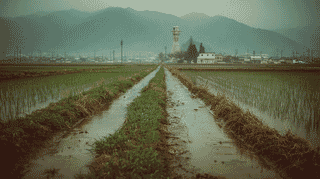
The challenger is Shinshu Spring Farm, based in Nagawa, a small town in Nagano Prefecture, a region with no coastline, no fishing tradition, and no obvious reason to be raising sturgeon. The company released its "Kuroyou Shinshu Caviar" in 2026, branding it around two pillars: a patented closed-loop aquaculture system called POSC-RAS, and a rare local spring water called Kuroyousui.
The technology piece is the more globally interesting half. POSC-RAS is an internationally patented recirculating aquaculture system developed by Acing Inc., another company based in Nagano's Okaya City. The system uses ozone-based water control to suppress viruses and harmful bacteria, allowing producers to raise water temperatures safely and speed up sturgeon growth by an estimated 1.5 to 2 times the conventional rate. In the most vulnerable juvenile stage (sturgeon between 5 and 30 centimeters), POSC-RAS reportedly cut the death rate to about one-third of the conventional level.
The water piece is the more local, almost romantic half. Kuroyousui, "obsidian water," is the underground spring that wells up around the Wada Pass in Nagawa, a region historically known as a source of obsidian. The water filters through ancient obsidian-rich strata over long periods, emerging with a hardness rating of 17 (effectively ultra-soft, near-distilled purity) and almost no organic content. About three tonnes of it flows out of the ground every minute on the farm site.
What Shinshu Spring Farm did was put these two things in series rather than parallel. Young sturgeon are raised in the POSC-RAS closed-loop system, where every variable is engineered. Then, before harvest, the fish are moved to flow-through tanks fed by the obsidian spring, and held there long enough for the ultra-pure water to flush out the muddy, earthy off-flavors that haunt freshwater fish farming. They call it a "hybrid land-based aquaculture" model: digital control for survival, natural water for taste.
The roe is then finished without pasteurization, a French-style fresh-caviar preparation that preserves the egg's natural texture but demands cold-chain rigor end to end.
What Japan is actually selling, and to whom
If this looks like just another national caviar brand, look at what Shinshu Spring Farm announced in its May 6, 2026 release alongside the product, with both agreements dated April 20: a regular distribution agreement to sell the POSC-RAS system itself, plus consulting contracts to help other fish farmers adopt it.
That detail reframes the whole story. Shinshu Spring Farm is not just trying to sell expensive fish eggs from a mountain village. It's trying to make Japan-developed aquaculture engineering, the same kind of precision-farming infrastructure that built China's caviar dominance and Europe's premium tier, into an export product.
In a world where "the geography of prestige caviar has expanded" and where Italy, France, China, and the United States are all producing world-class caviar under controlled conditions, this isn't a crazy bet. It's an obvious extension of how the industry actually works now. The competition isn't really about which country touches the Caspian. It's about who can reliably build sturgeon factories that produce roe of a quality and consistency that Michelin chefs will pay for.
How the Japanese approach differs from the others
The three established schools of premium caviar production each have their own pitch.
China optimized for scale and price. Hubei Province has the climate, the labor, and the state-backed capital to flood the world market with farmed roe, and the export numbers reflect it. Chinese producers are getting better year by year and increasingly compete on quality, not just price.
Italy and France leaned on heritage branding. Houses like Calvisius, Petrossian, and Maison Kaviari trade on European luxury culture and Caspian-style aging methods, selling caviar as an extension of fine-dining tradition rather than as a manufactured commodity.
Japan, as Shinshu Spring Farm is positioning it, is trying to combine three things: precision-farming engineering on the Chinese-European technical level, craft finishing in the Japanese tradition (low-salt, ingredient-first, minimal processing), and a Made-in-Japan luxury food brand that's already been validated globally by wagyu beef, premium sake, and Edomae sushi. The marketing pitch, "the obsidian water removes the muddy taste, leaving only the clean essence of the egg", is recognizable as the same approach that produces Japanese single-origin teas and lightly-cured sashimi.
The closest analogy is probably wagyu beef in the 2000s: a niche, technically rigorous, geographically improbable Japanese version of a food the world thought it already understood, eventually pried open premium menus globally.
The hard parts nobody can engineer around
The challenges are real and not all of them yield to technology.
The first is biology. Sturgeon take seven to ten years to mature enough to produce viable roe, and only the females do. Industry analysts note that "the slow growth cycle of sturgeon limits supply speed and cannot fully meet rapidly growing global demand." POSC-RAS reportedly accelerates growth in the juvenile stage, but the fundamental clock (egg, fingerling, mature female, viable roe) is still measured in years, not months.
The second is sex ratios. When Kindai University announced the world's first full-cycle farming of blackthroat seaperch in February 2026, it also reported that more than 90% of the hatchery-raised fish came out male. Sturgeon aquaculture runs into the same wall: male fish don't produce eggs. Several global producers have invested heavily in early sex determination and in selective breeding for female-skewed populations. Whether Shinshu Spring Farm or its peers can solve this efficiently will determine the unit cost of Japanese caviar.
The third is brand. Miyazaki Caviar 1983 has spent over a decade building international recognition through summit dinners and first-class flight menus. A new entrant from Nagano is starting that climb from below. In a category where prestige is half the product, getting onto the right tasting menus in New York, Paris, and Dubai is its own multi-year project.
And the fourth is the ghost in the corner of every aquaculture story: cost. Recirculating systems are capital-intensive. Premium caviar farms in Italy and California have been at this for decades and still struggle with profitability. Whether the POSC-RAS / Kuroyousui hybrid model can deliver something genuinely better at a price the market will accept is the open question for the next several years.
Why this is worth watching
The interesting thing about Japan's bid isn't whether Shinshu Spring Farm specifically wins. It's that the bid is even possible.
A landlocked Japanese prefecture entering a global luxury food market historically defined by a specific sea two thousand kilometers away is the kind of thing that only happens when the underlying economics of an industry have already changed. Aquaculture is one of those quiet revolutions, like solar panels in the 2010s, that suddenly makes regional advantages obsolete. The question stops being "where is the resource?" and becomes "who has the engineering?"
Japan has been quietly accumulating that engineering for forty years, first through Miyazaki's patient breeding research, now through Nagano's hybrid system. Whether or not "made in Japan" ends up at the top of caviar menus, the technology that gets developed along the way will probably end up exported, licensed, and copied across Asia, the Middle East, and parts of the Americas, much as Japanese rice-cooker technology and shochu distillation methods quietly traveled in earlier decades.
There's still no Caspian Sea in Japan. There almost certainly never will be. The bet Shinshu Spring Farm is making is that it doesn't matter anymore.
What about your country?
Does your country produce its own premium caviar, or is it still firmly imported? And when you imagine "the best caviar in the world," do you still picture Russia and Iran, or has that mental image already started to shift somewhere else?
References
- https://prtimes.jp/main/html/rd/p/000000002.000181016.html
- https://www.japancaviar.jp/
- https://caviarguide.com/caviar-trends-2026/
- https://caviarskazka.com/a/blog/caviar-by-the-numbers-statistics-about-the-global-industry
- https://equalocean.com/analysis/2024110821180
- https://www.kindai.ac.jp/news-pr/news-release/2026/02/049322.html
- https://springfarm.jp/




Global Discussion
5 comments