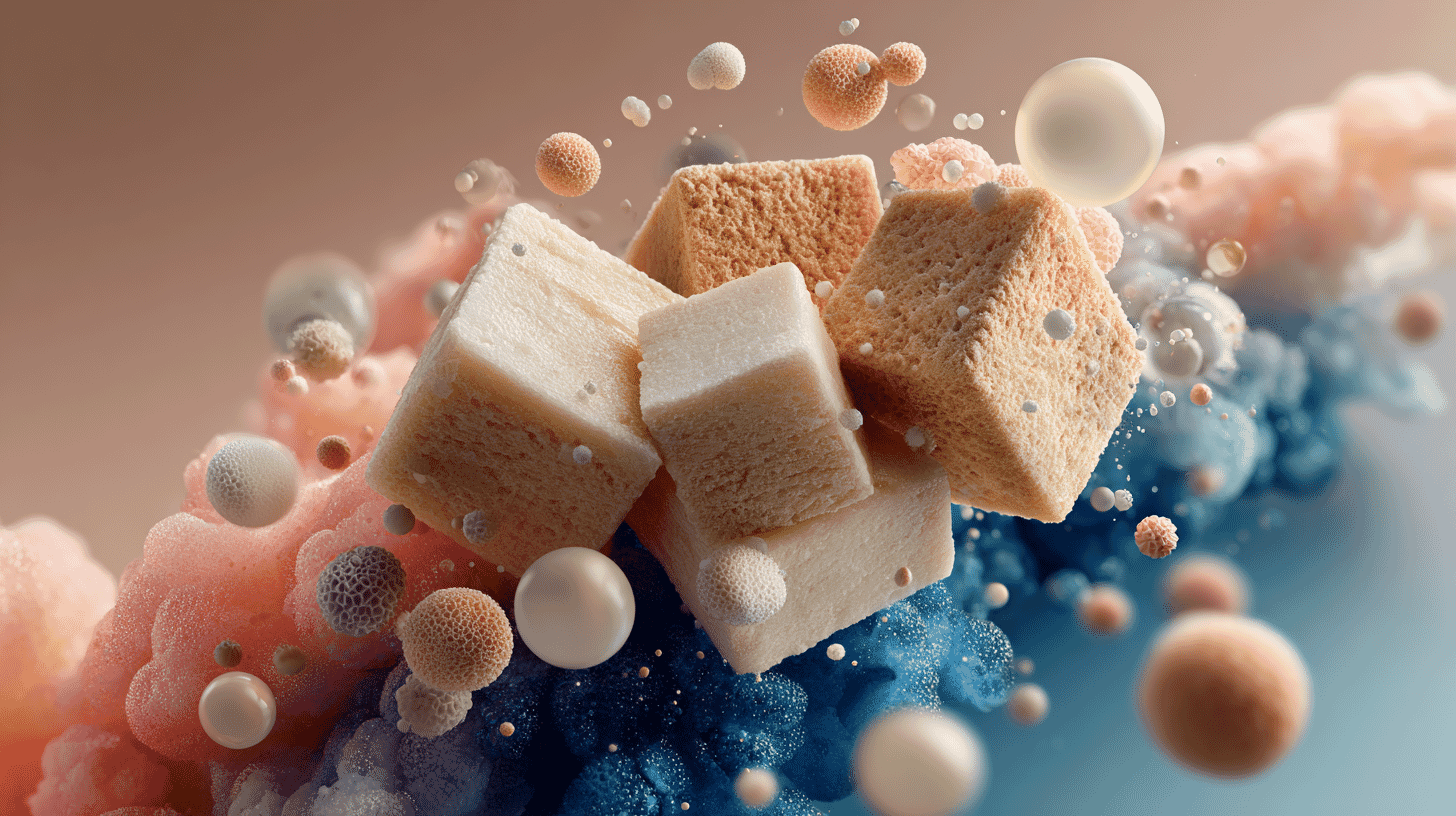
A joint study by Shinshu University and Asahimatsu Foods suggests that koya-dofu, almost all of which is made in Nagano Prefecture, may curb obesity and fatty liver. The results, though, come from mice. Here is the mechanism the team identified, in which koya-dofu protein works through gut bacteria to raise GLP-1, and the distance that remains before it applies to people.
Groundbreaking Research from Shinshu University Reveals New Health Benefits
In January 2026, a joint research project between Shinshu University School of Medicine and Asahimatsu Foods Corporation revealed that koya-dofu (freeze-dried tofu), a traditional Japanese preserved food, may help prevent obesity and fatty liver disease. The findings, published in the prestigious International Journal of Biological Macromolecules, have attracted significant attention from health-conscious consumers worldwide.
What is Koya-dofu? An 800-Year-Old Japanese Superfood
Koya-dofu is a preserved food made by freezing tofu, allowing it to mature at low temperatures for approximately three weeks, and then drying it. Its origins date back to Japan's Kamakura period (1185-1333), where it is said to have been accidentally discovered by monks at Mount Koya who used the winter cold to preserve their food.
Also known as "kori-dofu" (frozen tofu) or "shimi-dofu" (frost tofu), this traditional ingredient is particularly associated with Nagano Prefecture, which according to Shinshu University and Asahimatsu Foods accounts for close to 100% of domestic production. In its dried state, koya-dofu has a firm, sponge-like texture. When rehydrated in water or dashi broth, it becomes soft and can be used in various dishes, from simmered preparations to salads. Its long shelf life, it can be stored at room temperature for over six months, has made it a valuable emergency food throughout Japanese history.
Research Overview: The Connection Between Resistant Protein and the "Slim Hormone" GLP-1
Research Team and Duration
The work was carried out by Professor Naoki Tanaka's team at Shinshu University School of Medicine and the Graduate School of Medicine, Science and Technology, together with Takahiro Ishiguro, head of the research laboratory at Asahimatsu Foods Corporation, headquartered in Iida City, Nagano Prefecture. The joint research began in 2020.
Experimental Methods and Results
The research team conducted a 16-week experiment using mice, feeding them four different diets:
- Standard diet
- High-fat diet
- High-fat diet supplemented with koya-dofu protein
- High-fat diet supplemented with resistant protein
The results showed that mice fed a high-fat diet gained an average of 10 grams more weight compared to those on a standard diet. However, mice given high-fat diets supplemented with koya-dofu protein or resistant protein showed weight gain limited to approximately 6 grams.
The degree of fatty liver was reduced as well. All of these results are in mice; whether the same happens in people has not been tested. The university's own announcement describes it as a possibility.
The team also traced the mechanism. Eating koya-dofu-derived protein prompts gut bacteria to increase azelaic acid in the intestine, which raises production of glucagon-like peptide-1 (GLP-1) in the ileum. The GLP-1 then reaches adipose tissue and the liver and promotes fat burning. Separately, the resistant protein itself appears to bind lipids in the gut and carry them out of the body.
What is GLP-1?
GLP-1 is a hormone secreted by the small intestine, often called the "slim hormone" or "satiety hormone." It helps lower blood sugar and promotes fat breakdown, which is why it underpins a class of diabetes drugs. Wegovy, a GLP-1 receptor agonist approved for obesity, was added to Japan's national price list in November 2023 and launched there in February 2024.
The finding here is that an everyday food may act on the same pathway.
The Remarkable Health Benefits of Resistant Protein
What is Resistant Protein?
Resistant protein refers to "indigestible protein" that, unlike regular protein, is difficult to digest in the stomach and small intestine. Approximately 30% of koya-dofu's protein content consists of resistant protein, with a remarkably high concentration of 10-25 grams per 100 grams of koya-dofu.
Why Koya-dofu Contains More Resistant Protein
The manufacturing process of koya-dofu naturally increases its resistant protein content. During the compression and freezing stages, protein bonds become stronger. Furthermore, the extended maturation period of approximately three weeks at around minus 2°C allows ice crystals to grow, forming even more resistant protein.
Expected Health Benefits
Resistant protein has previously been linked to blunted post-meal blood sugar rises, lower LDL cholesterol and triglycerides, and a better gut environment. Small studies had already suggested koya-dofu lowers post-meal glucose and blood lipids, but its metabolic effects and the mechanism behind them were unknown. This study fills that gap.
No adverse effects on the stomach, kidneys, or heart were observed in the experiment.
Why the World is Now Focusing on Traditional Japanese Foods
One clarification is worth making: koya-dofu is not itself a fermented food. It is preserved by freezing and drying. But the mechanism described here runs through gut bacteria, which is the same reason miso and natto have drawn attention.
Global Expansion of the Fermented Foods Market
The global fermented foods market is expanding rapidly, projected to reach approximately $258 billion in 2025 and $378 billion by 2032. The average annual growth rate stands at about 5.6%, with the Asia-Pacific region accounting for approximately 49% of the market.
The Gut Health Movement and Interest in Probiotics
As global health consciousness rises, interest in "gut health" and "probiotics" has spread rapidly. In China, approximately 48% of consumers cite probiotics as the number one ingredient for gut health. The digestive benefits and immune-boosting effects of fermented foods are highly valued worldwide.
Japanese Fermented Foods Going Global
Traditional Japanese fermented foods such as miso, natto, soy sauce, and koji are rapidly gaining recognition overseas. Miso, in particular, has seen 21% of new product launches in Europe, 16% in broader Asia (outside Japan), and 11% in North America, indicating significant global expansion.
The reasons cited come down to five: gut environment improvement through probiotics, distinctive umami flavour, a strong plant-protein supply, low calorie and low sugar profiles, and a good fit with sustainable food production.
Global Recognition of Washoku
Washoku, registered as a UNESCO Intangible Cultural Heritage in 2013, is highly valued worldwide as a healthy food culture rich in fermented foods and dietary fiber. The washoku philosophy of balanced consumption of vegetables, fermented foods, and quality proteins perfectly aligns with modern health trends.
Future Developments and Possibilities for Koya-dofu
Deepening Research Through Medical-Agricultural-Industrial Collaboration
Professor Tanaka has expressed his desire to "add 'delicious' to 'healthy,'" showing enthusiasm for developing new food products such as hamburgers made with powdered koya-dofu. The "medical-agricultural-industrial collaboration" between Shinshu University's medical and agricultural faculties and Asahimatsu Foods is expected to accelerate research on koya-dofu's health benefits.
Application to Frailty Prevention
Ishiguro of Asahimatsu Foods has indicated plans to expand koya-dofu's health applications beyond obesity prevention. There is particular interest in addressing "frailty" in elderly populations, a weakened state characterized by decreased muscle strength and vitality, through koya-dofu's abundant protein content and gut health benefits.
A Secret to Japanese Longevity
Japan is one of the world's leading longevity nations, and traditional food culture has long been cited as one of the secrets. Research that spells out a mechanism, rather than repeating the association, gives that claim something concrete to stand on.
When Folk Knowledge Turns Into a Mechanism
The saying that koya-dofu is good for you has had 800 years to settle in Japan. What this research adds is a reason why. The caveat is equally plain: these were mice, and whether the same effect holds in humans is the next question.
Does your country have traditional foods that have been said to promote health since ancient times? We'd love to hear about your country's "superfoods" and traditional preserved foods!
References
- https://www.shinshu-u.ac.jp/zukan/cooperation/post-63.html
- https://newscast.jp/smart/news/8094373
- https://www.asahimatsu.co.jp/research-2.html
- https://www.shoku-do.jp/column/co_0167_kouyatofu/
- https://www.imarcgroup.com/japan-fermented-superfoods-market
- https://www.japanhousela.com/articles/japan-the-land-of-fermentation/








Global Discussion
14 comments