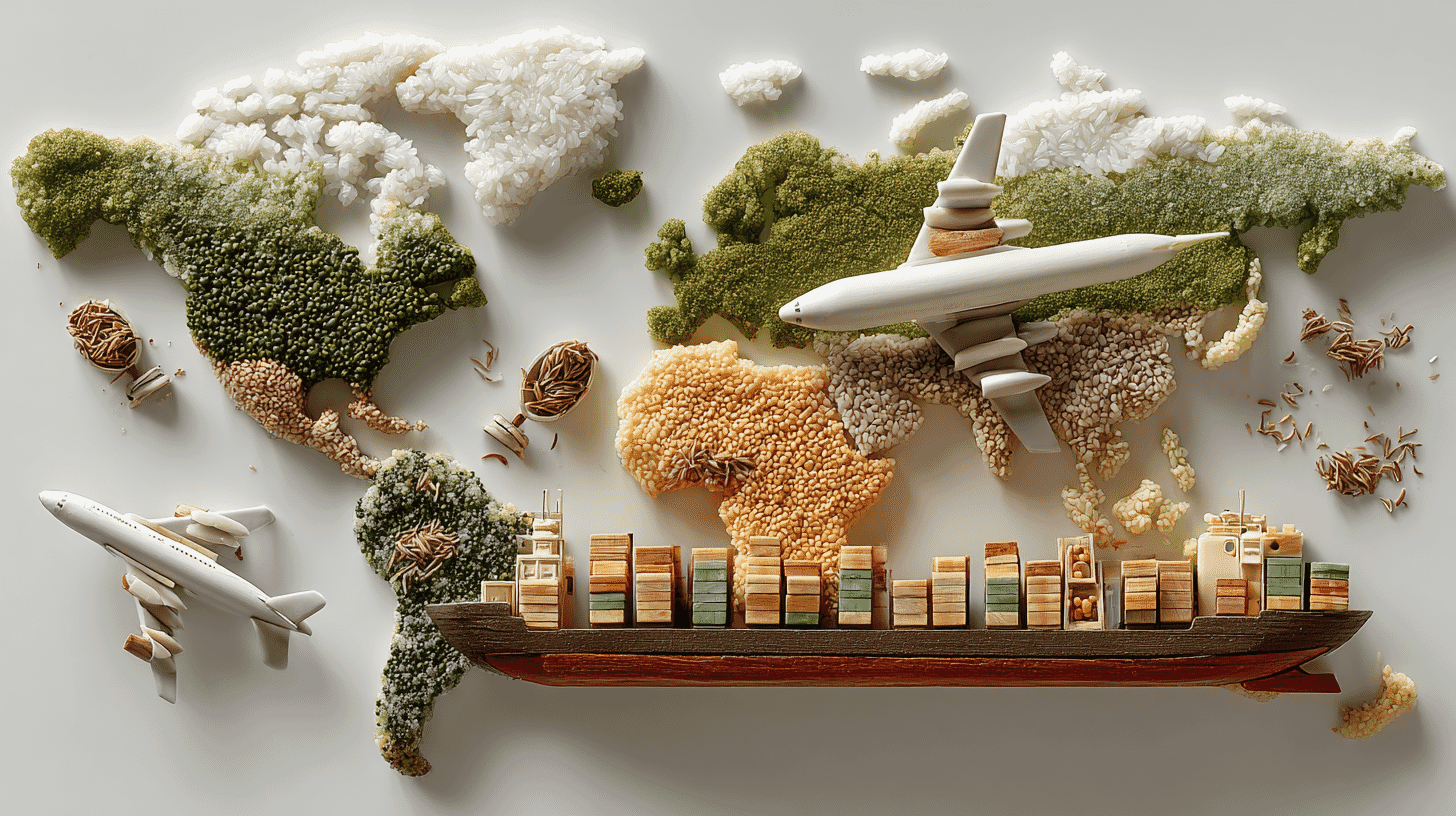
You've heard that Japanese food is taking over the world. But have you ever wondered how it actually gets there? Behind the record $11.3 billion in food exports, the $13 billion inbound food tourism market, and 181,000 Japanese restaurants worldwide sits a massive infrastructure of trade associations, startups, government agencies, and platforms working to connect Japan's kitchens to the world's tables.
20 Miso Makers Unite at Asia's Biggest Food Expo
In March 2026, FOODEX JAPAN, Asia's largest food and beverage trade show, drew over 3,238 exhibitors from 76+ countries and 70,000+ visitors to Tokyo Big Sight. For the first time ever, Japan's National Federation of Miso Industry Cooperatives (Zenmi) set up a unified industry booth with 20 miso manufacturers.
Why miso, and why now?
Miso exports hit a record ¥7.14 billion (approximately $47.5 million) in 2025, up 13.1% year-over-year. Export volume reached 23,825 tons, also an all-time high. To put that growth in perspective: in 1990, Japan exported just 2,800 tons. That's an 8.5x increase over 35 years.
The primary driver is the explosion of Japanese restaurants overseas. With approximately 181,000 Japanese restaurants now operating outside Japan, double the roughly 89,000 in 2015, demand for miso soup ingredients has surged automatically.
But miso's potential extends far beyond the soup bowl. Overseas, chefs and home cooks are using miso as a salad dressing base, a marinade for meat and fish, a secret ingredient in gratins, and even as a flavor enhancer in chocolate cake. In France's fine dining scene, "MISO" has quietly become an established umami weapon in the French kitchen.
Zenmi, designated as an official export promotion body by Japan's Ministry of Agriculture, Forestry and Fisheries (MAFF), sees the FOODEX debut as a springboard for export acceleration. The government's 2030 target for condiment exports (miso and soy sauce combined) is ¥92.6 billion, ambitious given current figures, but the industry's unprecedented unity signals serious intent.
The $13 Billion Pipeline: How Inbound Tourism Feeds Food Exports
One of the most underappreciated engines of Japan's food globalization is inbound food tourism.
According to the Japan Tourism Agency, foreign visitors spent approximately ¥9.5 trillion ($63 billion) in Japan in 2025. Of that, food and dining accounted for an estimated ¥2 trillion ($13.3 billion), over 20% of total spending. The average visitor spent roughly ¥49,000 ($325) on food alone during their trip.
Even more telling: when asked what they most looked forward to about visiting Japan, 84.9% of respondents said "eating Japanese food." Shopping (63.5%) and sightseeing (54.3%) trailed far behind. Food is the number one reason people come to Japan.
Preferences vary by nationality. Visitors from East Asia (China, Korea, Hong Kong, Taiwan) overwhelmingly favor meat dishes like yakiniku and sukiyaki. ASEAN visitors split between meat and ramen. Western visitors rank ramen first, with meat dishes close behind. Across all groups, teppanyaki (iron griddle cooking), ramen, and traditional Japanese cuisine consistently rank in the top three.
This creates a powerful feedback loop. A tourist who falls in love with ramen in Tokyo starts visiting Japanese restaurants at home, then buys miso and soy sauce at their local supermarket. JETRO's analysis explicitly cites "increased awareness of Japanese food through inbound tourism" as a major factor driving export growth.
Food tourism experiences, cooking classes, market tours, sake tastings, are growing rapidly too. These go beyond simple dining to teach visitors how Japanese food is made, building deeper connections that translate into long-term demand for Japanese ingredients.
An Onigiri Startup Takes Rice Diplomacy to Vietnam
Japan's food export infrastructure isn't just government agencies and trade associations. Startups are playing an increasingly important role.
In March 2026, at the 11th Japan-Vietnam Festival in Ho Chi Minh City, an event attracting over 430,000 visitors, Miyuki Kawarada, CEO of Rice Platformer, led an onigiri-making workshop organized by JFOODO (Japan Food Product Overseas Promotion Center).
Rice Platformer is a startup with the vision of making "onigiri a global fast-casual standard." The company opened its first shop, ONI&Co. Tokyo Lab., in Hatsudai, Tokyo in 2025. Kawarada also serves as an Onigiri Ambassador for the Japan Onigiri Association.
In Vietnam, workshop participants shaped onigiri using Japanese rice, a novel experience in a country where long-grain indica rice is the norm. Feedback included observations like "Japanese rice grains are shaped differently from Vietnamese rice and hold together well for making triangles" and "Japanese rice has a sweetness that Vietnamese rice doesn't."
Behind this initiative is MAFF's GOHAN Project, which positions onigiri as a strategic vehicle for Japanese rice exports. The logic is compelling: sushi requires specialized skills, ramen demands capital investment in equipment, but onigiri can be made by anyone with rice, salt, nori, and a filling. It's affordable, portable, and visually distinctive, the perfect gateway food.
With onigiri-making videos racking up hundreds of millions of views on TikTok and YouTube, awareness is surging. Startups like Rice Platformer bridge the gap between viral videos and real-world food experiences by bringing hands-on workshops to overseas markets.
Toyosu Shachu: Exporting the System, Not Just the Fish
Operating at an even larger scale is Toyosu Shachu, a company founded with the mission of "bringing Japan's delicious food to the world together."
Toyosu Shachu aims to build a platform for exporting Japanese food culture as an industry, not just individual products. Their 20-year vision targets expansion to 100 cities worldwide.
As a first step, they opened a sake experience facility in Asakusa, Tokyo in November 2024. Themed around "sake × inbound tourism × experience," it serves as a launchpad for introducing Japanese sake culture directly to international visitors.
This approach differs fundamentally from conventional food exports. Traditional exports ship goods, miso, soy sauce, fresh fish in containers bound for overseas markets. Toyosu Shachu aims to export the system itself: procurement networks, quality control know-how, the art of ingredient selection (known as mekiki), and food culture as a complete package.
This matters because of a striking reality: many of the approximately 181,000 Japanese restaurants abroad are operated by non-Japanese owners. Ensuring authentic quality requires exporting not just ingredients but the entire ecosystem of knowledge and standards that surrounds them.
The Invisible Infrastructure Shaping Japan's Food Future
Japan's food globalization isn't powered by the appeal of individual dishes alone. It runs on a multi-layered infrastructure: trade associations uniting at FOODEX, JFOODO and JETRO running overseas promotions, startups delivering hands-on experiences in local markets, and inbound tourism functioning as a massive on-ramp to Japanese food culture. Together, these systems support the ¥1.7 trillion export achievement and the government's ambitious ¥5 trillion target for 2030.
Twenty miso makers exhibiting together at FOODEX may sound like a small story. But it signals a fundamental shift, from individual company efforts to coordinated industry strategy. That shift, multiplied across dozens of food categories and thousands of organizations, is what's really driving Japan's food revolution worldwide.
What systems exist in your country to promote your food culture abroad? Do you have trade associations, government programs, or startups working to bring your local cuisine to the world stage? We'd love to hear your perspective.
References
- https://www.ssnp.co.jp/soy/662143/
- https://www.maff.go.jp/j/press/yusyutu_kokusai/kikaku/260203.html
- https://www.jetro.go.jp/agriportal/platform/
- https://gourmetpress.net/1423667/
- https://matcha-jp.com/jp/mcm14426
- https://prtimes.jp/main/html/rd/p/000000002.000169030.html
- https://foodex.jma.or.jp/about/







Global Discussion
15 comments