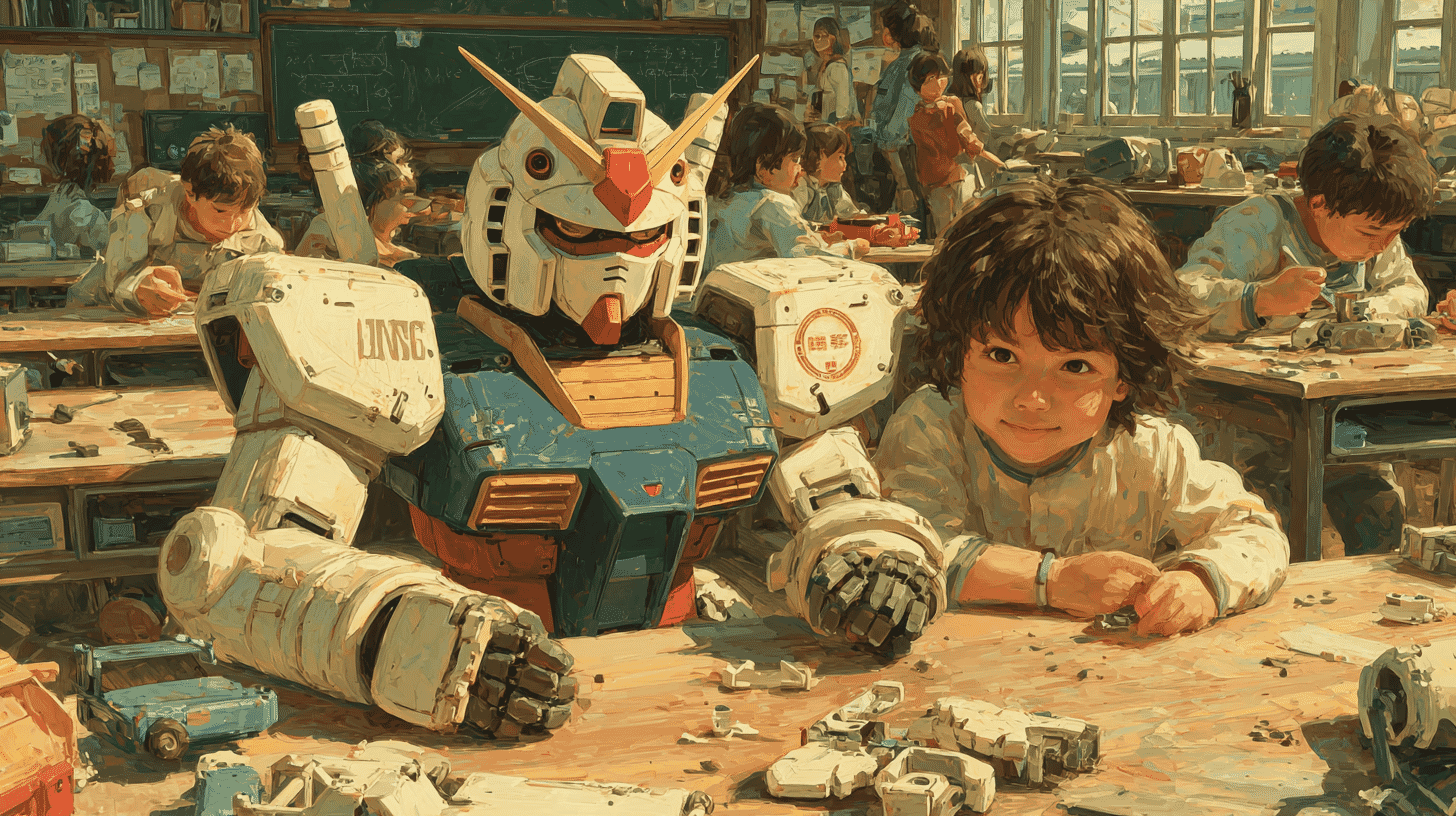
In 1980s Japan, bringing a plastic model kit to school meant one thing: confiscation. In 2026, Gundam model kits are being handed out BY the school, as official teaching material. When one father saw his daughter carry home a Gunpla from class, he witnessed a generational shift he never saw coming.
"Gundam Is Compulsory Education Now!?": The Post That Broke Japanese Internet
In April 2026, a post on X (formerly Twitter) went massively viral in Japan. A 59-year-old bar owner named PAL, who runs a retro anime and tokusatsu-themed establishment, shared a photo of the Gunpla his daughter had brought home from elementary school, not as contraband, but as a class assignment.
The reactions were immediate and emotional. Comments poured in from adults who grew up in the 1980s Gunpla boom era, when model kits were the most commonly confiscated items at school. "Gundam has become compulsory education!" one user exclaimed. "Back in my day, if you brought a model kit to school, the teacher would take it and you'd never see it again," wrote another.
For PAL and his generation, the shift is seismic. As he recalled, teachers in the 1980s never discussed anime in class. Adults who watched animation were often dismissed as "immature." The idea that a Gundam kit would one day be an approved educational tool was unthinkable.
What Is Gunpla Academia? A Free Program That's Reached 940,000 Students
The kit PAL's daughter brought home almost certainly came from "Gunpla Academia," a free educational program that BANDAI SPIRITS has been running since October 2021. The program targets fifth-grade students (ages 10–11) at elementary schools across Japan.
Gunpla Academia isn't just about snapping parts together. The curriculum, developed in collaboration with NHK Educational and the NPO Corporate Education Research Association, aligns with Japan's national curriculum standards. In a 45-minute class, students watch factory tour videos from Bandai's Hobby Center, learning about product planning, CAD design, injection molding, and plastic recycling, then build a special trial kit of the iconic RX-78-2 Gundam (51 parts, approximately 100mm tall, designed to be finished within the class period).
By February 2026, the program had reached 13,770 schools and approximately 940,000 students nationwide. BANDAI SPIRITS has set a goal of reaching every fifth-grader in Japan, about one million students per year.
An optional add-on called "My Plastic Station" takes things further: a specially equipped truck visits schools carrying a miniature injection molding machine and granulator. Students watch their leftover runners (the plastic frames that hold model kit parts) get recycled into new products right before their eyes.
A Father Who Never Bought a Gunpla, and the Gundam Girl He Raised
Here's where the story gets personal. PAL, despite being a lifelong Gundam fan, has never purchased a single Gunpla in his life. Growing up in a low-income household, he once saved up to buy one during the 1980s boom, only to be turned away by a practice called "dakiawase販売", a bundling tactic where stores forced customers to buy unpopular kits alongside the sought-after ones (packages typically ran $10–$20). Bitter from the experience, young PAL swore he would never buy a model kit.
Yet his love for Gundam endured. He raised his daughter on the original Mobile Suit Gundam, sharing favorite episodes like "Time, Be Still" (Episode 14) and the film Cucuruz Doan's Island. Today, his daughter's favorite series are Unicorn Gundam and Turn A Gundam, serious picks that mark her as a true Gundam connoisseur.
The Gunpla she brought home from school? She built it entirely by herself. Her teacher, in a very 2026 touch, told the class: "No reselling." PAL's reaction? A mixture of laughter and awe. The model kit he could never own as a child was now given freely to his daughter as part of her education.
The Educational Value: STEM, Craftsmanship, and Japan's Manufacturing Future
Gunpla Academia taps into a global trend toward hands-on STEM learning. Building a model kit exercises spatial reasoning, fine motor skills, reading comprehension (following assembly instructions), and persistence. The factory tour component introduces industrial concepts like CAD/CAM design, injection molding physics, and materials recycling.
For Japan, there's a deeper context. The country's manufacturing sector faces a looming workforce shortage as its population ages. BANDAI SPIRITS has framed Gunpla Academia as an investment in future "monozukuri" (craftsmanship) talent, an aspiration that extends beyond corporate branding into genuine social impact.
The program's developer shared a vision: "If someday adults reminisce saying 'Remember when we built Gunpla in class?' and that sparks a conversation about manufacturing and creativity, that's the future we want to create."
From Confiscation to Curriculum: How Japan's School Culture Evolved
The contrast between the 1980s and today tells a bigger story about Japan's changing relationship with pop culture. During the original Gunpla boom, schools banned model kits for practical reasons: kids brought cutters to class, arguments over rare kits led to fights, and teachers saw plastic models as distractions.
Anime itself carried stigma. Well into the 1990s, adult anime fans faced social pressure, and the idea that animation could be anything other than children's entertainment was mainstream in Japan far later than many foreign fans realize.
Today, anime is a pillar of Japan's cultural diplomacy. The government actively promotes it as soft power. And Gundam model kits, once the bane of teachers, are recognized as tools for teaching industrial production, sustainability, and engineering concepts. The 180-degree turn took roughly 40 years, but it's now official.
What were the "contraband" items at YOUR school growing up? Trading cards? Comic books? Handheld games? And how would you feel if they became official school supplies? Let us know in the comments.






Global Discussion
14 comments