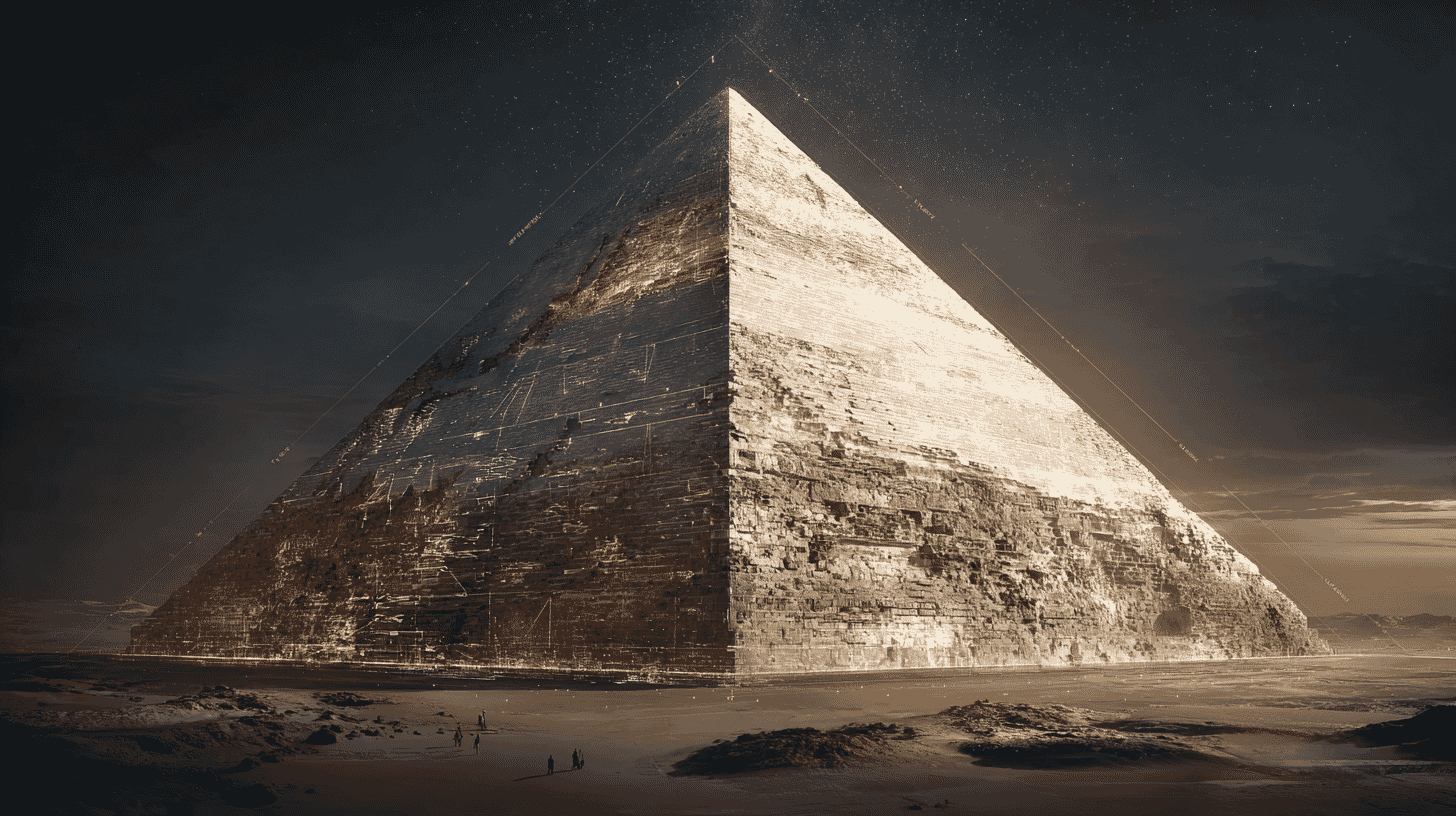
What if the Great Pyramid of Giza wasn't built 4,600 years ago, but 25,000?
An Italian engineer has developed a brand-new dating method based on stone erosion, and his results suggest the iconic pyramid could be far older than anyone imagined. If true, Pharaoh Khufu didn't build it, he just gave it a facelift. Here's the full story behind a claim that's shaking the foundations of ancient history.
A Dating Method Nobody Has Tried Before
For over a century, the Great Pyramid of Giza has been attributed to Pharaoh Khufu, who reigned around 2580 BCE during Egypt's Fourth Dynasty. Radiocarbon dating of mortar used between stone blocks, analysis of pottery found at the site, and historical texts have all supported a construction date of roughly 4,600 years ago. This timeline has been one of the most well-established facts in Egyptology.
But in January 2026, Alberto Donini, an engineer affiliated with the University of Bologna in Italy, published a preliminary report that challenges this consensus entirely. His paper, uploaded to the academic repositories ResearchGate and Zenodo, introduces a novel technique he calls the Relative Erosion Method (REM).
The core idea is surprisingly straightforward. The Great Pyramid was originally covered in smooth, white limestone casing stones. Most of these were stripped away about 700 years ago, primarily after a devastating earthquake in 1303 CE, and reused for construction projects in Cairo. This means the pyramid now has two kinds of exposed stone surfaces side by side: those that have been weathering since the pyramid was first built, and those that were protected by casing stones until relatively recently.
By comparing how much each surface has eroded, Donini argues, you can estimate how long the older surfaces have been exposed, and therefore, when the pyramid was originally constructed.
Measuring 12 Points Around the Base
Donini selected 12 measurement points around the pyramid's base, examining either pitting erosion (small cavities caused by chemical and physical weathering) or uniform surface wear. At each point, he estimated the volume of stone material that had been lost over time.
The results varied wildly. One measurement point (Point 1) yielded a date of roughly 5,700 years ago, not far from the conventional timeline. But Point 2 suggested approximately 18,000 years ago. Point 5 indicated over 30,000 years. And Point 9 pushed the estimate to an astonishing 54,000 years.
Donini explains that this wide variation is actually expected. Different parts of the pyramid face different directions, experience different wind patterns, and have been affected differently by sand burial, foot traffic from tourists, temperature fluctuations, and even acid rain. Some blocks may have been shielded by sand for centuries, dramatically slowing their erosion.
To account for this variation, Donini applied a statistical approach using a Gaussian probability curve. After averaging all 12 data points, his calculation produced a mean construction date of approximately 24,941 years before present, or roughly 22,941 BCE. The study also suggests a 68.2% probability that the pyramid was built somewhere between approximately 9,000 BCE and 37,000 BCE.
Was Khufu Just a Renovator?
The implications are staggering. If these estimates are even roughly correct, the Great Pyramid would predate every known advanced civilization. There was no dynastic Egypt 25,000 years ago. There was no Mesopotamia, no Indus Valley civilization, no written language anywhere on Earth. Humans at that time were still in the late Paleolithic era, the Old Stone Age.
Donini doesn't shy away from the implications. In his report, he writes that "around 20,000 years before Christ, there existed a civilization in Egypt capable of constructing at least the Khufu Pyramid." He also suggests that Pharaoh Khufu may not have built the pyramid at all, instead, Khufu may have simply renovated an already ancient structure and claimed credit for it.
Interestingly, the study also examined two smaller "Queens' Pyramids" located next to the Great Pyramid. Unlike the main structure, these smaller pyramids produced dates consistent with the conventional timeline of around 2,500–5,000 years ago. Donini interprets this as supporting his theory, the main pyramid was built by an unknown, far older civilization, while the smaller pyramids were later additions by the pharaohs of the Fourth Dynasty.
Why Mainstream Archaeologists Are Skeptical
Despite the buzz this study has generated, the archaeological establishment remains deeply skeptical, and for good reasons.
First, the study has not been peer-reviewed in any major archaeological or geological journal. It was self-published on open-access platforms, and the entire project was funded exclusively by Donini himself.
Second, erosion is notoriously difficult to model over long periods. Egypt's climate has changed dramatically over the millennia. During the "African Humid Period" (roughly 11,000 to 5,000 years ago), the Sahara region received far more rainfall than it does today. These changes in moisture, temperature, and wind patterns mean that erosion rates have not been constant, a critical assumption in Donini's method.
Third, Donini's own data shows enormous scatter. Individual measurements range from about 5,700 to over 54,000 years. Critics argue that averaging numbers with this much variation doesn't necessarily produce a meaningful result.
Fourth, and perhaps most importantly, the conventional dating of the pyramids is supported by multiple independent lines of evidence. Radiocarbon dating of organic materials in the mortar, analysis of pottery styles at the site, inscriptions and historical records, the discovery of workers' villages, and even the 2013 discovery of "Merer's Diary", a papyrus written by an overseer who helped transport limestone blocks to Giza, all consistently point to a construction date in the Third Millennium BCE.
As one archaeologist summarized: the pyramids fit perfectly into the known evolution of Egyptian architecture, from early mastaba tombs through step pyramids to the true pyramid form. Pushing the Great Pyramid back 20,000 years requires explaining why this architectural progression exists at all.
The Eternal Fascination with the Pyramids
Regardless of where you stand on the controversy, Donini's study has accomplished something remarkable: it has reignited global fascination with one of humanity's most enduring mysteries. The Great Pyramid has always attracted alternative theories about its origins, from ancient astronauts to lost civilizations like Atlantis. The appeal of these theories speaks to a deep human desire to believe that our distant ancestors were capable of more than we give them credit for.
Donini himself acknowledges that REM is a preliminary tool, not a definitive answer. He has invited archaeologists worldwide to collaborate in refining the method and expanding measurements across the entire Giza Plateau.
Whether REM ultimately gains scientific acceptance or joins the long list of debunked alternative theories, it has given the world one more reason to stare at those ancient stones and wonder: what secrets are they still hiding?
In Japan, this story has sparked intense discussion, with many people fascinated by the possibility of unknown ancient civilizations while others urge scientific caution. How would people in your country react to a claim like this? Do you think it's possible that some ancient structures are far older than we currently believe?
References
- https://www.researchgate.net/publication/399913321_Preliminary_Report_on_the_Absolute_Dating_of_the_Khufu_Pyramid_Using_the_Relative_Erosion_Method_REM
- https://www.preprints.org/manuscript/202601.0852
- https://greekreporter.com/2026/01/28/great-pyramid-date/
- https://allthatsinteresting.com/when-was-the-great-pyramid-of-giza-built
- https://dailygalaxy.com/2026/02/great-pyramid-egypt-built-before-pharaohs-40000bc-study-claims/








Global Discussion
15 comments