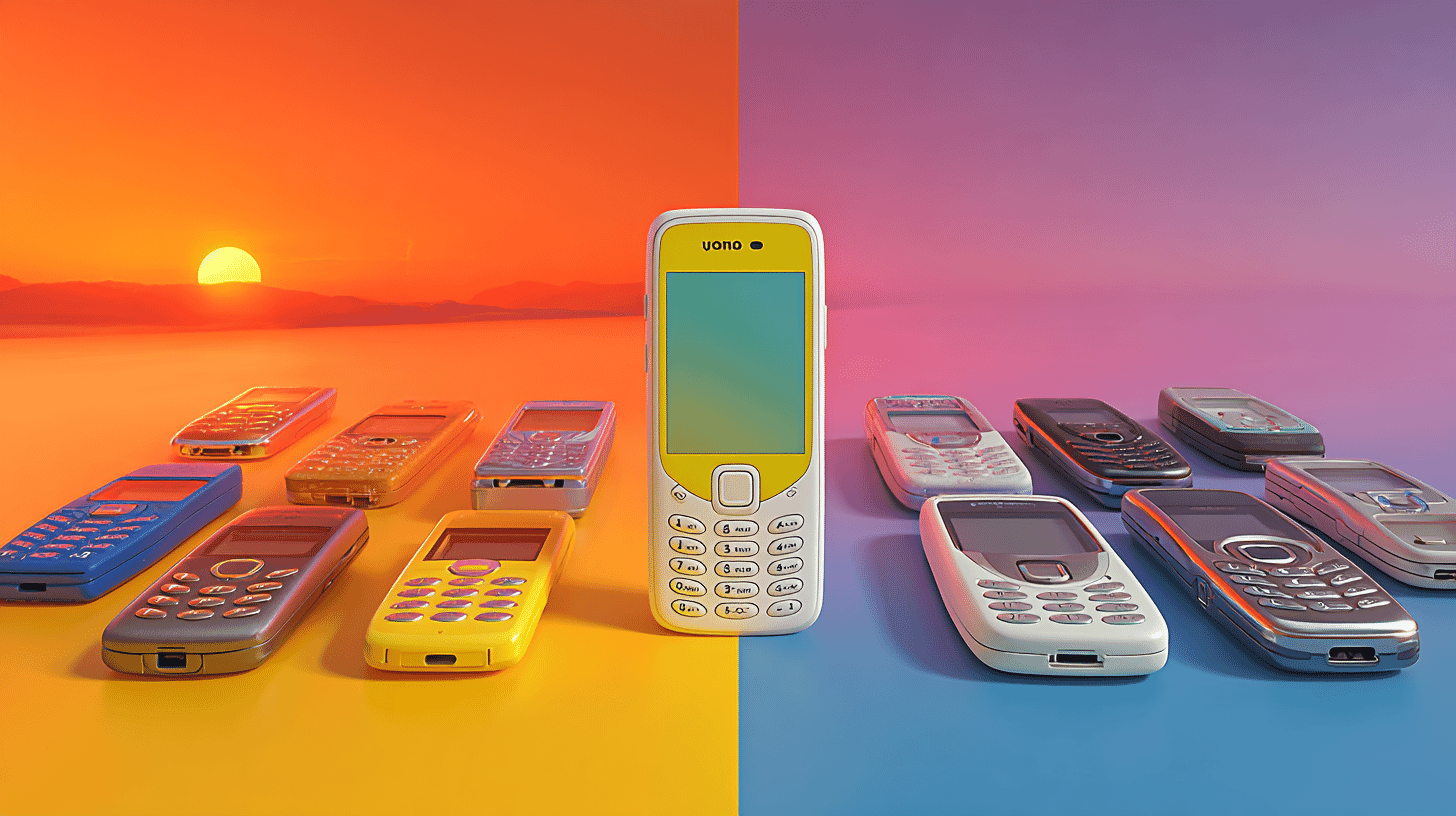
On March 31, 2026, a chapter of mobile phone history closes in Japan. NTT Docomo's 3G service goes permanently offline, and "i-mode," the world's first mobile internet platform, goes with it. The country that invented emoji, pioneered camera phones, and put the internet in people's pockets years before the iPhone is watching its most iconic handset disappear from the airwaves. They called it the "garakei," the Galápagos phone. Here's how Japan led the mobile revolution and then lost it.
The Final Shutdown: Docomo Pulls the Plug
On March 31, 2026, NTT Docomo will terminate its 3G communication service "FOMA" and its mobile internet service "i-mode." Once the signal goes dark, any phone that relies solely on 3G loses everything: voice calls, text messages, internet access, and even emergency calls to police or fire departments.
Docomo is the last of Japan's three major carriers to shut down 3G. KDDI, which operates the "au" brand, ended its 3G service on March 31, 2022. SoftBank had planned to switch off on January 31, 2024, then pushed the date to April 15 after the Noto Peninsula earthquake, and gave subscribers registered in Ishikawa Prefecture until July 31 of that year.
According to the Japan Times, more than 500,000 users will still be clinging to their 3G flip phones when the service ends. Many of them are elderly, people who have used the same clamshell handset for over a decade and see no reason to change. For them, this isn't a technology upgrade. It's the severing of a lifeline.
What Was a "Garakei"?
"Garakei" is a portmanteau of "Galápagos" and "keitai denwa" (携帯電話, meaning "mobile phone"). Just as the wildlife on the Galápagos Islands evolved in isolation into forms found nowhere else on Earth, Japan's mobile phones developed unique features and ecosystems that existed only within the country's borders.
Before the name "Galápagos" became a criticism, though, Japan was years ahead of the rest of the world in mobile technology. Features that eventually became standard on every smartphone were pioneered on Japanese flip phones first.
Japan's Mobile Firsts: The Innovations the World Forgot
1999: i-mode, the world's first mobile internet
NTT Docomo launched "i-mode" in February 1999, letting users browse websites, send and receive email, check weather forecasts, and even do their banking, all from a flip phone. That was eight years before the iPhone debuted. While most of the world was still arguing about dial-up versus broadband on desktop computers, Japanese commuters were reading the news on their phones during the morning train ride.
At its peak, i-mode had close to 50 million subscribers in Japan and was licensed to carriers in Europe, the Middle East, and Asia-Pacific, though it never took hold abroad the way it had at home.
1999: the birth of emoji
Shigetaka Kurita, a young developer on the i-mode team, noticed that text-only messages were easily misunderstood. His answer was 176 tiny icons, each a 12×12 pixel pictogram, drawn to add emotional context. He took his cues from manga expressions and public signage, producing symbols for smiling faces, weather, food, and transportation.
Those 176 original emoji entered the permanent collection of the Museum of Modern Art in New York in 2016. The word itself, from 絵 (e, "picture") and 文字 (moji, "character"), passed straight into English. In 2015, Oxford Dictionaries named the "Face with Tears of Joy" emoji its Word of the Year.
The path from Japanese flip phones to global adoption ran through Google, which began a project in 2006 to make Japanese carrier emoji work with Gmail. By 2010, emoji were folded into the Unicode standard, and in 2011 Apple put an emoji keyboard on the iPhone worldwide.
2000: the camera phone, "Sha-Mail"
In November 2000, J-Phone, now SoftBank, released the first mass-market camera phone, bundled with a service called "Sha-Mail" (literally "photo mail") that let users snap a picture and send it by email on the spot. Photographing your lunch and sharing it with friends started here, a decade before Instagram existed.
And So Much More
Japanese flip phones also pioneered mobile payments ("Osaifu-Keitai," literally "wallet phone," using FeliCa contactless technology), mobile TV reception ("One-Seg"), downloadable ringtones, waterproof handsets, infrared data exchange for swapping contact information, and QR code scanning. Most of these took years to appear on smartphones elsewhere.
How "Cutting-Edge" Became "Galápagos"
So if Japan was so far ahead, what went wrong?
The answer lies in the very success of Japan's mobile ecosystem. Carriers, manufacturers, and content providers had built a beautifully integrated but completely closed system. i-mode's web standards were proprietary. Its payment systems were carrier-specific. Its content was optimized for Japanese users and Japanese screens. Everything worked perfectly, as long as you stayed inside Japan.
When Apple launched the iPhone in 2007, it brought an open app ecosystem, a globally standardized user interface, and a platform that worked the same way whether you were in Tokyo, New York, or São Paulo. The iPhone didn't invent most of its core concepts. Mobile internet, emoji, camera phones, mobile payments: it repackaged all of them into a universal platform that could scale.
Japan's carriers and manufacturers, comfortable in their profitable domestic ecosystem, were slow to respond. By the time they realized the world had moved on, the term "Galápagos" had shifted from a neutral description to a critique: innovative but isolated, advanced but irrelevant outside its own ecosystem.
The country that pioneered mobile innovation became a cautionary tale about building technology that only works at home.
The Human Cost: 500,000 Left Behind
The 3G shutdown is not only a technology story. The hundreds of thousands of remaining garakei users are overwhelmingly elderly.
Consider a 90-year-old who has never used a computer, never sent an email, and uses the phone only for voice calls. For this person, the flip phone isn't a legacy device. It's the connection to family, to emergency services, to the outside world. Asking them to switch to a touchscreen is not a small request.
Japan's carriers have attempted to ease the transition. Docomo offers subsidized "first smartphone" programs with significant discounts on beginner-friendly devices. There are also "garaho," 4G-enabled handsets that look and feel like traditional flip phones while running Android internally. On August 7, 2025, Docomo released the "Raku-Raku Phone F-41F," built by FCNT and the first new model in the Raku-Raku line in six years, with large buttons, simplified menus, and a familiar clamshell body.
But the gap between these solutions and the reality of Japan's oldest and least tech-savvy citizens remains wide. The 3G shutdown has made visible a digital divide that was easy to ignore when the old network was still humming along.
The Unexpected Afterlife: Yakuza and Y2K Aesthetics
The garakei story has two fascinating footnotes.
First, the 3G shutdown has had an unexpected impact on Japan's organized crime groups. Under Japan's Yakuza Exclusion Ordinances, recognized yakuza members are effectively banned from signing new contracts with mobile carriers. The ordinances arrived in 2011, and since then carrier contracts have required signees to declare they are not members. Older bosses have been stuck on the contracts they held before that, which only cover 3G. With 3G gone, so are the phones, one more squeeze on a shrinking organization.
Second, there is a growing global nostalgia for garakei aesthetics. On social media platforms like TikTok and Instagram, Gen Z users in the West have been collecting vintage Japanese flip phones as "Y2K" fashion accessories and aesthetic objects. The candy-colored shells, the satisfying flip, the jeweled charms dangling from antenna nubs: these phones are being rediscovered not as communication tools but as artifacts of a more tangible, less screen-dependent era. The "dumb phone" movement has given the garakei a second life as a symbol of intentional disconnection.
What the Garakei Left Behind
The garakei era is over, but its legacy lives on in ways most people never notice.
Every emoji you send traces its lineage back to Shigetaka Kurita's 176 pixel-art icons on a Japanese flip phone. Every photo you take with your smartphone owes a debt to J-Phone's Sha-Mail. Every time you tap your phone to pay for coffee, you're using a concept that Japanese commuters pioneered with FeliCa-equipped flip phones over twenty years ago.
The garakei story is both an inspiration and a cautionary tale. It shows what happens when a country's engineers build the future before anyone else, and what happens when that future is bound too tightly to one market to survive a global platform's arrival.
What about in your country? What memories do you have of pre-smartphone mobile phones? Did your country have its own "Galápagos" technology, something innovative that evolved in isolation?
References
- https://www.newsonjapan.com/article/148676.php
- https://www.itmedia.co.jp/mobile/spv/2602/14/news017.html
- https://www.gov-online.go.jp/eng/publicity/book/hlj/html/201808/201808_12_jp.html
- https://soranews24.com/2022/03/08/flip-phone-graduation-ceremony-a-surprisingly-emotional-look-back-at-life-in-3g-era-japan/
- https://sumaholife-plus.jp/smartphone/15067/




Global Discussion
14 comments