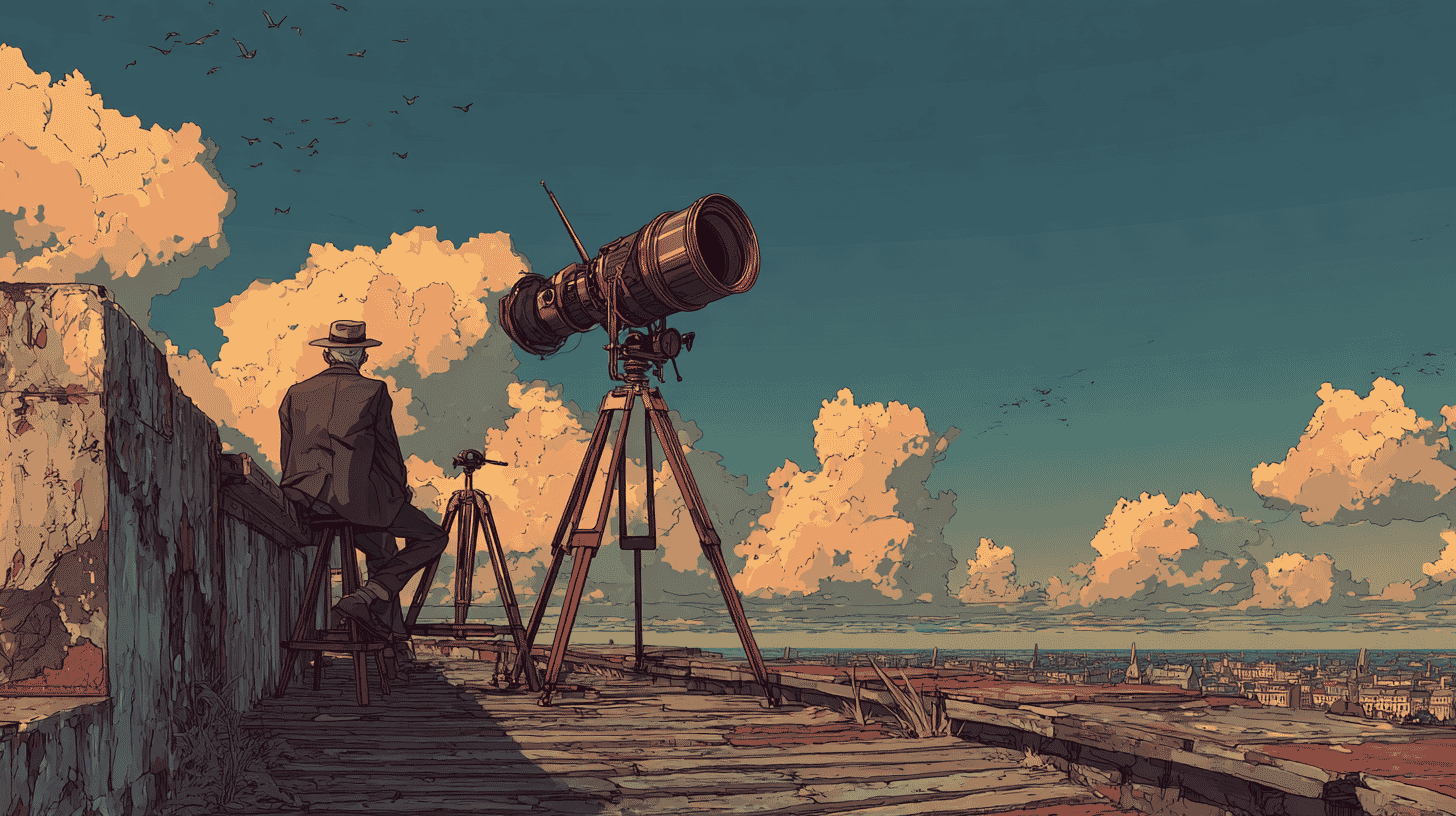
In 1880, Alexander Graham Bell stood on a Washington rooftop and made a phone call on a beam of sunlight. No wires. He called it the greatest thing he ever built, greater than the telephone itself. Then the world ignored it for 140 years. Today, invisible beams of light are quietly carrying the internet across rivers, disaster zones, and crowded city skylines. This is the strange, stubborn comeback of an idea that simply refused to die.
The invention Bell loved more than the telephone
On a June afternoon in 1880, Bell's assistant Charles Sumner Tainter climbed onto the roof of the Franklin School in Washington, D.C., aimed an instrument at a laboratory window about 213 meters away, and spoke. Inside the lab, Bell heard the words come out of a receiver. The two of them had just completed the first wireless voice transmission in history, and they had done it with sunlight.
The device was called the photophone. A person's voice vibrated a thin mirror; the trembling mirror made a beam of sunlight bouncing off it flicker in step with the speech. At the receiving end sat a piece of selenium, a material whose electrical resistance drops when light falls on it. The flickering light became a changing current, and the current became sound again.
Bell was certain he had made something historic. Of the roughly thirty patents tied to his name, four were for the photophone. Shortly before his death he told a reporter it was "the greatest invention I have ever made, greater than the telephone."
The world disagreed. The photophone went into a drawer, and stayed there for the better part of a century.
Why anyone would want to send data on a beam of light
It is worth pausing on why the idea refused to die, because the appeal is genuine. In communication terms, light is almost absurdly capable. It oscillates at vastly higher frequencies than radio waves, which means it can, in principle, carry far more information. And unlike radio, light is not a crowded, regulated resource: you do not need a government spectrum license to point a beam of light at a rooftop. The beam is also narrow and tightly aimed, so it is hard to intercept and does not interfere with the link next door.
Engineers have a name for the through-the-air version of this idea: free-space optics, or FSO. The principle is exactly Bell's. Take data, encode it onto a beam of light and send it across open air to a receiver. The light is now an invisible infrared laser rather than flickering sunlight. No trench, no cable, no license.
If that sounds a lot like fiber-optic internet, that is not a coincidence. Fiber optics is the photophone's other child: light again, but sent down a protected glass thread instead of through open air. Fiber grew up indoors, so to speak, shielded from rain and fog, and went on to become the backbone of the global internet. FSO is the sibling that stayed outside.
The 140-year "almost"
Staying outside is hard. The reason the photophone failed, and the reason FSO spent decades as a laboratory curiosity, comes down to one stubborn fact: open air is a difficult, unreliable thing to send a precise beam of light through.
Fog and heavy rain scatter and swallow the beam. Hot air rising off a road bends it: the same shimmer you see over summer asphalt will smear a data link. The two endpoints must see each other perfectly, so a tree branch, a new building, or even a passing bird becomes a problem. And because the beam is so narrow, the terminals have to stay aligned to a fraction of a degree, an alignment a gust of wind or a slowly swaying rooftop can quietly ruin. A traditional FSO link is also stubbornly one-to-one: it connects two points and nothing else.
For most of the twentieth century, that list of problems was simply disqualifying. Bell never had a good light source to begin with, since sunlight cannot be switched cleanly on and off. The laser, invented in 1960, finally gave engineers a clean, controllable beam. Low-loss optical fiber, perfected around 1970, gave light a protected highway to travel down. Between them, those two inventions built the modern internet and left through-the-air optics as a niche for people with a very particular problem and a clear line of sight.
The balloon fell, the laser kept flying
The thing that dragged FSO back into the spotlight began, improbably, as a failed plan to beam the internet down from balloons.
For most of the 2010s, Alphabet, Google's parent company, ran a project called Loon, which floated network balloons into the stratosphere to cover hard-to-reach areas. Loon shut down in 2021; Alphabet concluded that the path to a viable business was longer and riskier than it had hoped. But those balloons had needed a way to pass data to one another, high above the weather, and for that the team had built precise optical links: lasers locking onto lasers across long distances.
The balloons were grounded. The laser technology was not. It became a project called Taara, and in March 2025 Taara spun out of Alphabet's "moonshot factory" as an independent company based in Sunnyvale, California.
Taara's first product, Lightbridge, is a unit roughly the size of a traffic light that sends up to 20 gigabits per second across distances of up to 20 kilometers. It is now deployed in more than twenty countries, by operators including India's Airtel, Digicel in the Caribbean, Liquid Intelligent Technologies in Africa and Japan's SoftBank. In the United States, T-Mobile used Lightbridge to add backhaul capacity at large outdoor events including the Albuquerque Balloon Festival and Coachella. One of its showcase links crosses the Congo River between Brazzaville and Kinshasa, two capital cities where laying fiber beneath the river is wildly expensive; the optical link cut the cost of internet on the Kinshasa side dramatically.
Taara has also started doing the thing the photophone never could: making peace with the weather. Its newer Lightbridge Pro model is rated for "five nines" of uptime, or 99.999%, and it reaches that figure by quietly falling back to a radio or fiber connection whenever fog or rain degrades the optical link. The beam itself is not weatherproof. The system around it simply stops pretending it has to be.
And the hardware is shrinking fast. Taara has packed the core of a Lightbridge, all those steering mirrors and sensors, onto a silicon chip the size of a fingernail, steering the beam with software instead of moving parts. In outdoor tests, two of the chips carried 10 Gbps over one kilometer. The chip-based product, Taara Beam, made its industry debut at the Mobile World Congress trade show in Barcelona in March 2026, alongside Lightbridge Pro, which is due to ship from the summer of 2026.
Where Japan stands
Japan has a particular reason to care about all this, and some real strength to bring to it.
The reason is geography and disaster. Japan is a country of mountains and thousands of islands, where pulling fiber to every valley and every coastline is slow and expensive, and where earthquakes routinely sever the cables that are already in the ground. After the 2024 Noto Peninsula earthquake, restoring telecommunications was one of the hardest parts of the recovery. A communications link you can carry to a disaster site and switch on within hours, with no trench and no pole, is not a gadget in that context. It is infrastructure.
The strength is optics. Japan has a deep bench of companies that make lenses, lasers, and optical components, and several are now pushing terrestrial optical links forward. In March 2025, NEC ran a demonstration from the observation deck of the Tokyo Skytree, 350 meters up, sending an optical signal to a point about 3 kilometers away. In January and February it had pushed a ground-to-ground link past 10 kilometers in Nasushiobara, Tochigi Prefecture, beating the previous domestic best of 7.8 kilometers set by NICT. Both tests confirmed the link by sending text data. NEC says it wants to shrink the equipment from around two cubic meters to roughly one-hundredth of that, small enough for a single person to carry, and turn it into a product in 2028. It points the technology straight at disaster backup, ship-to-shore links, and reaching places fiber cannot.
The national research institute NICT, meanwhile, is working at the extreme end of the scale: in December 2025 it reported holding a stable 2 terabits per second, five wavelength-division channels of 400 Gbps each, across 7.4 kilometers of turbulent city air between its Koganei headquarters and a site in Chofu, western Tokyo. It says this is the first time terminals small enough to fly on a satellite or a stratospheric platform have carried more than a terabit, and it plans a low-Earth-orbit demonstration in 2026. And SoftBank, beyond being a Taara customer, bought roughly 200 patents out of the wreck of Loon and is now developing optical links between stratospheric "flying base stations" and satellites.
It probably will not take over the world, and that is fine
Here is the part the breathless coverage usually skips: free-space optics is almost certainly not going to become the main way the world connects. Buried fiber is simply too good: higher capacity, longer lifespan, indifferent to fog. For dense, permanent, high-traffic networks, light in a glass thread wins, and it does not win by a little.
But "not the main thing" is not the same as "not important." The entire value of FSO is that it goes where fiber cannot, will not, or cannot yet: across a river or a canyon, into a disaster zone within hours, out to an island or a mountain village, between data centers that need a fast link without a months-long construction project, between satellites where there is no ground to dig at all. Those are not small markets. In a country shaped like Japan, they are not even really niche ones.
Which is the quiet vindication buried in this whole story. Bell was not wrong that sending information on light was a profound idea. He was simply about 145 years early, working with sunlight and selenium instead of lasers and silicon photonics. The photophone did not fail. It just had to wait for the rest of technology to catch up and be born.
Japan is now betting on beams of light to reach the places its cables never will. Where you live, what gets left disconnected? The island, the valley, the neighborhood the fiber quietly skipped. And what do you think it would actually take to close that last gap?
References
- https://en.wikipedia.org/wiki/Photophone
- https://en.wikipedia.org/wiki/Taara_(company)
- https://www.fierce-network.com/wireless/taara-debuts-lightbridge-pro-touts-five-nines-uptime
- https://jpn.nec.com/press/202504/20250425_01.html
- https://www.nict.go.jp/press/2025/12/16-1.html
- https://xtech.nikkei.com/atcl/nxt/column/18/00001/11724/





Global Discussion
0 comments