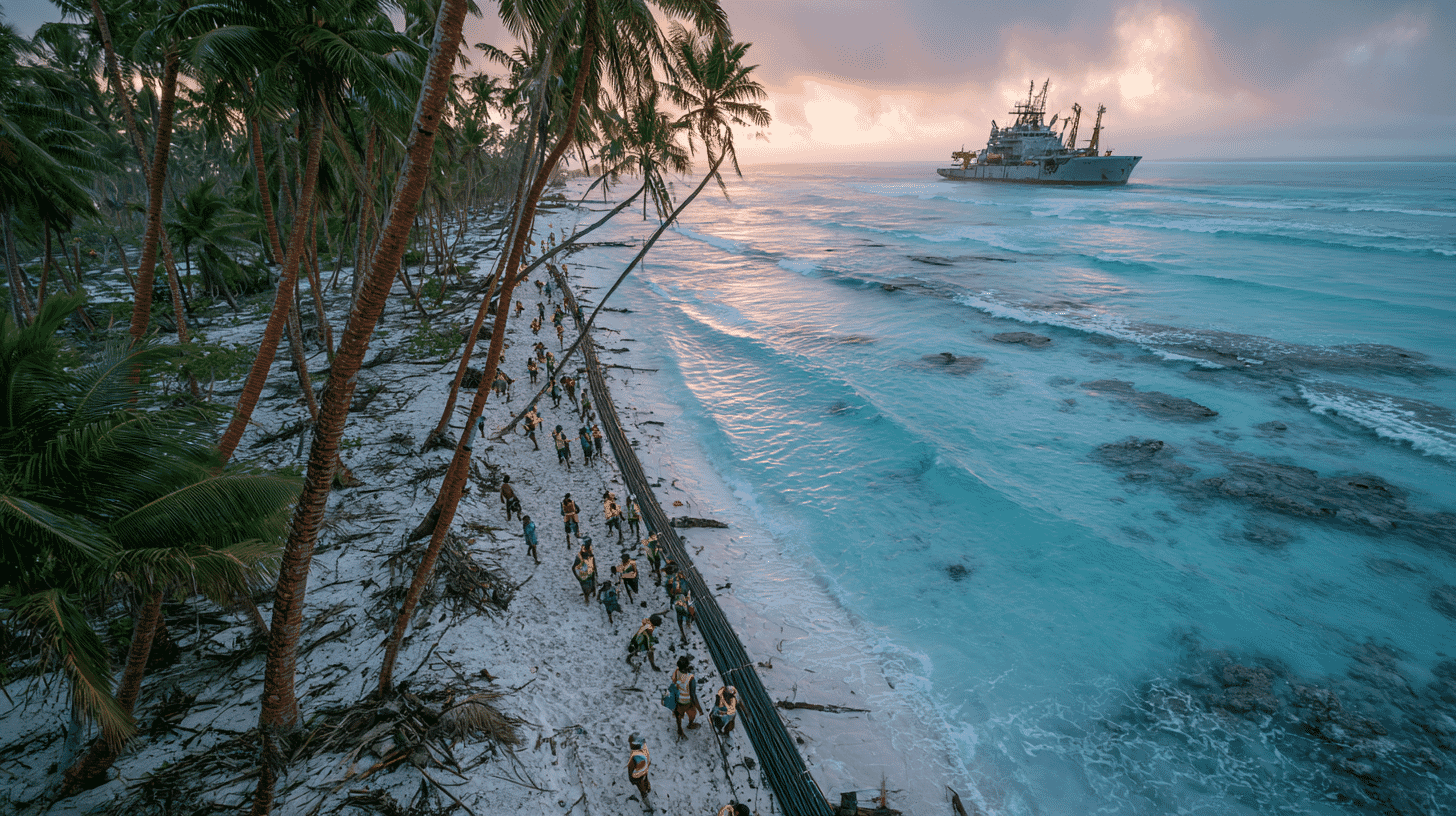
🌊 On May 15, in the middle of the Pacific, something happened for the first time.
The island of Kosrae in Micronesia. Tarawa in Kiribati. Nauru. Three places where every video call used to fight a 600-millisecond satellite lag. finally got their first-ever optical submarine cable.
Length: 2,250 kilometers. Cost: roughly US$95 million. Builder: Japan's NEC. Funders: Japan, the United States, and Australia. And here's the other half of the story. this project was originally on track to be won by Chinese state-linked HMN Tech, which bid more than 20% below NEC and Europe's Alcatel Submarine Networks. A US diplomatic warning, a World Bank cancellation, and a 2021 Quad-style rescue quietly redrew the map.
This is what "great-power competition in the Pacific" actually looks like when it finishes, and gets handed over to the people who'll use it.
From 600 milliseconds to 50
NEC's May 15, 2026 announcement reads, on the surface, like routine infrastructure news. The East Micronesia Cable System (EMCS), a roughly 2,250-kilometer optical submarine cable, has been completed and handed over to three operators: FSM Telecommunications Cable Corporation (FSMTCC) in the Federated States of Micronesia, BwebwerikiNet Limited (BNL) in Kiribati, and Cenpac Corporation in Nauru.
But the cable itself is anything but routine.
It connects four islands: Tarawa in Kiribati, Nauru, Kosrae and Pohnpei in FSM. Of those four, three (Tarawa, Nauru, and Kosrae) had relied exclusively on satellite for international connectivity. Satellite is fine in the abstract, but it imposes a round-trip latency of roughly 600 milliseconds. On the new fiber, the same trip from Tarawa to Guam is around 50 to 60 milliseconds. That's the difference between video calls that work and video calls you tolerate, between digital government services that feel modern and ones that feel like an obstacle course.
The cable will serve more than 100,000 people across the three nations. By continental standards that's a small city, Nauru has only about 12,000 residents, Kiribati around 120,000, FSM around 100,000. But for island states scattered across vast distances of ocean, moving off satellite is a generational upgrade.
"This project is Nauru's first undersea cable, enabling the provision of high-speed, reliable internet services to residents," said Zikki Eoe, chairlady of Nauru's Cenpac Corporation, in the official handover statement. "We have high expectations that this will significantly accelerate Nauru's economic development and digitalization going forward."
The cable that almost belonged to China
The other half of the EMCS story starts in 2018.
That year, the World Bank, working alongside the Asian Development Bank, opened bidding "to all eligible firms from any country" on what was then a roughly US$72.6 million submarine cable for FSM, Kiribati, and Nauru. The three serious bidders were Japan's NEC, France's Alcatel Submarine Networks (ASN, then part of Finland's Nokia), and China's HMN Technologies, formerly Huawei Marine Networks, since rebadged after US sanctions and majority-owned by Shanghai-listed Hengtong Optic-Electric.
HMN's bid came in more than 20% below NEC's and ASN's. On price alone, the contract was theirs to lose.
Then, in July 2020, the US State Department sent a diplomatic note to the Federated States of Micronesia. FSM has a Compact of Free Association with the United States, a decades-old arrangement that ties the two nations on defense and security. The note, later reported by Reuters and analyzed in detail by the Center for Strategic and International Studies (CSIS), warned that HMN's participation posed a Chinese-government espionage risk. Pacific island governments took the warning seriously. In February 2021, the World Bank cancelled the bidding process altogether, ruling all participants "non-compliant" with required conditions. HMN walked away without a contract.
The project nearly died there. Then, in December 2021, the United States, Australia, and Japan jointly stepped in. Together with FSM, Kiribati, and Nauru, they re-launched the cable as the East Micronesia Cable System. The new project value rose to roughly US$95 million (AU$135 million in headline terms). Australia, through its Australian Infrastructure Financing Facility for the Pacific (AIFFP), put in up to AU$65 million. Japan contributed a ¥2.4 billion grant. The US matched in. In June 2023, NEC signed the contract. Cable landings followed in 2024 and 2025. The May 2026 handover closes the loop, eight years after the original tender opened.
A Pacific paradox: Nauru flipped to Beijing, then took the Quad's cable anyway
Here's where the story gets uncomfortable for any clean narrative.
The US security warning that sank the HMN bid was framed around Chinese influence in the Pacific. Yet Nauru itself switched diplomatic recognition from Taiwan to China in January 2024, just two days after Taiwan's presidential election, a deliberately bruising piece of timing that reduced Taiwan's diplomatic allies to twelve. Australia's Lowy Institute reported that Beijing reportedly offered Nauru a multi-year aid package worth around AU$125 million, in part to fill a hole left as Australian funding for Nauru's offshore refugee-processing center wound down.
So Nauru today is in a curious split position. Diplomatically: aligned with China. Digitally: connected to the world via a cable funded and built by Japan, the US, and Australia.
That tension is, in many ways, the whole picture of contemporary Pacific geopolitics. There is no neat "West vs China" binary. Each project, each agreement, each port visit gets negotiated on its own terms. Small island nations have agency, and they exercise it. EMCS lands, in this sense, as a quiet reminder that infrastructure dependencies aren't automatically realigned by diplomatic letters.
It's worth noting that NEC's May 15 press release doesn't mention China, doesn't mention HMN, doesn't claim any geopolitical "win." It reads as a straight corporate construction announcement. But that restraint is itself part of the strategy. Japan, the US, and Australia don't need to spike the football. The cable is in the water; the data flows their way.
Why NEC keeps winning the Pacific
NEC has been in the submarine cable business for more than 60 years and has laid roughly 400,000 kilometers of cable, about ten times around the Earth. Together with America's SubCom and France's ASN, NEC is part of a three-firm cartel that handles roughly 90% of all new submarine cable construction globally.
What gives NEC a structural edge in the Pacific isn't just geography. Submarine cable projects depend on a thicket of local relationships, permits, coastal surveys, fisheries negotiations, government trust built over decades. Those things don't appear overnight. NEC has been working with Japan-allied and Quad-friendly small island states for so long that, when a project like EMCS needs a builder both technically capable and politically clean from Washington's, Canberra's, and Tokyo's perspective, NEC is the obvious phone call.
The vertical integration also helps. The optical cable itself was made by NEC subsidiary OCC, based in Yokohama. The optical repeaters that boost the light signal across thousands of kilometers were manufactured by NEC Platforms in Tokyo. NEC handles everything from route survey to cable laying to landing-station setup to final acceptance testing in-house.
In June 2025, NEC's CEO Takayuki Morita said the company is targeting a 40% share of the global submarine cable market, citing strong Pacific and Asian demand. Japan's Ministry of Internal Affairs and Communications has set a national goal of 35% share for Japanese vendors by 2030. EMCS isn't going to move those numbers by itself, but it's another data point, a small, hard, completed one, in NEC's pitch to the next set of Pacific-island buyers, and to the hyperscalers (Google, Meta, Amazon, Microsoft) whose cable orders are now reshaping the entire industry.
The bigger picture: AI is making submarine cables a strategic asset
Step back from EMCS for a moment.
TeleGeography's 2026 submarine cable map plots 694 systems in service or under construction. More than 1.5 million kilometers of cable were in the water at the start of 2026, and they carry 95 to 99% of all international data traffic. Telecommunications analyst TeleGeography projects roughly US$13 billion in new submarine cable investment between 2025 and 2027, nearly double the prior three-year period, driven by the unprecedented data demands of AI training and inference, plus the geographic expansion of hyperscaler clouds.
That demand is colliding with hard supply constraints. Only a few companies can manufacture cable, NEC, SubCom, ASN, plus China's HMN. Cable-laying ships number only in the dozens worldwide. Repair ships are even scarcer, with fewer than 100 globally, many aging. In 2024 and 2025, suspicious cable damage incidents in the Taiwan Strait and the Baltic Sea, with Chinese and Russian-linked vessels among the suspects as analyzed by CSIS, pushed governments to treat submarine cables not as ordinary commercial infrastructure, but as strategic national assets.
Layered on top of that, the Pacific is full of overlapping flashpoints. Three nations (FSM, the Marshall Islands, and Palau) have Compacts of Free Association with the US. Palau, the Marshall Islands, and Tuvalu still recognize Taiwan. The Solomon Islands, Kiribati (since 2019), and now Nauru have leaned toward China. The Pacific's submarine cables aren't just plumbing, they're the physical substrate of the influence contest playing out across the world's largest ocean.
EMCS, in that frame, is small but symbolically dense. It's 2,250 kilometers of glass on the seafloor. It's also a working answer to a bigger question: Whose job is it to wire up the Pacific? On May 15, 2026, the answer became, at least for these three islands, Tokyo, Washington, and Canberra, with NEC holding the welding torch.
For people in Tarawa, Nauru, and Kosrae, the real story is just starting. Video calls without the satellite stutter. Online banking that doesn't time out. Telemedicine consultations with specialists in Guam or Honolulu that actually load. The things continental users take for granted are about to become possible.
How does the internet reach your country, by satellite, submarine cable, or both? Most of us never think about the layer underneath the apps we use. But peer below the surface, and the geopolitical map of the 21st century is right there, traced in fiber on the ocean floor.
References
- https://www.nec.com/en/press/202605/global_20260515_02.html
- https://jpn.nec.com/press/202605/20260515_02.html
- https://www.submarinenetworks.com/en/systems/trans-pacific/emcs
- https://www.eastmicronesiacable.com/the-project
- https://www.aiffp.gov.au/investments/investment-list/improving-digital-connectivity-in-the-federated-states-of-micronesia-kiribati-and-nauru-via-submarine-cable
- https://jamestown.org/laying-down-the-law-under-the-sea-analyzing-the-us-and-chinese-submarine-cable-governance-regimes/
- https://www.datacenterdynamics.com/en/news/east-micronesia-subsea-cable-scrapped-as-us-says-chinese-firms-pose-threat/
- https://www.lowyinstitute.org/the-interpreter/nauru-s-diplomatic-switch-china-rising-stakes-pacific-geopolitics
- https://www2.telegeography.com/submarine-cable-faqs-frequently-asked-questions









Global Discussion
4 comments