
Your smartphone gets fast internet thanks to a technology called MIMO: it uses multiple antennas to send several data streams at once over the same frequency. Now, Japan's NTT and space agency JAXA have proven that MIMO works in space too, orbiting hundreds of kilometers above the Earth. This world-first achievement could bring affordable connectivity to mountains, oceans, and remote islands where no cell tower exists, and dramatically speed up how we receive satellite data about our changing planet.
The World's First Satellite MIMO Communication: Confirmed in Orbit
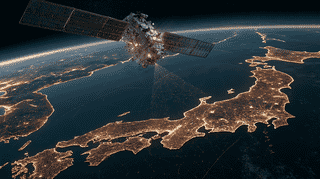
On April 15, 2026, NTT announced it had successfully started orbital demonstration experiments for low-Earth orbit (LEO) satellite MIMO communication and satellite sensing technology, in partnership with JAXA (Japan Aerospace Exploration Agency).
The technology is hosted on a device called LEOMI (LEO MIMO/IoT Transmission Equipment), mounted aboard JAXA's "Innovative Satellite Technology Demonstration-4" small satellite, which launched on December 14, 2025. After completing checkout tests and initial operations, the team conducted the first regular experiment on March 13, 2026.
In that experiment, LEOMI transmitted two different data streams from two antennas aboard the satellite, both using the same frequency. Two ground stations received these overlapping signals, and after signal processing, specifically interference cancellation and equalization, the team confirmed that the signals were cleanly separated. The signal constellation points converged to four distinct clusters, proving that MIMO signal processing was working exactly as designed.
This marks the world's first orbital demonstration of satellite MIMO technology on a 920 MHz IoT platform. The team plans approximately one year of experiments to fully establish the technology.
What Is MIMO? The Technology Behind Your Fast Smartphone
MIMO (Multiple-Input Multiple-Output) is a wireless communication technology that uses multiple antennas on both the transmitting and receiving sides to boost data capacity. It's a standard feature in every modern smartphone and Wi-Fi router, and it's the backbone of 4G and 5G networks.
Think of it this way: if normal communication is a single-lane road, MIMO is like opening multiple lanes on the same road. You can move more data at the same time without needing more "road" (radio frequency spectrum), which is an expensive and scarce resource.
However, applying MIMO to satellite communications has been considered extremely difficult. The distance between a satellite and the ground is hundreds of kilometers, orders of magnitude farther than between a cell tower and a phone. In the open space between satellite and ground, there are no buildings or terrain features to create the signal reflections that ground-based MIMO systems rely on.
NTT solved this challenge with proprietary signal processing technology: its ability to correct timing and frequency misalignments between multiple signals and remove interference, combined with JAXA's expertise in modeling communication capacity in satellite orbit environments.
Benefit #1: IoT Connectivity Everywhere, No Cell Towers Required
If this technology becomes commercially viable, the biggest beneficiaries will be people and businesses in areas with no ground-based communication infrastructure.
Even in technologically advanced Japan, large stretches of mountainous terrain, remote islands, and ocean areas have no cellular coverage. Sensors monitoring dam structures, water meters in mountain villages, ocean temperature buoys for fishing, and weather stations on remote islands, these IoT devices have been held back either by the absence of data transmission methods or by the prohibitive cost of dedicated satellite terminals.
What makes NTT's approach especially promising is that it targets the 920 MHz band, the same frequency used by widely deployed LPWA (Low Power Wide Area) devices on the ground, such as smart meters and environmental sensors. This means existing, inexpensive IoT terminals costing just tens of dollars could potentially connect via satellite without any hardware modifications. The project also aims for battery life on par with ground-based IoT networks, measured in years, not months, making long-term deployment in off-grid locations practical.
Imagine a world where a $30 sensor placed on a fishing buoy in the middle of the Pacific, a water pipe in a mountain village, or a landslide-prone slope can transmit its data to a satellite passing overhead, no cell tower, no power line, no dedicated satellite dish required. That's the vision.
Benefit #2: Dramatically Faster Satellite Data Downloads
The second major advantage is speed. Satellite MIMO can significantly increase data transmission rates from satellites to the ground.
NTT's target is to achieve peak capacity improvements of 2x and average improvements of 1.5x or more with 2×2 MIMO, compared to conventional single-antenna transmission. The long-term vision goes even further: enabling transmission speeds exceeding 20 Gbps between LEO satellites and the ground by scaling up the number of antennas.
Why does this matter for everyday life? Earth observation satellites capture high-resolution images and radar data, but they only pass over a ground station for about 10 to 15 minutes at a time. Every bit of additional transmission capacity during that narrow window means more data delivered faster.
During natural disasters like the 2024 Noto Peninsula earthquake in Japan, this could mean higher-resolution satellite imagery reaching rescue teams sooner. For agriculture, it means more frequent crop monitoring. For weather forecasting, it means more data points feeding into prediction models. The gap between "seeing from space" and "acting on the ground" shrinks considerably.
How This Differs from SpaceX's Starlink
SpaceX's Starlink operates roughly 11,000 satellites to provide broadband internet directly to consumers. It's a subscription service, you buy a $499 terminal, point it at the sky, and stream Netflix from a cabin in the woods.
NTT's satellite MIMO project is aiming at something fundamentally different. Rather than consumer internet, it focuses on sensor data collection and high-volume observation data transfer, the "infrastructure behind infrastructure."
The technical approach also diverges significantly. Starlink achieves coverage through sheer satellite numbers, thousands of spacecraft in coordinated orbits. NTT's strategy is to maximize the frequency efficiency of limited satellite resources through MIMO, getting more data throughput from fewer satellites.
The cost model is starkly different too. A Starlink terminal costs around $499 (about ¥79,500). NTT's satellite IoT platform envisions using existing LPWA terminals that cost a few thousand yen (roughly $20–40). For deploying thousands of sensors across a coastline or mountain range, this cost difference is transformative.
NTT's IOWN Vision: From Ground to Space
This satellite MIMO project is part of NTT's broader IOWN (Innovative Optical and Wireless Network) initiative, the company's next-generation communication infrastructure strategy. IOWN aims to replace electrical signal-based networking with optical technology, achieving dramatically lower power consumption, higher speeds, and greater capacity.
In 2022, NTT and satellite operator SKY Perfect JSAT established a joint venture called Space Compass, pursuing what they call the "Space Integrated Computing Network" concept. The satellite MIMO technology demonstrated here serves as a foundational piece of the "satellite sensing platform" within this larger vision.
The architecture works like this: IoT sensors on the ground transmit data via satellite, MIMO technology enables efficient high-capacity downloads from satellite to ground, and IOWN's optical network processes the data at high speed. It's an end-to-end communication infrastructure stretching from the Earth's surface to low-Earth orbit.
NTT operates this space business under the brand "NTT C89" (NTT CONSTELLATION 89 PROJECT), and today's demonstration falls under that umbrella.
Japan's Space Communication Strategy
Japan's government established the Space Strategy Fund in 2024, committing approximately ¥1 trillion (about $6.3 billion) over ten years to grow the country's space industry from roughly ¥4 trillion to ¥8 trillion by the 2030s. Satellite communication and sensing are central pillars of this growth plan.
NTT and JAXA have been collaborating on space communication research since 2019, and this orbital demonstration represents the first concrete milestone. Beyond the current one-year experiment program, NTT envisions applying satellite MIMO to lunar exploration and deep-space missions, enabling high-capacity data downlinks from the Moon and beyond.
The number of active satellites in orbit surpassed 14,000 by 2026, most of them Starlink, roughly ten times the number from a decade ago. In this era of mega-constellations dominated by SpaceX and Amazon, Japan isn't competing on satellite volume. Instead, it's developing unique technologies to maximize the efficiency of limited satellite resources.
The combination of satellite MIMO and IoT sensing creates a value proposition distinct from broadband internet: the ability to sense every corner of the planet. Detecting anomalies in mountain water infrastructure, collecting ocean and weather data across the Pacific, monitoring disaster-prevention systems on remote islands, all at low cost. These capabilities directly translate to safer, more resilient communities.
In Japan, reactions range from excitement about solving rural infrastructure challenges and accelerating digital transformation in agriculture and fishing, to pragmatic questions about how long commercialization will take and whether costs will truly come down. What about in your country, what would you want to connect if satellites could reach the places cell towers can't?








Global Discussion
13 comments