
🛰️ A spacecraft coming home from orbit still survives reentry the old way. A layer of material in front of it chars, flakes away, and carries the heat off with it. Researchers at two Japanese universities have now put hard numbers on an alternative in which a magnetic field takes over part of that job.
They did not stop a capsule from burning up. They built a system that can hold a very strong magnetic field steady for the 40 microseconds a wind tunnel gives you, and then watched what the superheated air in front of the model did about it. The work appeared on 23 July 2026 in Journal of Spacecraft and Rockets, published by the American Institute of Aeronautics and Astronautics.
What actually happens on the way down
Hit the atmosphere at several kilometres per second and the air in front of you has nowhere to go. It piles up against a shock wave, compresses violently, and heats to thousands of degrees. The pocket of gas trapped between that shock and the vehicle's skin is called the shock layer, and most of reentry engineering is a response to it.
The standard answer has two parts. Ceramic tiles insulate. Ablative materials do something cruder and more effective: they are designed to erode, taking heat away as their own surface boils off. Both work, and both have flown for decades.
Both also cost you. Thermal protection is mass that could have been payload. Ablative surfaces are consumed by definition, so a vehicle meant to fly again needs inspection and repair between flights. For a capsule flown once that is acceptable; for a reusable vehicle it is a recurring bill.
Pushing the air back with a magnet
The air inside a shock layer is hot enough to be partly ionised, which means it conducts electricity. Apply a magnetic field and you get a Lorentz force acting on that flow, pushing the hot gas outward and away from the surface. Two effects are expected to follow: less heat reaching the skin, and a larger effective frontal area, which increases drag and helps the vehicle shed speed. The formal name is magnetohydrodynamic aerobraking, or MHD aerobraking.
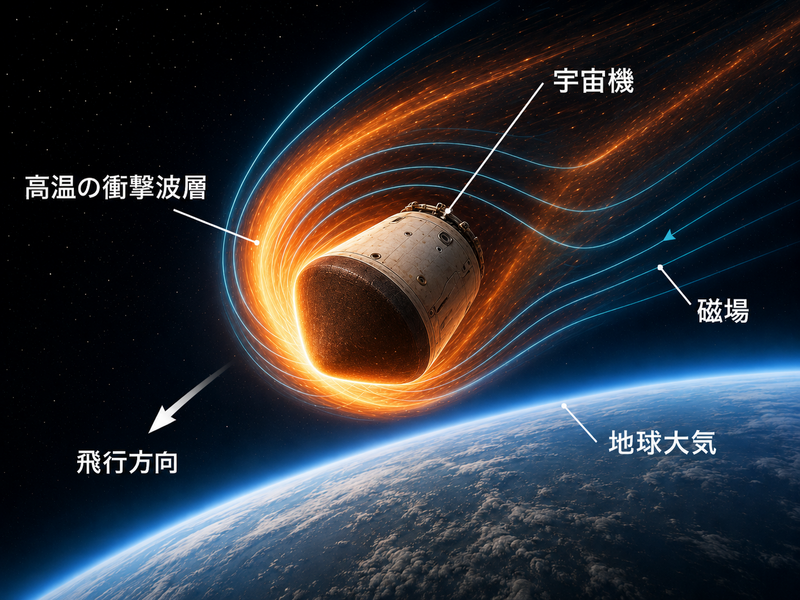
Source: Tokyo Metropolitan University press release
The idea is decades old. Testing it properly is the hard part. Ground experiments at anything close to real entry speed have generally relied on packing a neodymium permanent magnet inside a scale model, and a permanent magnet has a ceiling on its strength, while the shape of the field it produces is fixed by the shape of the magnet. That makes it awkward to ask the two questions that matter most: what happens if the field gets stronger, and what happens if you shape the field to suit the vehicle?
A system built for 40 microseconds
The team at Tokyo Metropolitan University and Tottori University started from an unglamorous fact about their own equipment. In their hypersonic wind tunnel, the window in which the flow can actually be observed is roughly 40 microseconds long.
That constraint turns out to be a gift. The field only has to exist for a single instant, timed to the arrival of the flow. And a coil that only carries current for microseconds does not need cooling, which is precisely the thing that limits how much current you can push through an electromagnet.
So they built a seven-stage pulse forming network, a chain of capacitors and inductors that dumps its stored energy in sequence rather than all at once. The result is a flatter, longer current pulse than a single discharge would give, delivering roughly 1 kiloampere into an air-core coil inside the model. A pressure sensor catches the shock wave before it reaches the test section, a preset delay fires the network, and the flow, the field and the high-speed camera all line up to within microseconds. Across the entire test window, the field stayed above 99 percent of its peak.
Two models, both 20 millimetres across but with different nose shapes, got different coils: 12 millimetres and 49 turns for a broad, gently varying field, and 4.5 millimetres and 54 turns for a field concentrated close to the surface. Numerical simulation of the electromagnetic field decided the geometry in each case. One of the two was shaped after the sample-return capsule from the Hayabusa asteroid mission.
What 1.58 tesla showed, and what it did not
The two models reached peak fields of 1.24 and 1.58 tesla in front of the nose, about 1.7 and 2.1 times what a neodymium sphere of comparable size produces. For scale, clinical MRI scanners commonly operate at 1.5 or 3 tesla, so this is hospital-magnet territory, generated inside a 20-millimetre model and sustained through a hypersonic flow at about 7 kilometres per second. The group describes it as the highest field strength achieved in an MHD aerobraking experiment at that flow speed.
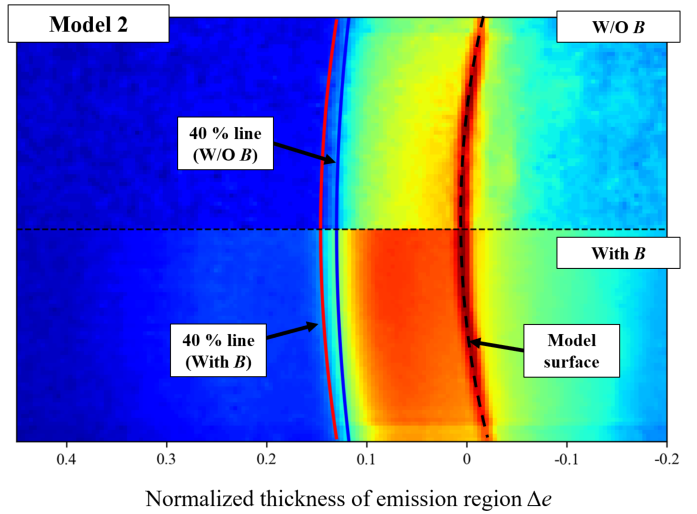
Source: Tokyo Metropolitan University press release
With the field on, the glowing region ahead of each model thickened by about 15.7 and 16.2 percent. Emission spectra from nitrogen molecules and molecular nitrogen ions shifted as well. Together those two observations say the field is reshaping the shock layer and altering the energy state of the gas inside it.
This experiment did not measure heat flux, and it did not measure drag. Those are the two numbers that would tell you whether MHD aerobraking is worth building into a vehicle. What the group established is the platform for measuring them: a rig where field strength, field shape and vehicle geometry can each be varied independently and the consequences observed.
It is also not the first MHD aerobraking experiment anywhere, nor the first to use a pulsed magnet. A group at the University of Queensland has run the same class of test in the X2 expansion tube at speeds representative of a return from Mars, and in 2022 reported total heat-flux measurements taken with and without permanent magnets fitted into a scaled model of NASA's Stardust capsule. DLR, the German aerospace centre, has driven a 30-tesla pulsed magnet from a 100-kilojoule capacitor bank in its high-enthalpy shock tunnel at Göttingen. What the Japanese group claims sits inside that landscape: a field of that strength produced from a coil small enough to fit inside a 20-millimetre model and shaped to match it.
Toward a sounding rocket, and perhaps Mars
The next step is already funded. A five-year Grant-in-Aid for Scientific Research (A) runs from April 2025 to March 2030, led by Hiroshi Katsurayama of Tottori University. It covers two problems the wind tunnel cannot solve: how to seed the flow with an ionising agent so the electromagnetic force works regardless of entry conditions, and how to arrange magnets so that field strength and onboard equipment space can coexist. Kohei Shimamura of Tokyo Metropolitan University, a co-author on the paper, is among the collaborators. The plan, as of July 2026, is to fly a low-orbit entry capsule carrying that hardware on a sounding rocket. It is a plan, not a launch date.
The grant record lists an allocation of about 47.06 million yen for the full project period, which at the early-August 2026 rate of 157.6 yen to the dollar is roughly 300,000 dollars.
If it eventually works in flight, thermal protection gets lighter and the inspection bill between flights gets smaller. Capsules returning to Earth and probes entering atmospheres like that of Mars would each gain another way to slow down. All of that is a prospect, not a product.
Reentry is one of the problems every space programme eventually has to solve for itself. Tiles and ablative materials are the answer everyone uses now; whether they are the last answer is open. Better materials, or something stranger? Which way is your country's space agency leaning?







Global Discussion
3 comments