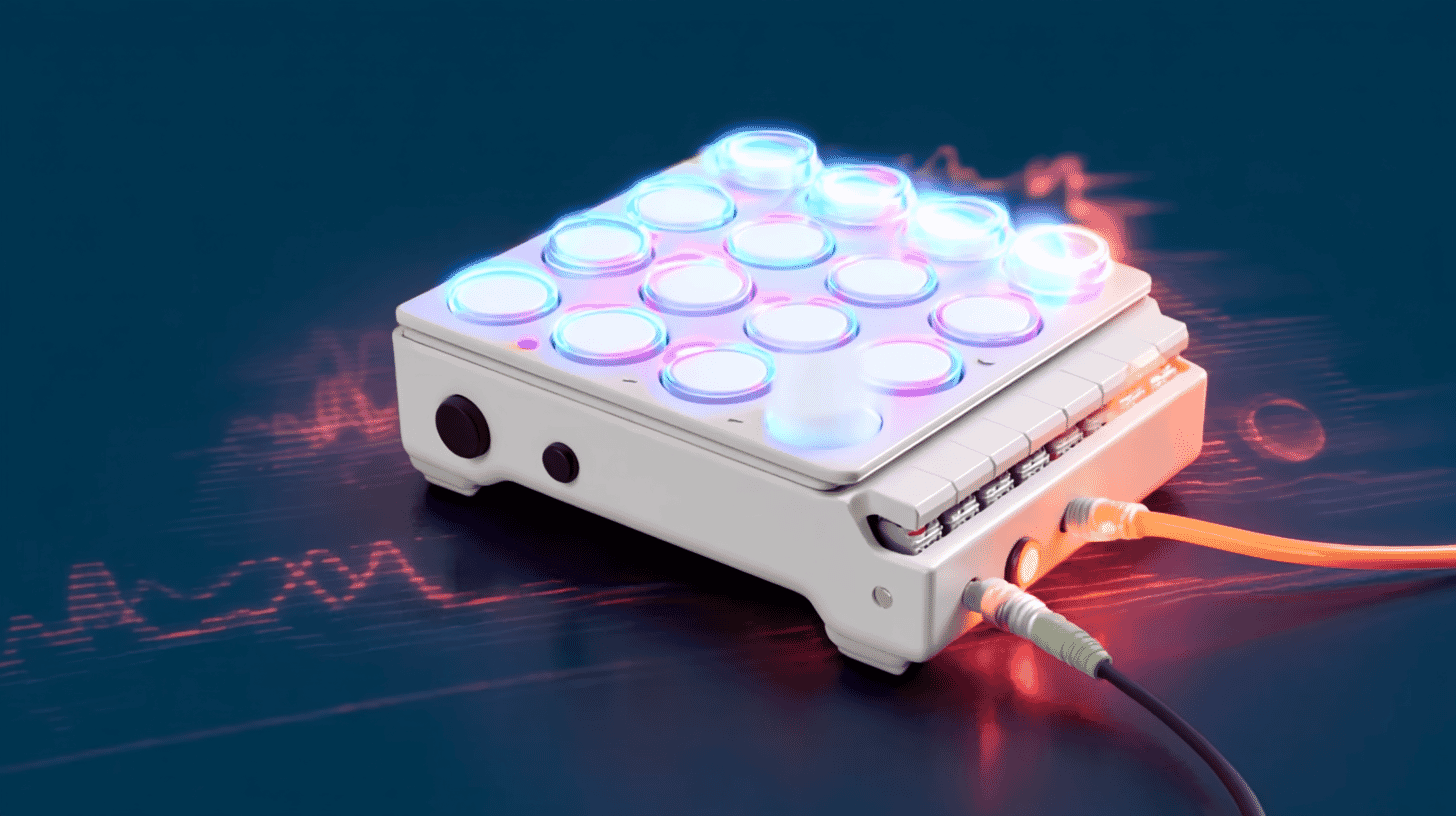
Press a key and it lights up, sounds, and pops out. That instrument robot just made its world debut in Texas. Sixteen keys, built by a small Japanese startup, are trying to open a channel between humans and AI that doesn't run on words.
What Is PONKEY?
On March 12, 2026, a small robot made its world debut at SXSW (South by Southwest) 2026 in Austin, Texas, the world's premier festival celebrating the intersection of technology, music, and film. Called "PONKEY," this self-described "instrument robot" was created by DOT P, a Tokyo-based hardware startup founded just one year ago.
At the heart of PONKEY are 16 custom-designed "solenoid keys." A solenoid is an electromagnetic component that converts electrical energy into linear motion, the same technology used inside player pianos, where hidden mechanisms strike the keys from below. In PONKEY, solenoids are built directly into each key. Press one, and it lights up with an LED, produces an electronic sound, and physically pops upward with a satisfying bounce. This trinity of light, sound, and motion is what gives PONKEY its playful identity.
Three Instruments in One Device
PONKEY isn't a toy, it's a serious electronic music device with three distinct modes of operation.
First, it works as a step sequencer-style drum machine. Users can program rhythm patterns across its 16 keys to build beats commonly heard in techno, hip-hop, and electronic music. Step sequencers, where timing is laid out on a grid, have been a cornerstone of electronic music production since legendary machines like the Roland TR-808 and TR-909.
Second, PONKEY functions as a digital synthesizer, allowing users to assign musical notes to the keys and play melodies or chords. While simple in layout, the 16-key format encourages creative exploration rather than technical virtuosity.
Third, and most innovatively, PONKEY connects to a companion app that transforms it into a device through which AI can physically play music.
Non-Verbal Dialogue Between Humans and AI
The most compelling aspect of PONKEY's concept is its vision of "non-verbal dialogue between humans and AI through the physical movement of keys."
Today, most interactions with AI happen through text or voice, fundamentally language-based exchanges. PONKEY introduces something different: physicality. When a human presses a key, the AI can respond by physically moving other keys. The AI's "thoughts" and "reactions" aren't displayed as text on a screen, they manifest as keys popping up, lights flashing, and sounds emerging from the device in your hands.
Think of it as a musical jam session. Just as jazz musicians improvise and respond to each other in real time, PONKEY enables a real-time musical exchange between a human and an AI. Subtle nuances and emotional expressions that words can't capture get communicated through rhythm, melody, and tactile motion. It's a glimpse of what human-AI communication could look like beyond the chatbot paradigm.
The SXSW Exhibition and ICOMA TOYBOX
PONKEY's SXSW debut is happening inside the "ICOMA TOYBOX" booth, operated by ICOMA Inc., a Tokyo-based hardware startup best known for the "Tatamel Bike", an electric motorcycle that folds down to briefcase size. ICOMA's CEO, Takamitsu Ikoma, previously worked on Transformers international business at Takara Tomy and helped develop LOVOT, Japan's beloved companion robot.
In recent years, ICOMA has evolved beyond making its own products into a "design firm" that helps other startups make their innovations accessible through what it calls the "TOYBOX Method", essentially turning complex technology into approachable, toylike products that capture public imagination. The co-exhibition with PONKEY is a perfect example of this philosophy in action.
The exhibition runs March 12–14 at the Fairmont Hotel Manchester Ballroom, Section 122, within the STATION Ai booth at SXSW 2026. Visitors can touch and play PONKEY firsthand.
Tokyo's Startup Ecosystem at Work
Behind DOT P's journey to SXSW is a robust support system. The company is part of "FFF Tokyo" (Fabrication Factory Founding Tokyo), a prototyping-focused incubation program that operates under Tokyo's broader "TOKYO SUTEAM" startup initiative. Launched in 2022, TOKYO SUTEAM is the Tokyo Metropolitan Government's ambitious plan to multiply the city's unicorn count, startup creation rate, and public-private collaboration each by ten within five years, the so-called "10×10×10" vision.
FFF Tokyo specifically targets creators in design, product development, and architecture, offering a nine-month program based at KOCA, a maker-focused incubation space in Tokyo's Ota Ward, a district historically known as the heartland of Japan's small-scale precision manufacturing. Participants receive up to ¥500,000 (approximately $3,300) each for prototyping costs and international exhibition expenses, along with mentoring from experienced entrepreneurs and designers.
On March 28, 2026, FFF Tokyo will hold its Demo Day at TiB (Tokyo Innovation Base) in Marunouchi, where PONKEY and other selected projects will present their results.
About DOT P
DOT P was incorporated in March 2025, making it barely one year old at the time of its SXSW debut. CEO Takaharu Kanai leads the company from its headquarters in Tokyo's Chiyoda Ward. The fact that such a young startup secured a spot at one of the world's most competitive technology showcases speaks to both the strength of Japan's startup support infrastructure and the team's execution ability.
PONKEY is targeting a public release in 2027. Updates are available through its teaser website (ponkey.jp) and Instagram (@ponkey_jp).
Japan's Hardware Startups on the Global Stage
PONKEY's appearance at SXSW is part of a broader story about how Japanese hardware startups are finding their footing in global markets. Unlike software ventures, hardware companies face steep development costs, manufacturing challenges, and the notorious "valley of death" between prototype and mass production.
Yet recent success stories are changing the narrative. ICOMA's Tatamel Bike gained international attention through SXSW and CES exhibitions, eventually leading to mass production and global interest. Other Japanese hardware innovations, from companion robots to precision medical devices, have similarly leveraged international showcases as launchpads.
PONKEY occupies a unique position at the intersection of musical instruments, robotics, and AI, three areas where Japan has deep cultural and technical expertise. Its tagline, "For adults, for children, and for AI, an instrument robot for everyone," captures an inclusive vision that transcends age, skill level, and even the boundary between human and machine.
What creative experiments with AI and music are happening in your country? We'd love to hear about them.
Update: This article reflects the March 2026 SXSW showing. Beyond the booth, PONKEY was played at event spaces, bars and on the street around Austin. On March 28 it went on to win the grand prize at the FFF Tokyo Demo Day pitch.









Global Discussion
13 comments