
⚡ Beneath the farms and coastlines of Chiba Prefecture lies an estimated 500-year supply of iodine, the core ingredient in perovskite solar cells, a next-generation technology invented in Japan. Put the two together and the country could build something it has never had: a fully domestic energy cycle, from mining to generation and back again.
The Iodine Beneath Chiba
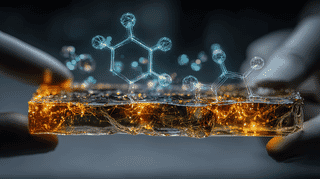
The South Kanto Gas Field, stretching beneath Mobara City and its surroundings in Chiba Prefecture, is Japan's largest water-soluble natural gas reservoir, with recoverable reserves estimated at 368.5 billion cubic meters. The underground brine pumped from it carries iodine at roughly 2,000 times the concentration of seawater. Extracted and crystallized, that iodine appears as glistening dark-violet crystals.
World iodine output runs to about 34,000 metric tons a year. Japan produces roughly 10,000 tons of that, about 30% of global supply and second only to Chile. Around 80% of the Japanese total comes from Chiba alone, which makes the prefecture responsible for roughly a quarter of the world's iodine. The main producers are Ise Chemicals (15% global share), Godo Shigen (7%), and K&O Iodine (5%). Chiba's recoverable reserves are estimated at 4 million tons, which at current output rates works out to roughly 500 years' worth.
The brine yields something else alongside the iodine: water-soluble natural gas, almost pure methane with no sulfur. It is distributed as city gas through a pipeline network of about 3,000 km inside the prefecture, and a single regional supplier serves around 170,000 households. Locals call the arrangement "Chiba-san Chiba-sho," produced in Chiba and consumed in Chiba, and it has been running for decades.
What Is a Perovskite Solar Cell?
In 2009, Professor Tsutomu Miyasaka at Toin University of Yokohama published a solar cell built around a crystal structure called perovskite. Initial efficiency was 3-4%. By 2024, single-junction cells had reached 26.7%, and in December of that year a joint study by Kyoto University, the University of Oxford and others recorded up to 29.7% in a two-layer all-perovskite tandem. Commercial silicon panels typically land around 20-22%.
Three features drive the global interest.
Flexible, Light, and Thin
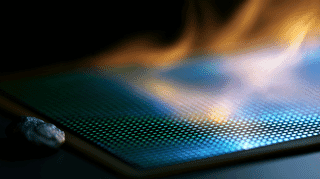
Unlike rigid silicon panels, perovskite cells can be printed onto flexible film, thin enough to think of it as camera film. That opens up curved rooftops, building facades, bridge embankments, and even the back of a worker's jacket. Demonstrations in Japan have run inside restricted zones at Kobe Airport, on a river levee in Aichi Prefecture, and on bus-stop roofs at the 2025 Osaka-Kansai Expo.
Lower Cost of Production
Silicon panels require energy-intensive high-temperature processing. Perovskite layers can be coated or printed onto a substrate, cutting manufacturing steps sharply. Sekisui Chemical puts its 2030 target generation cost at around 20 yen/kWh, roughly $0.13/kWh, on the back of mass production.
A Raw Material Japan Already Has
Conventional silicon panels lean on indium, gallium, and selenium, rare metals Japan imports almost entirely. The core material for perovskite cells is iodine, and Japan has more of it than almost anyone.
The Closed-Loop Energy Scenario
This is where the two stories converge. Brine comes up from under Chiba and gives up its iodine; domestic factories turn it into perovskite cells; the cells go onto buildings, homes, and infrastructure and generate power locally; and at end of life the iodine is recovered and fed back in. Mining, manufacturing, generation, recycling: every stage could in principle happen inside Japan. That would be unprecedented for a country that imports more than 99% of its oil and virtually all of its natural gas.
The government has formalized the vision. In November 2024, the Ministry of Economy, Trade and Industry published a Next-Generation Solar Cell Strategy targeting 20 GW of deployed perovskite capacity by 2040, equivalent to about 20 nuclear power plants. A domestic market launch was set for fiscal 2025, with GW-scale manufacturing capacity targeted in the early 2030s. NEDO, Japan's national research agency, projects the related market at roughly 5 trillion yen, about $33 billion, by 2050.
The supply side is moving too. In 2018, Chiba University opened the Chiba Iodine Resource Innovation Center (CIRIC) on its Nishi-Chiba campus and signed a joint research agreement with four partner firms: Ise Chemicals, Godo Shigen, Nippoh Chemicals, and Nac Techno Service. First on the center's list of research themes is stable supply of the lead iodide used in perovskite cells.
Four Challenges That Must Be Solved
The logic is compelling, but the hurdles are real.
Durability
Current cells last about 10 years in the field, well short of the 20-25 years expected from silicon. Sekisui Chemical has set a 20-year service life as its 2030 target, and Canon is developing protective coating materials aimed at 20 to 30 years.
Lead Toxicity
The dominant formulation relies on lead iodide, which carries toxicity and possible carcinogenicity concerns. Lead-free alternatives using tin (Sn) or bismuth (Bi) are in active development but still underperform lead-based cells. Infrastructure for safely recovering lead from discarded panels is also badly underdeveloped.
Iodine Supply Constraints
Pumping brine too fast risks ground subsidence in Chiba, so output cannot simply be scaled up on demand. Whether domestic supply could keep pace with a sudden surge in perovskite demand is unclear, which makes higher iodine recovery rates from recycling a key variable.
Large-Area Manufacturing
High efficiency in small laboratory cells does not automatically carry over to the uniform quality needed across a building facade. Sekisui Chemical, whose Sakai plant in Osaka Prefecture is due to start 100 MW-scale production in April 2027, along with Panasonic, Toshiba, and startup EneCoat Technologies, are all working on that gap.
Japan's Second Chance, and How Long the Window Stays Open
Japan effectively ceded the silicon panel market to Chinese manufacturers. Perovskite is one of the few areas where the country holds both the founding invention and a domestic raw material supply.
But the race is already on. UK-based Oxford PV began commercial shipments of perovskite-silicon tandem panels in 2024, and Chinese, South Korean, and American firms are investing aggressively.
The 500-year iodine reserve beneath Chiba's farmland is a rare strategic asset. Whether Japan converts it into lasting energy independence depends on clearing the four hurdles above, and on doing it before rivals build leads that cannot be closed.
What about your country?
Does your country have a domestic resource that could unlock a new energy technology? We'd love to hear your story.
Update: On March 27, 2026, Sekisui Chemical announced the commercial launch of SOLAFIL, its film-type perovskite solar cell. Manufacturing and sales run through Sekisui Solar Film, a subsidiary set up in January 2025 and owned 86% by Sekisui Chemical and 14% by the Development Bank of Japan. The first products are rated at 15% conversion efficiency and 10 years of durability. A 100 MW line under construction at the former Sharp plant in Sakai is scheduled to start up in April 2027, with 1 GW of annual capacity targeted for fiscal 2030. Tandem records have kept moving as well: in 2026 a perovskite-silicon cell from the National University of Singapore and partners reached a certified 32.76%.






Global Discussion
12 comments