
🧪 For most of the history of organic chemistry, building a carbon molecule has worked like extending a house: you add rooms along the outside walls and leave the load-bearing structure alone.
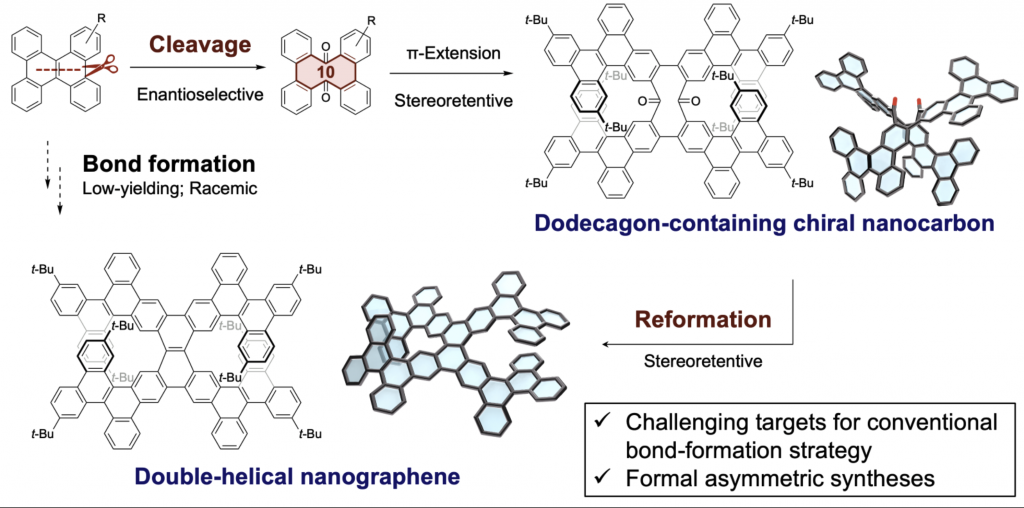
A group at Nagoya University went in anyway. They cut a bond deep inside a molecule you can order from a catalogue, stretched what was left, and in one case welded the cut back together. What came out spirals like a figure eight, glows with light that corkscrews as it travels, and stacks into crystals that inhale and exhale carbon dioxide.
The part of the molecule nobody touched
Nanocarbons are molecule-sized fragments of the carbon world: pieces of graphene, sections of a nanotube, relatives of the fullerene footballs discovered in 1985. Chemists want them because their electronic behaviour is unusually tunable, which makes them candidates for low-power electronics, gas storage, and optical materials.
The standard way to build one is called bottom-up synthesis, and the Japan Science and Technology Agency's announcement puts it well: you assemble a jigsaw, joining small flat pieces at their edges until the target shape appears. Every reaction happens at the rim. Nothing happens in the middle.
There is a reason for that. The atoms buried inside a flat carbon molecule sit in a rigid, planar sheet, and their bonds have essentially nowhere to flex. Attacking one of them means fighting the whole structure at once. Norihito Fukui, the senior author and an associate professor at Nagoya's Graduate School of Engineering, explained in the university's announcement that altering the interior generates so much strain that reactions simply take the easier route around the edge. Over decades, that practical fact hardened into an assumption: the inside was not a place you could work.
Why a ten-sided ring won't fit
Look closely at almost any nanocarbon and you find the same tiling: hexagons, nothing but hexagons, like a floor laid entirely in six-sided tiles. That is not an aesthetic preference. A carbon atom of the sp2 type, the kind that makes up graphene, is happiest when its three bonds sit at roughly 120 degrees to one another, and hexagons are what 120 degrees builds.
Force a differently shaped tile into that floor and the floor buckles. Chemists have learned to do this with seven-sided and eight-sided rings, and the resulting molecules curve out of the plane and pick up properties their flat cousins never had. But rings of nine members and above stayed out of reach. So did a second prize: asymmetric synthesis, meaning you get only the left-handed or only the right-handed form of a chiral molecule instead of a mixture. Chirality is easiest to see in your own hands. Same shape, and yet one will never sit flush on the other. According to the Nagoya and JST announcement, it had been achieved with nanocarbons only twice before.
Cut, stretch, then weld it back
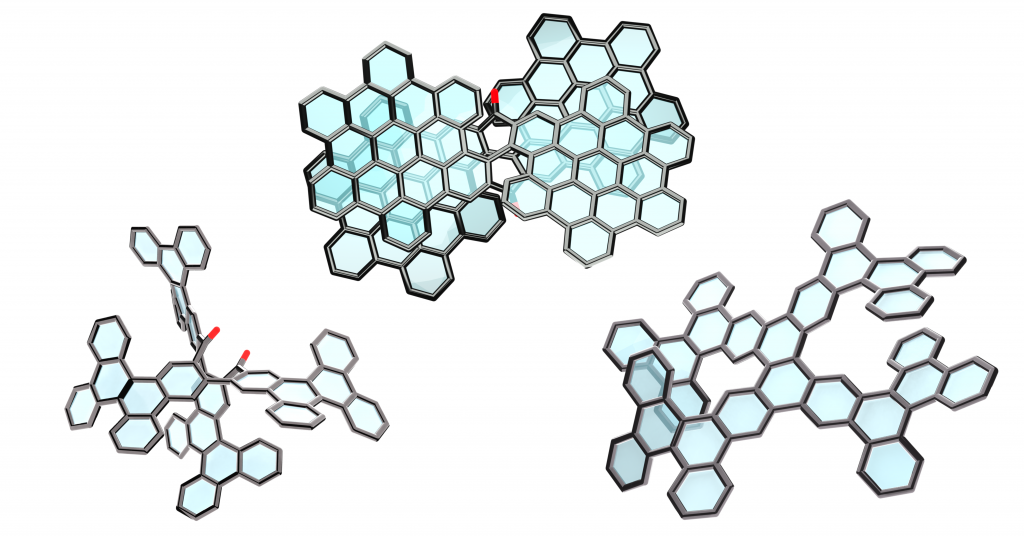
The starting material was dibenzochrysene, an unremarkable flat molecule available commercially. Doctoral student Junichiro Hirano and his colleagues broke one of its internal bonds, then expanded the carbon framework outward from the wound. Three new nanocarbon molecules came out of that route, each containing a ring of ten carbons, and each forced out of flatness by the mismatch. One takes the shape of a figure eight. Another looks, as the team describes it, like a bathtub.
Credit: Graduate School of Engineering, Nagoya University
Then came the move that turns a clever result into a strategy. Having opened the bond, the researchers closed it again. Rejoining the cut produced a nanographene, a molecule made purely of six-membered rings, in a single handedness. It should have been the boring case. Instead, the pieces on either side of the repair collide with each other, and the molecule resolves the collision by twisting into a double helix. It is chiral without containing a single irregular ring, held in shape by nothing but its own internal congestion.
A twisted molecule that glows and breathes
The properties are where a synthetic curiosity starts to look like a material. All the new molecules emit circularly polarized light. The light around us mixes right-twisting and left-twisting components in equal measure, and these molecules push out more of one than the other. Two of them can be stripped of electrons or loaded with them repeatedly without falling apart, which is the baseline requirement for anything meant to work in an electronic device.
Credit: Graduate School of Engineering, Nagoya University
Handedness here is also stubborn, and that matters: a chiral molecule that flips into its mirror image when warmed is useless in a device. Nagoya University reports that one of the new molecules holds its handedness even at 280 degrees Celsius.
The double helix does something else again. In the solid state, the molecules stack into spirals, and the spirals leave chiral channels running through the crystal, which take up carbon dioxide and release it again. Porous frameworks of this general family are the reason the 2025 Nobel Prize in Chemistry went to Susumu Kitagawa, Richard Robson and Omar M. Yaghi for metal-organic frameworks, or MOFs. What Nagoya built belongs to the same family without the metal, a class sometimes labelled πOF, held together by weak contacts between the molecules themselves rather than by metal joints. A πOF with chiral pores, the announcement says, had not been reported before.
A tool borrowed from the drug industry
The technique the team used has a name and a lineage. Skeletal editing, the direct surgical alteration of bonds inside a molecular framework, took off in the early 2020s, and its natural home has been pharmaceutical chemistry, where swapping a single atom in a drug candidate can be worth years of work. Those targets are soft, saturated hydrocarbons that tolerate being rearranged. Rigid, flat, all-sp2 carbon sheets were the opposite case, which is exactly why nobody had tried.
Applying the method to nanocarbons is, by the team's own careful phrasing, the first such example rather than a world first of any broader kind. The field it enters is crowded: precise synthesis of graphene nanoribbons and defined carbon architectures is a real international contest that no single result settles. What this one shifts is the map of possible moves: retrosynthesis, the backward planning chemists use to work out how to reach a target, has assumed for decades that bonds get made one at a time from the outside in. Fukui says he hopes the work prompts other groups to ask "what else can be built by editing the interior of molecules." Nagoya University and JST announced the result on July 28, 2026; the paper appeared in Nature Communications.
There is something appealing about a result whose real content is a change in method rather than a product. Nobody is going to sell you a bathtub-shaped molecule. But a technique that reopens the middle of a structure, in a field that had written the middle off, tends to outlive whatever it first produced. Which fields in your country are stuck on an assumption like that, and who is testing it?
References
- https://www.jst.go.jp/pr/announce/20260728/index.html
- https://www.jst.go.jp/pr/announce/20260728/pdf/20260728.pdf
- https://en.nagoya-u.ac.jp/news/articles/pr-scientists-cut-and-rebuild-molecules-from-the-inside-to-create-new-chiral-nanocarbons/
- https://www.nagoya-u.ac.jp/researchinfo/result/2026/07/post-1045.html
- https://doi.org/10.1038/s41467-026-75280-6
- https://www.nobelprize.org/prizes/chemistry/2025/press-release/









Global Discussion
3 comments