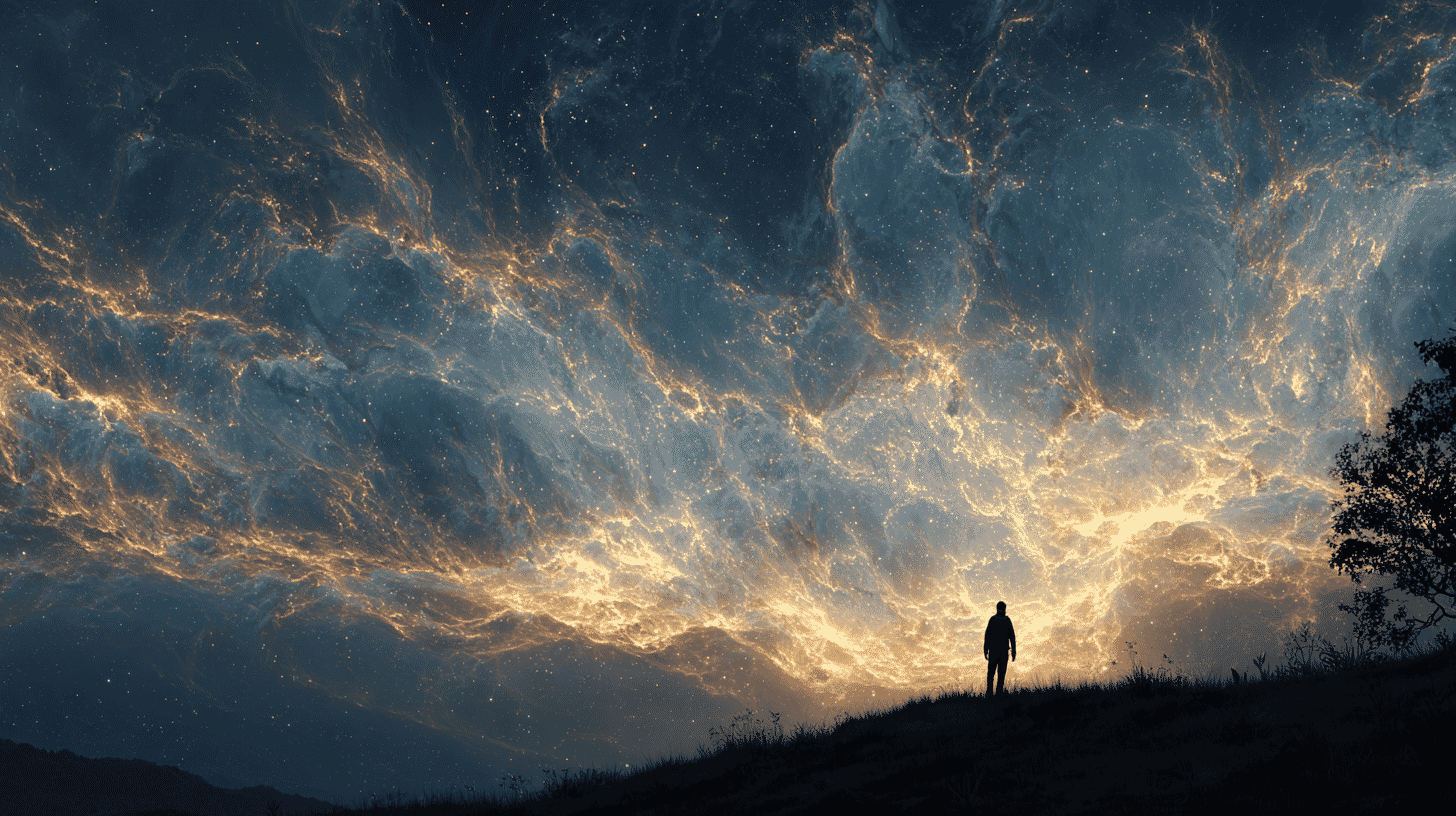
🌌 Look up at the night sky. Every star and galaxy you can see, everything that shines, adds up to roughly 5% of the universe. Nobody knows what the other 95% is made of. A Japanese cosmologist said as much twenty years ago. In 2026, the answer still isn't in. So what have researchers been doing all this time? Slacking off? Quite the opposite.
The man who said 96% of the universe is a mystery
In 2004, Japanese novelist Hideaki Sena published a book of dialogues with leading scientists, What Are Researchers Seeing at the Frontiers of Science? (Nikkei). One chapter carries a startling title: "The 96% Mystery Left in the Universe." The scientist speaking is Katsuhiko Sato, one of the founders of inflation theory, the idea that the newborn universe underwent a burst of exponential expansion. Sato proposed it in 1981, independently and at almost the same time as American physicist Alan Guth (Sato's paper was actually submitted first). Now a professor emeritus at the University of Tokyo and a member of the Japan Academy, he has long been mentioned as a Nobel Prize contender and remains one of Japan's most prominent cosmologists.
The number in that chapter title wasn't rhetoric. Take every "ordinary" particle in the periodic table, from stars and planets and gas clouds to your own body, and you account for only a few percent of the universe's contents. The rest splits into two unknowns: dark matter, which exerts gravity but emits no light, and dark energy, the mysterious something accelerating the expansion of the universe. Together, roughly 96% of everything: composition unknown.
That figure had hard evidence behind it. In 1998, two teams studying distant supernovae discovered that the universe's expansion isn't slowing down but speeding up. Dark energy was proposed as the culprit, and the discovery earned the 2011 Nobel Prize in Physics. By the early 2000s, observations pegged the recipe at roughly 70% dark energy, a bit over 20% dark matter, and about 4% ordinary matter.
In other words, by 2004 humanity had essentially written out the universe's ingredient list. The problem was that more than 95% of the entries read "unidentified."
So what did researchers do for twenty years?
If it's still unsolved after two decades, has anything actually happened? It's a fair question, until you line up what those decades produced.
In 2013, Europe's Planck satellite measured the oldest light in the universe, the cosmic microwave background, with extraordinary precision, sharpening the recipe to the now-standard figures: about 68% dark energy, 27% dark matter, 5% ordinary matter. The "96%" became a more precise "about 95%." Within the error bars, the punchline is unchanged: almost all of it is still a mystery.
In 2015, gravitational waves were detected directly for the first time (another Nobel followed in 2017). In 2019, astronomers captured the first image of a black hole's shadow. Einstein's general relativity kept passing its most extreme tests. The James Webb Space Telescope, launched in 2021, began photographing galaxies from the universe's infancy. In 2023, Europe's Euclid space telescope and Japan's XRISM X-ray satellite launched within months of each other, both with dark matter and dark energy in their mission statements.
Japan's contribution runs deeper than satellites. The Subaru Telescope's wide-field Hyper Suprime-Cam measured the subtle distortions in the shapes of roughly 10 million galaxies, an effect called gravitational lensing, and used them to draw a three-dimensional map of invisible dark matter. Charting something you cannot see sounded like science fiction in 2004. It is now precision science.
Meanwhile, the hunt for the dark matter particle itself has gone underground, literally. Detectors like LUX-ZEPLIN in the United States, XENONnT in Italy, and the XMASS experiment in Japan's Kamioka mine have pushed sensitivity up by orders of magnitude without catching a confirmed signal. Leading candidate particles have been ruled out one by one. That isn't a record of failure; it's the slow carving-out, by elimination, of what the mystery can and cannot be.
And then the mystery got deeper
The plot turned in 2024. The protagonist: DESI, the Dark Energy Spectroscopic Instrument, mounted on a telescope at Kitt Peak in Arizona. Five thousand small robotic positioners aim their optical fibers at a fresh batch of distant galaxies roughly every 20 minutes, relentlessly building a 3D map of the cosmos. It began collecting data in May 2021.
After an intriguing first-year analysis in 2024, the DESI collaboration released its three-year results in March 2025, based on nearly 15 million galaxies and quasars. What emerged startled much of the field: dark energy may not be constant. It may be weakening over time.
Why does that matter? The standard model of cosmology, called Lambda-CDM, treats dark energy as a "cosmological constant," a fixed value that never changes. It's the very constant Einstein introduced, retracted, and observations later forced back into the equations. If dark energy truly evolves, the foundation of the last quarter-century of cosmology needs rewriting, and so might our forecast for the universe's ultimate fate.
A crucial caveat, and the scientists themselves insist on it: the statistical significance of the signal, depending on which datasets are combined, reaches the low four-sigma range at best, short of the five-sigma threshold physics demands before declaring a discovery. Researchers involved in the analysis have repeatedly cautioned that declaring a discovery of evolving dark energy would be premature at this stage. DESI's data taken alone remains consistent with the standard model; the tension appears only in combination with other measurements such as supernovae, the cosmic microwave background, and weak lensing.
Even so, momentum is building. On the night of April 14-15, 2026, DESI observed the last field in its plan and finished its five-year survey ahead of schedule, having charted more than 47 million galaxies and quasars against an original target of 34 million, plus 20 million stars in the Milky Way. No 3D map of the universe has ever captured so much at such resolution. Thanks to the instrument's performance and those tantalizing hints, observations will continue into 2028, expanding the map by about 20 percent, from 14,000 to 17,000 square degrees. The full five-year dark energy analysis is expected in 2027. That's when we learn whether the hint dissolves or grows into a discovery.
The quality of "we don't know" has changed
Judged by the headline number alone, 96% merely became about 95%. But what "unknown" means has been transformed.
In 2004, the unknown was an unmapped wilderness. In 2026, it is an unknown surveyed across 47 million galaxies, narrowed by elimination, with scientists closing in on exactly where the standard model might crack. Sato spoke in that 2004 book as one of the generation that carried cosmology to that point. The generation that followed didn't solve the mystery; it measured the mystery more precisely than anyone thought possible.
In science, a question getting deeper is not a defeat. When the accelerating expansion was discovered in 1998, the universe didn't become more understood. It became less understood, and that set off a remarkably productive quarter-century for the field. If the evolving-dark-energy signal is real, it will happen again.
Next time you're under a clear night sky, remember: what you see is the 5%. Does your country have a tradition of looking up and wondering about the rest? The other 95% hangs over all of us, no passport required.
References
- https://newscenter.lbl.gov/2025/03/19/new-desi-results-strengthen-hints-that-dark-energy-may-evolve/
- https://noirlab.edu/public/news/noirlab2610/
- https://www.cnn.com/2025/04/02/science/desi-dark-energy-results/
- https://www.ipmu.jp/ja/20180926-HSC-S8
- Hideaki Sena, Kagaku no Saizensen de Kenkyusha wa Nani o Mite Iru no ka (Nikkei, 2004)







Global Discussion
4 comments