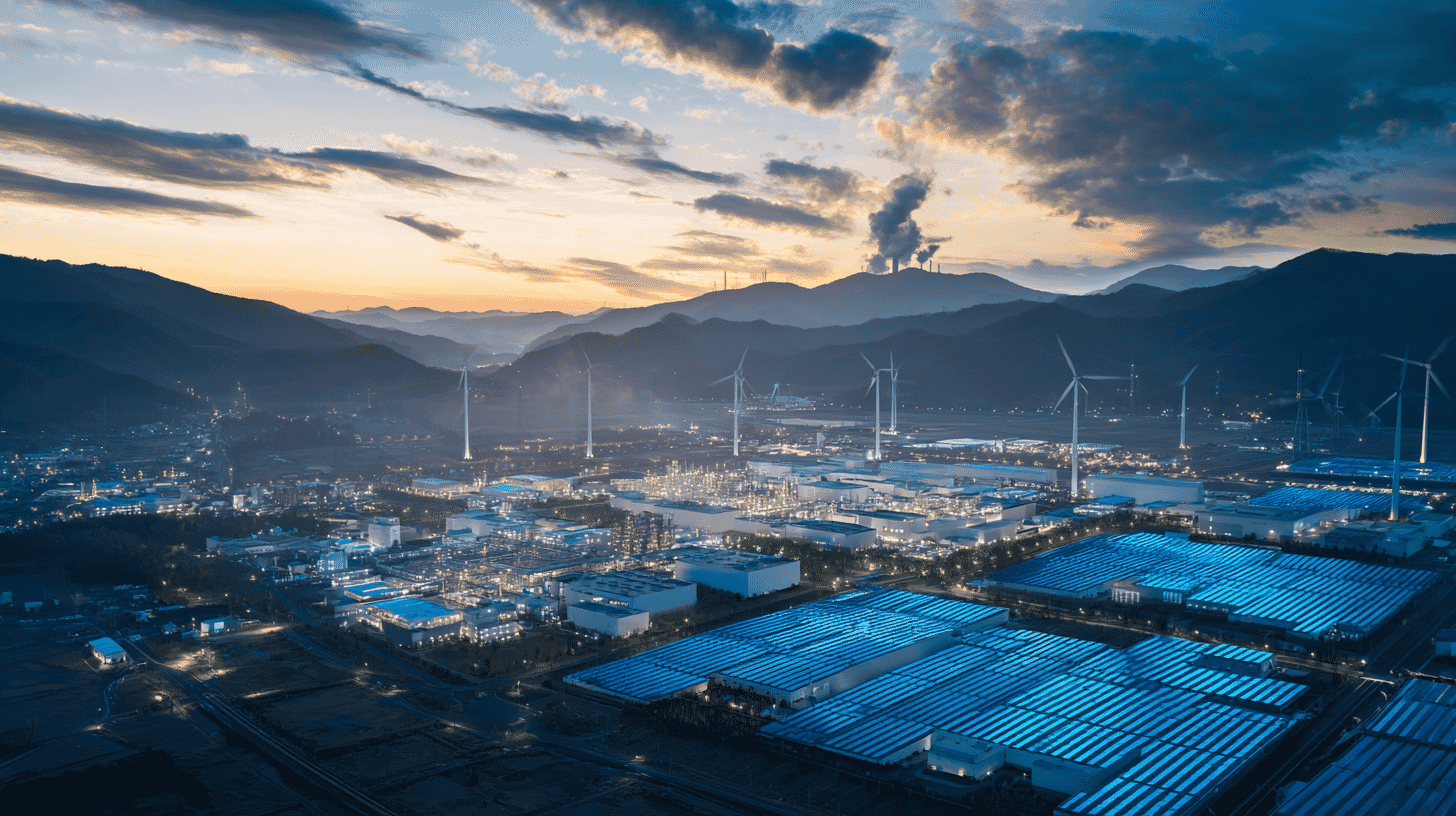
Kyushu Electric's president, Masaru Nishiyama, expects electricity demand in Kyushu to be 20 to 30 percent higher in 2034 than today. TSMC's chip plants in Kumamoto and the growing power appetite of AI and data centres across Japan are behind it. Here is how the region is preparing, from the 7th Strategic Energy Plan's shift to making maximum use of nuclear power to grid upgrades and the pressure to decarbonise.
Kyushu Faces Significant Power Demand Growth
In an interview published by Jiji Press on 18 January 2026, Masaru Nishiyama, president of Kyushu Electric Power Company, put a number on the region's energy future: electricity demand in Kyushu will run 20-30% above current levels by 2034, driven mainly by the arrival of Taiwan Semiconductor Manufacturing Company (TSMC) and the suppliers that follow it.
This projection is underpinned by TSMC's semiconductor factory in Kikuyo Town, Kumamoto Prefecture, which began mass production in December 2024. A second fab broke ground in October 2025 and is targeting start-up by the end of 2027. Semiconductor factories operate 24 hours a day, 365 days a year, consuming enormous amounts of electricity for manufacturing equipment and cooling systems. According to estimates from the Institute of Energy Economics, Japan, the combined power consumption of TSMC's Kumamoto factories (first and second) is expected to reach 300,000-400,000 kilowatts, equivalent to 30-40% of the generating capacity of a typical nuclear power plant.
AI and Data Centers Transform Japan's Power Landscape
The surge in power demand extends far beyond Kyushu. Globally, the rapid expansion of artificial intelligence (AI) and data centers is driving unprecedented electricity consumption. According to the International Energy Agency (IEA), global data center power consumption is projected to double from 2024 levels to approximately 945 billion kWh by 2030, roughly equivalent to Japan's current total electricity consumption.
Within Japan, data center power consumption is forecast to triple from 19 TWh in 2024 to 57-66 TWh by 2034. Wood Mackenzie's analysis suggests that data center peak power demand could reach 6.6-7.7 GW by 2034, representing approximately 4% of Japan's total peak power demand.
AI-optimized servers are particularly power-hungry. Gartner projects that their power consumption will increase nearly fivefold, from 93 TWh in 2025 to 432 TWh by 2030. This explosive growth in AI-related energy demand is fundamentally challenging existing power infrastructure paradigms.
Japan's 7th Basic Energy Plan: A Nuclear Pivot
To address these increasing power demands, the Japanese government approved the 7th Basic Energy Plan in February 2025. This plan marked a significant policy shift, removing the phrase "reduce nuclear dependence as much as possible" that had been included in energy plans since the 2011 Fukushima Daiichi nuclear disaster, and instead emphasizing the "maximum utilization" of nuclear power.
The 2040 energy mix targets are as follows:
- Renewable energy: 40-50% (solar 23-29%, wind 4-8%, hydro 8-10%, etc.)
- Nuclear: approximately 20%
- Thermal power: 30-40%
President Nishiyama praised this plan, noting that it "demonstrates the nation's strong determination." Kyushu Electric has one of the highest nuclear utilization rates in Japan, and its balanced power source composition has resulted in relatively low electricity prices compared to other regions. This cost competitiveness is considered one of the key factors that attracted TSMC to choose Kyushu for its investment.
Renewable Energy and Decarbonization Pressures
Alongside growing power demand, pressure for decarbonization is intensifying. TSMC has announced its intention to power its Kumamoto factory entirely with renewable energy. This commitment stems from demands by major customers like Apple, which requires its suppliers to transition to clean energy.
Kyushu is rich in "non-fossil power sources" (renewables and nuclear), and the government's "GX 2040 Vision" promotes accelerated industrial concentration in regions with abundant decarbonized power. President Nishiyama expressed his ambition: "We want to leverage Kyushu's abundant non-fossil power to contribute to national economic growth and industrial competitiveness."
Can the Grid Keep Up?
Adapting to that growth means rebuilding transmission and distribution. Kyushu Electric Power Transmission and Distribution is upgrading two substations in Kumamoto Prefecture: Yuge, in northern Kumamoto City, and Kumamoto Substation in Ozu Town. As planned when the Kumamoto Nichinichi Shimbun reported the work in February 2025, Yuge was to come into service in June 2025 and Kumamoto in June 2027. Each goes from one transformer to two, doubling their combined capacity from roughly 1.24 million kilowatts to about 2.48 million. The work is budgeted above 8 billion yen, and rising material costs could push that higher.
Currently, approximately 90% of Japan's data centers are concentrated in the Tokyo-Osaka metropolitan areas. The government is promoting data center distribution to regions rich in renewable energy through subsidy programs. The "Watt-Bit Collaboration" public-private project aims to comprehensively address data center power consumption challenges by integrating and operating power and communication systems.
Two-Thirds of the Demand Sits in the US and China
Globally, the United States and China are expected to account for more than two-thirds of data center power demand. Japan and South Korea together represent about 5% of global data center power consumption, a share projected to remain stable through 2030.
However, Japan's data center penetration remains relatively low compared to the United States. Wood Mackenzie notes: "The question isn't whether Japan will reach similar penetration levels to the US, but how quickly the power system can adapt to support that growth."
What Happens After "About 10 Years"
Kazuhiro Ikebe, Kyushu Electric's former president, once said supply capacity would hold for "about 10 years" before power from Honshu, Japan's main island, would have to be considered. Nishiyama's 2034 horizon lands almost exactly where that decade runs out.
Update: After this article was published, TSMC announced in February 2026 that the second Kumamoto fab would be reconfigured for 3-nanometre production. Investment rises to roughly $13.9 billion, with up to 732 billion yen in Japanese government support, and mass production of 3nm chips is expected in 2028; Taiwan's Ministry of Economic Affairs cleared the export on 31 March 2026. Gartner also revised its outlook in June 2026, projecting global data centre electricity consumption of 565 TWh in 2026 against 447 TWh in 2025, and data centre power demand rising from 104 GW in 2025 to 290 GW by 2030.
How is your country addressing power challenges related to data centers and AI demand growth? How does the role of nuclear energy and renewables in energy policy differ from Japan's approach? We'd love to hear your thoughts!
References
- https://kumanichi.com/articles/1677908
- https://news.yahoo.co.jp/articles/95e2946b246c182d4ebc80a4ab82014c9b425537
- https://www.meti.go.jp/press/2024/02/20250218001/20250218001.html
- https://www.enecho.meti.go.jp/category/others/basic_plan/
- https://www.jaif.or.jp/information/ai_energy
- https://www.woodmac.com/press-releases/japan-data-centers-power-demand/
- https://www.gartner.co.jp/ja/newsroom/press-releases/pr-20251119-dc
- https://www.spglobal.com/energy/en/news-research/latest-news/electric-power/041025-global-data-center-power-demand-to-double-by-2030-on-ai-surge-iea







Global Discussion
15 comments