
👂 A thin electrode slides into the inner ear, turns sound into electricity and talks to the hearing nerve directly. The two people who made that device carry words, not just noise, have won the 47th Honda Prize. The prize is run by a foundation that Honda's founding brothers paid for. So why would a prize tied to a carmaker pick an electrode in the ear?
Hearing a sound is not the same as understanding a word
On September 15, 2026, the Honda Foundation, a public interest foundation that is separate from Honda Motor, named its 47th Honda Prize winners: Graeme M. Clark, an Australian physician and neuroscientist and Laureate Professor Emeritus at the University of Melbourne, who is 91, and Ingeborg Hochmair, an Austrian electrical engineer and the co-founder and CEO of MED-EL, who is 73. Their ages are as reported by Science Portal, a Japanese science news site. The prize honors their work on the multichannel cochlear implant, from research to clinical use to worldwide adoption.
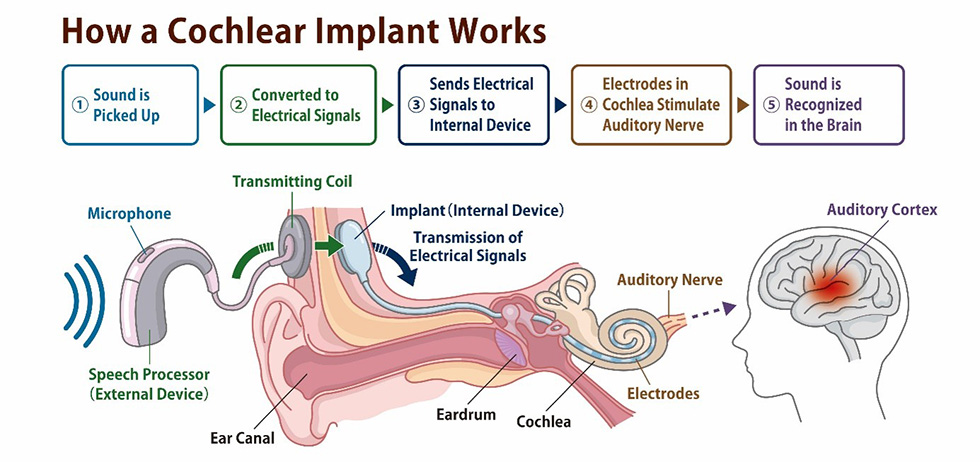
Cochlear implants are meant for people whose hearing loss is so severe that, even with hearing aids, speech stays hard to follow. Deep in the inner ear sits the cochlea, a snail-shell-shaped organ where sound vibrations normally become electrical signals. The implant takes over that job with hardware: electrodes placed inside the cochlea send signals straight to the auditory nerve.
Source: Honda Motor Co. (Honda Foundation announcement)
The number of electrodes made the difference. Early single-channel implants, with one electrode, could tell users whether a sound was there, how loud it was and its rhythm. But one electrode cannot carry the frequency information that makes up speech. According to the foundation, users often fell back on lip-reading to follow a conversation.
A multichannel implant splits sound into several frequency bands and sends each one through a different electrode in the cochlea. That is what opened the way to hearing sound as words.
A pharmacist's son and a student in Vienna
Clark's starting point was his family. According to IEEE Spectrum, his father Colin was a pharmacist in Camden, a small town near Sydney, and had poor hearing. Every time he asked a customer to speak up, the whole shop could hear their business. The boy who watched this decided at age 10 to become an ear doctor. He became an ENT surgeon, began his research in 1967 and in 1970 took up the chair of otolaryngology at the University of Melbourne.
On August 1, 1978, after a 9-hour operation at the Royal Victorian Eye and Ear Hospital in Melbourne, Clark's team placed a multichannel device in Rod Saunders, who had gone deaf after a car crash two years before.
Hochmair was an electrical engineering student at the Technical University in Vienna. In 1975, Erwin Hochmair, an electrical engineer who later became her husband, invited her to join the work. Teaming up with ear surgeon Kurt Burian, they built electrodes, circuits and sound processing. On December 16, 1977, Burian implanted their multichannel device in a patient at the University of Vienna's ENT clinic. Her résumé, attached to the foundation's materials, describes that operation as the first time anywhere that a multichannel implant built on microelectronics was placed in a patient.
There is no single "first"
The story did not start with these two, though. According to IEEE Spectrum, André Djourno and Charles Eyriès in France inserted an electrode in a patient's ear in 1957. Reading about it, William House and colleagues in the United States implanted devices in two patients between December 1960 and March 1961. In 1965, a team at Stanford University reported a multichannel implant in the journal Science.
So the multichannel idea came before them. What Clark and Hochmair did was turn it into a medical device people could live with every day. The foundation explains that they did not simply add electrodes; they chose the sound information needed to follow speech and worked out which electrode should carry it, how strongly and with what timing.
Nor is this the first time the pair has been honored together. In 2013, they shared the US Lasker-DeBakey Clinical Medical Research Award with Blake S. Wilson of Duke University.
They did not stop at the prototype
Clark worked with industry. His team's results became products of Cochlear, set up as a division of the Nucleus Group, a maker of pacemakers. The US Food and Drug Administration approved its implant for adults in 1985 and for children in 1990. The Hochmairs started their own company instead. MED-EL hired its first employee in 1990, and she still runs it as CEO.
According to the Honda Foundation, cochlear implants have now been fitted in more than one million people around the world. Science Portal puts the number in Japan at more than 20,000.
The technology has also met resistance. IEEE Spectrum notes that when Clark began working on implants for children, some in the Deaf community pushed back hard. For people who see deafness as a culture rather than a disability, operating on a young child looked like a decision made by parents that cut the child off from that culture before the child could choose.
Why would a carmaker's prize pick the ear?
The Honda Foundation was set up in December 1977 with donations from Soichiro Honda and his younger brother Benjiro, and it created the Honda Prize in 1980. The foundation describes it as Japan's first international award in science and technology. As of October 2026, the ceremony is scheduled for November 16 at the Imperial Hotel, Tokyo, where the two will receive medals, certificates and a total of ten million yen (about $63,000 at 157.75 yen to the dollar as of October 4, 2026).
The selection runs on a word the foundation coined: ecotechnology. It sounds like green tech, but the foundation's definition is broader. It goes beyond merely being friendly to the Earth and refers to a philosophy of science and technology that values people and seeks harmony with both the natural and the human environment.
A cochlear implant turns information from the outside world into electrical signals and delivers them to the brain's nerve pathways. The foundation sees it as an early, practical bridge between humans and machines, and says what it taught us underpins human-machine interaction.
The laureate list shows this is not a one-off. In 2021, the prize went to Alim-Louis Benabid for deep brain stimulation to treat involuntary movements in conditions such as Parkinson's disease. In 2024, it went to James G. Fujimoto for optical coherence tomography (OCT). Russell Taylor won in 2015 for surgical robots, and Philippe Mouret in 2007 for making laparoscopic gallbladder surgery practical. Topics tied directly to cars are a minority, such as Barry John Cooper's three-way catalyst for cleaning exhaust, honored in 2002.
The winners come from many countries, too. Last year's winner, in 2025, was Kenichi Iga of Japan, for the vertical-cavity surface-emitting laser; this year both winners are from abroad. Some past laureates later won the Nobel Prize in Physics. Shuji Nakamura, of the blue LED, received the Honda Prize in 2000 and the Nobel in 2014. Geoffrey Hinton, of deep learning, received the Honda Prize in 2019 and the Nobel in 2024.
In Japan, a prize left by a carmaker's founders has ended up choosing technologies like these. If your country has a science prize that a company founder started with their own money, what has it chosen to honor?
References
- https://scienceportal.jst.go.jp/newsflash/20261001_n01/
- https://global.honda/jp/topics/2026/c_2026-09-15.html
- https://global.honda/en/topics/2026/c_2026-09-15eng.html
- https://www.hondafoundation.jp/data_files/view/2984
- https://www.hondafoundation.jp/data_files/view/2985
- https://www.hondafoundation.jp/winner.html
- https://spectrum.ieee.org/cochlear-implant-history
- https://laskerfoundation.org/winners/modern-cochlear-implant/
- https://www.nobelprize.org/prizes/physics/2014/summary/
- https://www.nobelprize.org/prizes/physics/2024/summary/








Global Discussion
3 comments