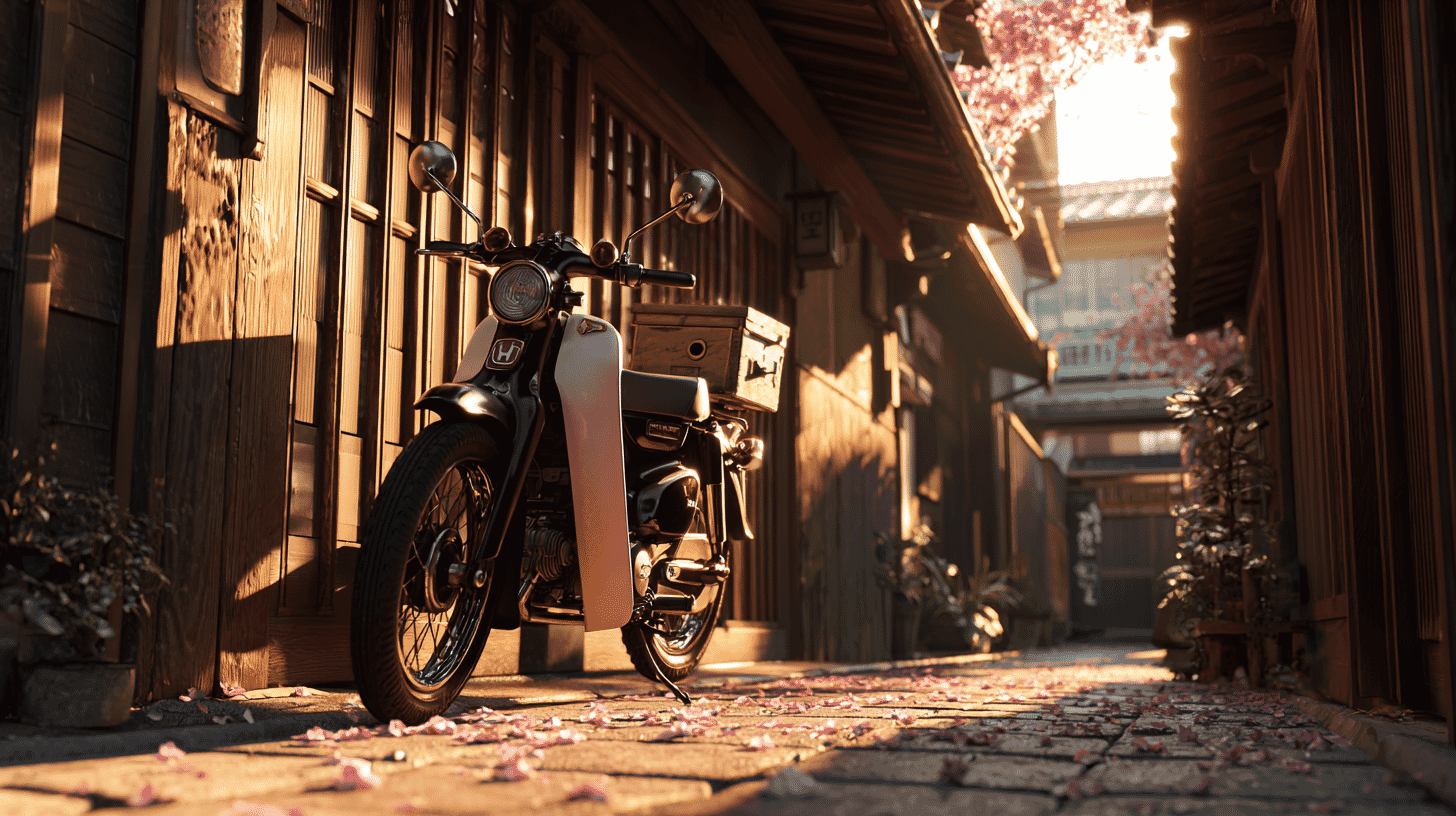
The world's best-selling motor vehicle isn't a Toyota, a Ford, or a Volkswagen. It's a motorcycle, the Honda Super Cub. Over 110 million produced. It all started with one instruction from founder Soichiro Honda: "Build a bike that a soba delivery boy can ride with one hand." Why has this humble little motorcycle conquered 160+ countries?
1958: It All Started with a Noodle Delivery Boy
The Honda Super Cub was born in 1958, just as Japan was entering its era of rapid economic growth.
Soichiro Honda and his business partner Takeo Fujisawa had just returned from a trip to Europe. In Germany, they noticed small mopeds were everywhere, ordinary people used them as daily transportation. The pair returned to Japan with a conviction: they would build an entirely new kind of vehicle suited to Japanese roads and Japanese life.
The concept they gave their engineering team was brilliantly specific:
"A bike that a soba delivery boy can ride with one hand."
In Japan, soba (buckwheat noodle) shops are a traditional fast-food staple, think of them as Japan's version of pizza delivery. Delivery workers would balance a tall stack of noodle bowls in one hand while steering through narrow alleyways with the other. This everyday scene became the starting point for everything the Super Cub would become.
From this concept, the team established four non-negotiable requirements:
- A quiet, fuel-efficient 4-stroke engine, The dominant 2-stroke engines of the era were cheap but came with noise, white exhaust smoke, and the hassle of mixing oil with gasoline
- A body design easy for anyone to mount and dismount, Including women wearing skirts, achieved through a revolutionary "step-through" frame
- A transmission that doesn't require clutch operation, The automatic centrifugal clutch freed the rider's left hand entirely
- A friendly, timeless design, A utilitarian vehicle that was also beautiful
These four pillars have defined every Super Cub for nearly seven decades.
The "Indestructible" Legend
If there's one word that defines the Super Cub worldwide, it's indestructible.
A famous British TV show put the Super Cub through extreme torture tests: replacing engine oil with cooking oil (tempura frying oil, to be exact), throwing it down a flight of stairs, dropping it from the roof of a building, and even submerging it in the ocean. Each time, the engine fired up again. These weren't special effects, they were filmed live on camera.
This reliability traces back to the original C100 model.
At the time, most small-displacement motorcycles used inexpensive 2-stroke engines. But Soichiro Honda deliberately chose a costlier air-cooled 4-stroke OHV engine. His reasoning was straightforward: reduce the burden on the user. Two-stroke engines required riders to manually mix oil with gasoline, carried a higher risk of engine seizure, and produced unavoidable noise and smoke. Honda eliminated all of these problems by choosing the superior, but more expensive, engine type.
This obsession with durability continues in modern Super Cubs. A technology called "Spiny Sleeve" creates microscopic protrusions on the cylinder's outer wall to improve heat dissipation and maintain perfect roundness. It's a detail no rider will ever see, and that's precisely the point. Honda's philosophy is to pour craftsmanship into the parts that are invisible.
Going Global, Two Very Different Stories from America and Vietnam
The Super Cub went international remarkably quickly.
In 1959, just one year after its Japanese debut, the Super Cub crossed the Pacific. It went on sale in America for just $295 (about $3,100 in today's dollars). But this was a country where "motorcycle" meant Harley-Davidson, big, loud, and associated with leather-clad rebels. A tiny 50cc step-through looked like a toy.
Everything changed in 1963 with one of the most famous advertising campaigns in history: "You meet the nicest people on a Honda."
The concept originated from a UCLA student named Mike Curb, who created it as a class assignment. Ad agency Grey Advertising purchased the rights and pitched it to Honda. The campaign shattered the American stereotype that motorcycles were only for tough guys. The ads showed housewives, college students, businessmen, ordinary, respectable people, all riding Hondas.
The Beach Boys' 1964 song "Little Honda" gave the Super Cub a further boost, and parents giving Super Cubs as Christmas presents became a social phenomenon.
Vietnam's relationship with the Super Cub tells a completely different story.
In the late 1960s, the U.S. military brought over 20,000 Super Cubs to South Vietnam. Between 1967 and 1969, approximately 750,000 Honda motorcycles entered the country. After the fall of Saigon in 1975, countless abandoned Super Cubs were adopted by locals. Even during the U.S. trade embargo, Vietnamese people kept their Cubs running through ingenious repairs, local parts, and gray-market imports.
The result? In Vietnam, people began calling all motorcycles "Honda", regardless of the actual manufacturer. It's similar to how Americans might say "Xerox" when they mean any photocopier, or "Band-Aid" for any adhesive bandage. The Super Cub didn't just enter Vietnamese life, it became Vietnamese life.
When a Shape Becomes a Brand
In 2014, the Super Cub achieved something unprecedented: its body shape was registered as a three-dimensional trademark in Japan, the first vehicle ever to receive this distinction.
A three-dimensional trademark means that the shape itself, not a logo or name, is legally recognized as a brand. Think of the Coca-Cola bottle. The Super Cub now stands alongside it. Anyone who sees that distinctive step-through silhouette, the leg shield, the curved lines, instantly knows: "That's a Cub." This universal recognition, maintained consistently for over half a century, earned it this extraordinary legal status.
Honda's corporate philosophy rests on two pillars: Ningen Soncho (Respect for the Individual) and the Three Joys, the joy of buying, the joy of selling, and the joy of creating. The Super Cub is perhaps the purest, longest-running embodiment of these principles.
Beyond 100 Million
The Super Cub series is currently manufactured at 10 plants across 9 countries and sold in over 160 nations. Cumulative production has surpassed 110 million units.
Consider that number from another angle. Earth's population is roughly 8 billion. If each Super Cub serves a family of several people, then a measurable percentage of humanity has ridden a Super Cub at some point. Not a bus. Not a train. A single personal vehicle, and it's reached that scale.
In Japan, tightened emissions regulations in 2025 will end production of the 50cc model. But the 110cc version continues, and the Super Cub's story is far from over. The journey that began with a soba delivery boy is still going.
In Japan, the Super Cub is more than just a motorcycle, it's seen as a symbol of monozukuri (the Japanese philosophy of meticulous craftsmanship). Its unbreakable reliability, its accessibility to anyone, and a design that hasn't fundamentally changed in decades all contribute to its almost legendary status. Does your country have a similar "national vehicle" or an industrial product that has been loved across generations?
References
- https://global.honda/en/Cub/history/stories/special-edition/
- https://global.honda/jp/news/2017/c171019a.html
- https://www.nippon.com/ja/japan-topics/g02472/
- https://en.wikipedia.org/wiki/Honda_Super_Cub
- https://hondanews.com/en-US/powersports/releases/release-e888887b6471c0aba407829ba7089f92-2024-honda-super-cub-c125-features-benefits




Global Discussion
15 comments