The 47th Honda Prize goes to Graeme Clark and Ingeborg Hochmair for the multichannel cochlear implant, now fitted in more than one million people. Why did a carmaker founder's foundation pick it?
Prelude, Supra, Primera, Pajero: Japanese carmakers keep reviving retired nameplates. Four forces explain it, from trademark law and the EV-era heritage premium to a 1988 US import rule still moving prices in Japan.
Nissan shareholders voted down the reappointment of outside director Motoo Nagai. A Mizuho-linked board insider, an abstaining Renault, and executive pay in a loss-making year explain how a rare rejection happened.
Honda's full-scale eVTOL demonstrator, designated F1, completed its first flight in the US, hovering for about 90 seconds. Instead of going all-electric, Honda chose a gas-turbine hybrid built for 400km-plus intercity range. Here's the contrarian bet, and the F1 and HondaJet technology behind it.
China's Chery and Japan's Autobacs are among five companies behind EMTA, a new kei-class EV brand planned for 2027. Why Japan's open market looks nothing like the US or EU.
GAIA RESORT ACURA, a new rental villa in Zao, Miyagi, preserves the workshop and stained-glass art of the late Honda engineer Akira Ishizuya, who worked on the CVCC engine. A stay built around Japan's craftsmanship for car and motorsport fans.
Mazda launched the third-generation CX-5 in Japan on May 21, 2026, starting at 3.3 million yen (around $20,800). With 5 million sold globally, this redesigned SUV is Mazda's bet on hybrids and combustion as the EV boom cools, and how it stacks up against Toyota RAV4, Honda CR-V, Tesla, and BYD.
Why a Nissan deep in restructuring picked Red Hat for its next-generation in-vehicle OS. We unpack the trap of in-house software development that cost Volkswagen's CARIAD 14 billion euros, and the path Nissan chose to avoid it.
In spring 2026, Honda wrote off roughly $10 billion in EV development. That same season, US ITER closed out the supply of ITER's 1,000-tonne central solenoid, the UK's Pulsar Fusion ignited the first plasma inside a fusion rocket engine, and Kyoto Fusioneering pushed on with its integrated fusion fuel cycle test facility in Canada. Stack the candidates in watt-hours per kilo and the picture is brutal: nothing beats gasoline in a form you can put in a car, except one category up, where fusion sits at 7.8 million times the density. Win the bet and you unlock effectively free electricity, working climate reversal, Mars in two months, lunar helium-3, and the solar system as a shipping route. Honda's mistake alone covers nearly 40 percent of ITER's budget. Maybe it's time to stop arguing about EVs and just go build the sun.
Honda reported a 423.9 billion yen net loss for the year to March 2026, its first since listing in 1957, alongside 1.58 trillion yen in EV-related charges, most of them non-cash. The same day it unveiled a turnaround plan: 15 new hybrids by FY2029 and a 1.4 trillion yen operating profit target. We set it against Toyota's multi-pathway bet, the Tesla and BYD lead changes of 2026, and Hyundai-Kia's quiet rise.
Honda's Zero EV brand launches its first model—the 0 Alpha compact SUV—in India by early 2027, exporting back to Japan. After cancelling three North American EVs and posting record losses, Japan's #2 automaker is betting on Rajasthan over Ohio. We unpack the gamble, the rivals waiting in India, and why this could rewrite Japanese EV strategy.
Nissan revised its FY2026 operating outlook from a 60-billion-yen loss to a 50-billion-yen profit. The 110-billion-yen swing reflects cost cuts, yen weakness, and a one-off provision reversal tied to the US repealing its greenhouse-gas vehicle rule. Net loss still expected at 550 billion yen for a second straight year of red ink.
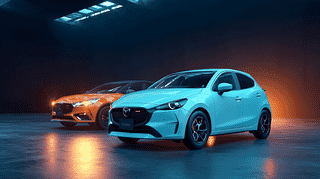
Mazda will end domestic production of its signature compact car Mazda2 (formerly Demio) at the end of August 2026. We explore the 30-year legacy of the car that saved Mazda from bankruptcy in the 1990s, and what this means for Japan's shrinking compact car market.
Honda will end four-wheeler sales in South Korea by the end of 2026, closing a 23-year chapter with cumulative sales of just 108,600 cars. The retreat coincides with China factory shutdowns from June 2026, the cancellation of the Sony-Honda AFEELA EV, and scrapped North American EV plans, part of a sweeping strategy to concentrate resources on the US, Japan, India, and ASEAN. A deep dive for global readers.
On April 14, 2026, the headline from Nissan's long-term vision wasn't rare earths or robotaxis, it was the return of the Skyline, the continuation of the GT-R, the revival of the Xterra, and the debut of the all-new X-Trail/Rogue e-POWER and Juke EV. Here's Espinosa's 56-to-45 model cull, the new 'Heartbeat' classification, and how Japan, the US, and China each get distinct lineups as Nissan walks a standalone path after the Honda merger collapse.
A rigorous evaluation of Nissan's triple strategy against a global EV slowdown. With Trump's tax credit repeal, China's sales slump, Honda canceling its 0 series, and BloombergNEF cutting EV forecasts by 14 million units, is this Nissan's genuine breakthrough or just the fifth failed long-term plan in six years? Surprisingly, the EV slowdown might actually be a tailwind for Nissan. Here is why.
Honda faces its first-ever annual loss since going public in 1957, with up to $15.7 billion in EV-related write-downs. Three flagship EVs cancelled, Sony-Honda AFEELA scrapped, and China sales declining for 25 straight months. We break down the crisis, analyze Honda's hybrid pivot and May 2026 strategy reveal, and share Japanese and global reactions.
SoftBank, NEC, Honda, and Sony have established a new company to develop Japan's own AI foundation model, backed by $6.3 billion in government support over five years. Instead of competing head-on with US and Chinese tech giants in general-purpose AI, Japan is betting on 'Physical AI', AI that controls robots and factory equipment using the country's deep manufacturing expertise.
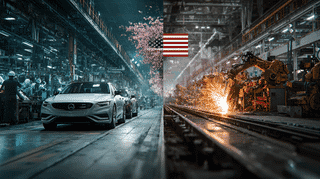
Trump tariffs triggered a massive production shift by Toyota, Honda, Nissan, and Subaru from Japan to the US. With $35 billion in annual tariff costs industry-wide, we explore each maker's strategy, the impact on 5.5 million Japanese jobs, and how this echoes the 1980s trade wars.
Sony Honda Mobility has cancelled its AFEELA EV just months before its planned launch. With Honda posting a record $4.6 billion loss and abandoning its 2040 zero-engine goal, we analyze what went wrong—from Trump's EV policy rollback to BYD's rise—and what it means for Japan's auto industry.