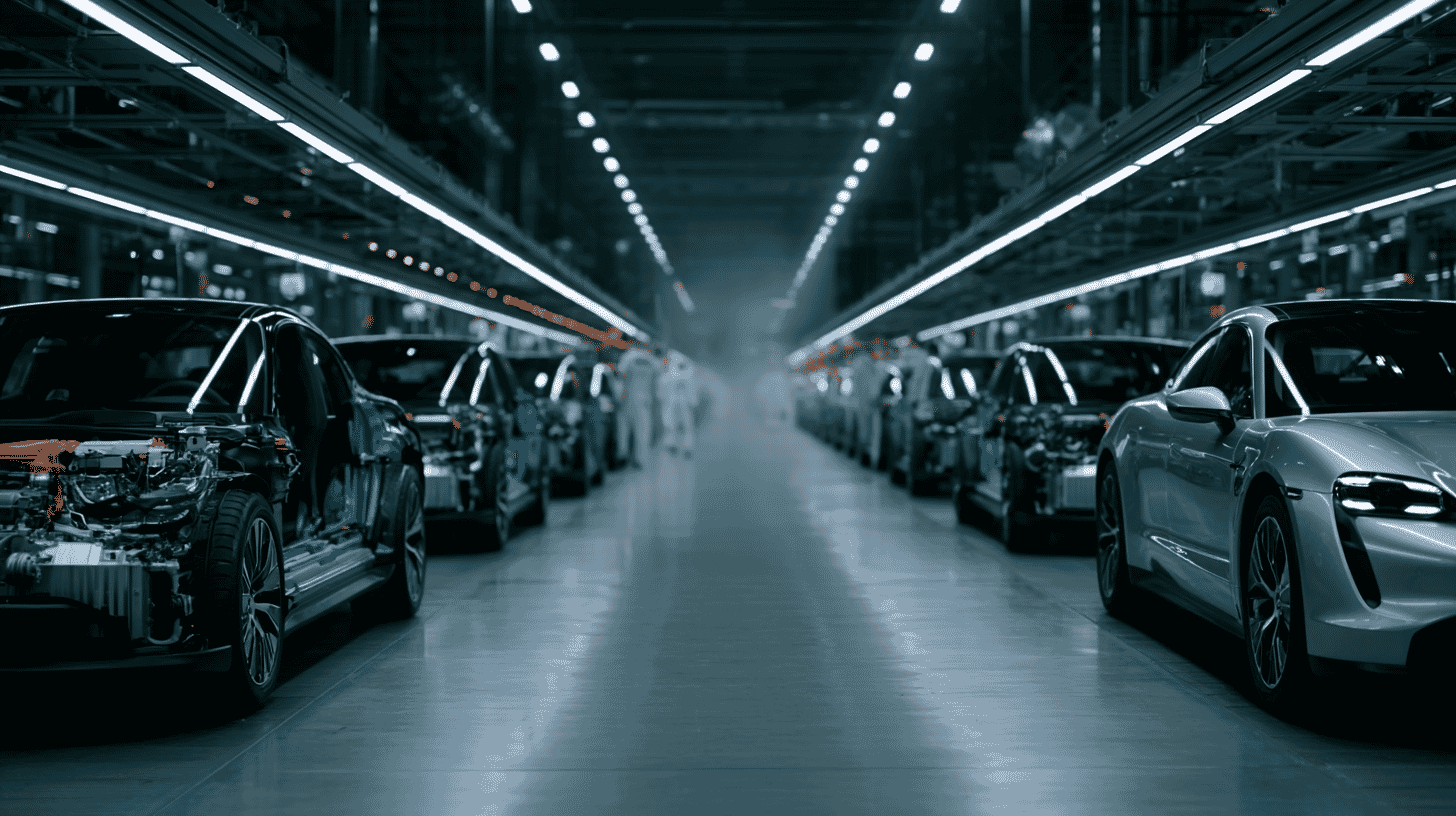
🚗 Honda just booked its first net loss since going public in 1957.
The number on the page: 423.9 billion yen in the red, reported on May 14, 2026. The number underneath it is uglier, 1.58 trillion yen wiped off the books for an EV program that never reached customers. And the number Honda would rather you watch sits further out: a 15-model hybrid offensive, due 2027 through 2029, that the company is now betting its next decade on.
For a carmaker that shrugged off oil shocks, financial crises and the Nissan merger that never happened, the symbolism is heavier than the figure. Honda came through Lehman in the black. It did not come through its own EV bet.
What actually happened on May 14
In a Shinjuku ballroom, CEO Toshihiro Mibe stood next to two unfamiliar prototypes, a Honda hybrid sedan and an Acura hybrid SUV, both wearing a redesigned "H" badge, and walked reporters through three documents at once: a record earnings miss, a quietly upbeat outlook, and a five-year restructuring plan branded the "2026 Business Update."
The headline figures, all under IFRS:
- Revenue: 21.80 trillion yen, up 0.5% year on year.
- Operating result: 414.3 billion yen loss, against a 1.21 trillion yen profit a year earlier. Also a first.
- Net result: 423.9 billion yen loss, against a 835.8 billion yen profit a year earlier, and the company's first since listing in Tokyo in 1957.
- EV-related charges baked into the above: 1.58 trillion yen, of which 1.45 trillion hit operating profit and 124 billion hit equity-method investments. Some 267.1 billion was booked through the third quarter; the decision to cancel the North American BEVs added 1.31 trillion in the fourth.
- Adjusted operating profit, ex-EV losses: 1.04 trillion yen. The underlying business was profitable; the strategy was not.
- Unit sales: 3.387 million automobiles, down 329,000 year on year, against 22.101 million motorcycles, up 1.529 million. Two wheels covered the hole left by four.
Honda also published guidance for the fiscal year ending March 2027: revenue of 23.15 trillion yen, up 6%, operating profit of 500 billion, and net income of 260 billion. That is a return to the black even after another 500 billion yen in EV-related charges is baked in. Analysts polled by QUICK had penciled in a 35.6 billion yen net loss; Honda guided to a profit instead.
The dividend is held at 70 yen a share, and Honda introduced a shareholder-return benchmark targeting a dividend-on-equity ratio of around 3.0%. Net cash at the operating companies sits at 3.3 trillion yen. This is not a company without ammunition. It is one whose strategy just blew up in public.
How the money went
Honda announced the bones of the EV pullback back in March, when it told suppliers and shareholders it was killing three North American models: the Honda 0 SUV, the Honda 0 Saloon, and the Acura RSX. The numbers have now hardened.
The 1.58 trillion yen charge covers three buckets. The first is asset impairments: factories retooled for EVs that will not make EVs, tooling ordered for vehicles that will not ship, and battery-related equipment that will be reconfigured for hybrid use rather than scrapped. The second is compensation to suppliers, whose contracts had been signed, parts ordered and in some cases molds already cut. The third is impairments on Honda's equity-method stake in its Chinese joint ventures, where sales have been falling year on year for a long stretch in a market increasingly defined by BYD's pricing and software speed.
One detail matters for reading the number correctly: most of the 1.58 trillion is non-cash, impairments and write-offs rather than money leaving the building. Actual cash goes out mainly on supplier compensation. That is precisely why Honda could hold the dividend while making a decision this drastic.
And there is more to come. Honda's FY2027 guidance includes a further ¥500 billion in EV-related costs, supplier compensation tends to tail for a year or two after a program is killed. Cumulative pain from the 0 Series reversal is still tracking toward the 2.5 trillion yen figure the company floated in March.
The harder truth, though, is buried in the same disclosure. Strip out the EV mess and Honda's adjusted operating profit was over ¥1 trillion. The two-wheel business, the unglamorous part of the company that sells motorcycles in India, Indonesia, and Brazil, is a cash machine. So the loss is not a sign that Honda has stopped working. It is the price tag on a strategic call that Mibe himself made in 2021, when he stood up shortly after taking the CEO job and pledged that 100% of new Honda sales would be EVs or fuel-cell vehicles by 2040.
That target is, as of May 14, gone. Mibe declined to repeat it. The "Power of Dreams" slogan remains; the 2040 deadline does not.
The new bet: 15 hybrids in 30 months
What Honda announced instead was the hybrid pivot reporters had been told to expect, with more specificity and more money than most had guessed.
The plan, in broad strokes:
- A next-generation hybrid system arrives in 2027, with a new platform and a newly developed electric AWD unit. Two prototypes were shown on stage: the Honda Hybrid Sedan and the Acura Hybrid SUV.
- Fifteen hybrid models globally by the end of FY2029, roughly two and a half years from launch, with North America as the lead market. A D-segment-and-above large hybrid is slated for 2029.
- Cost down 30% versus the 2023-model hybrid system, with a further 10% gain in fuel economy.
- Next-generation ADAS rolled out from 2028, fitted to more than 15 hybrids over five years.
- The new "H" emblem will appear on both EVs and the new hybrids, signaling that hybrids are no longer a transitional fudge but the flagship.
The capital allocation behind this is striking. Of 6.2 trillion yen in three-year R&D and capex, EV spending is held to 0.8 trillion. Software gets 1 trillion. Internal combustion and hybrids get 4.4 trillion. Five years ago those ratios would have been roughly inverted.
There is a process bet inside the product bet, too. Mibe set a goal he called "Triple Half": cutting development cost, development time, and engineering man-hours by 50% each versus 2025 baselines. Minor model changes adopt the new pace this fiscal year; full model changes adopt it from 2028. Honda is, in effect, telling itself it has to develop cars at roughly the speed BYD develops them: half the engineers, half the months, half the money.
The Canadian battery-and-EV value chain announced last year has been indefinitely shelved. So has any pretense that Honda will be vertically integrated in batteries; the company now openly says it will lean on external partners and standardized parts, using Chinese and Indian cost bases where it can.
The payoff line: 1.4 trillion yen in operating profit by FY2029, which would match or exceed Honda's all-time high, and ROIC of 10% by FY2031.
Where this leaves Toyota, Tesla, BYD, and Hyundai
Honda's stumble is a Honda story, but not an isolated one. Through 2026, conventional hybrids have been taking a larger share of US new vehicle sales while battery-electric volumes have gone backwards. Ford has booked large EV-related charges of its own, and GM and Stellantis have run versions of the same exercise.
Against that backdrop, four contrasts matter.
Toyota. The multi-pathway line the company stuck to through years of mockery, hybrids and plug-in hybrids and EVs and fuel cells, each sized to its market, looks vindicated. Toyota's own internal math, the so-called 1-6-90 rule, holds that the lithium and nickel needed for one long-range EV can build six plug-in hybrids or 90 hybrids. That sounded like an excuse in 2022. In 2026, with US BEV demand contracting and hybrid demand surging, it sounds like a forecast. Toyota is still expanding its BEV lineup in Europe, but it never gave up the hybrid backbone Honda is now scrambling to rebuild.
Tesla. The pure-play has had its own difficult stretch, but it briefly took the global BEV crown back from BYD in Q1 2026, with 358,023 deliveries against BYD's 310,389, helped largely by BYD's domestic stumble. Tesla's structural advantage over a Honda or a Ford is that it never had to write down an ICE business, compensate ICE suppliers or renegotiate a hybrid dealer network. Its losses, when they come, are losses on EVs from a base that is already entirely EVs.
That crown changed hands again one quarter later. In Q2 2026, BYD delivered 557,090 BEVs against Tesla's 480,126. Tesla's quarter was its strongest second quarter ever, up about 25% year on year, while BYD's BEV deliveries fell around 8%, narrowing the gap from more than 220,000 units a year earlier to roughly 77,000. The ranking is less interesting than the fact that the two trajectories are pointing in opposite directions.
BYD. Q1 BEV sales were down 25% year on year. China's domestic EV market, long the engine of BYD's growth, is now its biggest problem: the expiry of the EV purchase-tax exemption at the end of 2025 and a ferocious price war hit volumes and margins at once. BYD's answer is the opposite of Honda's: push harder abroad, especially in Europe, Southeast Asia and Latin America, and lean on plug-in hybrids as the bridge product. The company has told analysts it expects overseas sales of 1.5 million vehicles in 2026, above its official 1.3 million target. Notably, BYD's PHEV-heavy lineup looks structurally closer to Toyota's multi-pathway than to Tesla's pure-EV stance.
Hyundai-Kia. The quiet winner. The Korean group never made a 2040 commitment as absolute as Honda's, kept investing in ICE and hybrid in parallel, and is now winning share in the US precisely as Japanese rivals retrench. Where Toyota's hybrid wins are loud, Hyundai's balance has been winning quietly.
The picture is not that EVs failed. The speed of the EV transition was overestimated almost universally by legacy automakers, subsidies and rules in the United States moved faster than capital expenditure plans, and the companies that hedged now look better than the ones that committed.
What Mibe didn't say
Two questions hovered over the room on Thursday that the prepared remarks did not directly answer.
The first is governance. Alongside the results, Honda resolved that Mibe and the executive vice president would voluntarily return 30% of three months' monthly pay in the year to March 2027. Mibe's longtime ally on the executive committee was confirmed as not being renominated as a director. Beyond that, no further executive accountability was announced and no succession schedule offered. For a reversal of a 2021 strategy on this scale, the share of pain absorbed at the top is still, by most standards, light.
The second is China. The five-year plan as published is candid about Honda's collapse there, with a long run of year-on-year declines and sales far below their peak. The proposed fix, using local partners' platforms, local standardized parts and local development speed, is rational. Whether it is achievable in a market where the dominant players are now Chinese brands that have spent five years optimizing exactly that operating model is a different question. Honda's framing of China as the place where it needs to "take in local speed" reads, between the lines, like an admission that it cannot lead there anymore.
Why this matters beyond Honda
Honda is the world's biggest motorcycle maker, the seventh-largest car company by volume, the company that put the small-displacement Civic into the American driveway and the Cub onto half the back roads in Asia. A bad year is not existential. But the 1.58 trillion yen write-off is also a marker, possibly the cleanest single marker, of where the global auto industry's mid-2020s EV experiment actually landed.
The optimistic read is that Honda has now done the painful arithmetic, freed up capital, and put hybrids back where the market is. The pessimistic read is that the company has spent five years and the equivalent of a major automaker's annual profit to end up roughly where Toyota always said it should be. Both can be true.
In Japan, the reaction has split along recognizable lines: vindication from hybrid loyalists, frustration from EV believers who think the country has now lost a generation to indecision, exasperation from suppliers absorbing the second-order pain, and resignation from longtime Honda fans who remember when the company moved faster than its rivals, not slower.
The deeper question, the one Mibe pointedly did not try to answer, is whether Honda can run Triple Half, meaning half the time, half the cost and half the engineering, against companies that have been running at that pace for years.
How is your own country's national champion automaker handling the same problem? Doubling down on EVs, hedging back to hybrids, or quietly trying to do both?
References
- https://global.honda/jp/news/2026/c260514b.html
- https://news.yahoo.co.jp/articles/8d569d1a7ea106e9cc7fc722ce1325485c9e85a4
- https://www.nikkei.com/article/DGXZQOUB115RA0R10C26A5000000/
- https://response.jp/article/2026/05/14/411271.html
- https://response.jp/article/2026/05/14/411275.html
- https://car.watch.impress.co.jp/docs/news/2108657.html
- https://finance.yahoo.com/news/toyota-hybrid-strategy-starting-look-180057546.html
- https://www.autoblog.com/news/tesla-reclaims-global-ev-sales-crown-from-byd
- https://thedriven.io/2026/04/09/byd-and-tesla-still-dominate-as-ev-sales-surge-but-new-brands-make-their-mark/








Global Discussion
0 comments