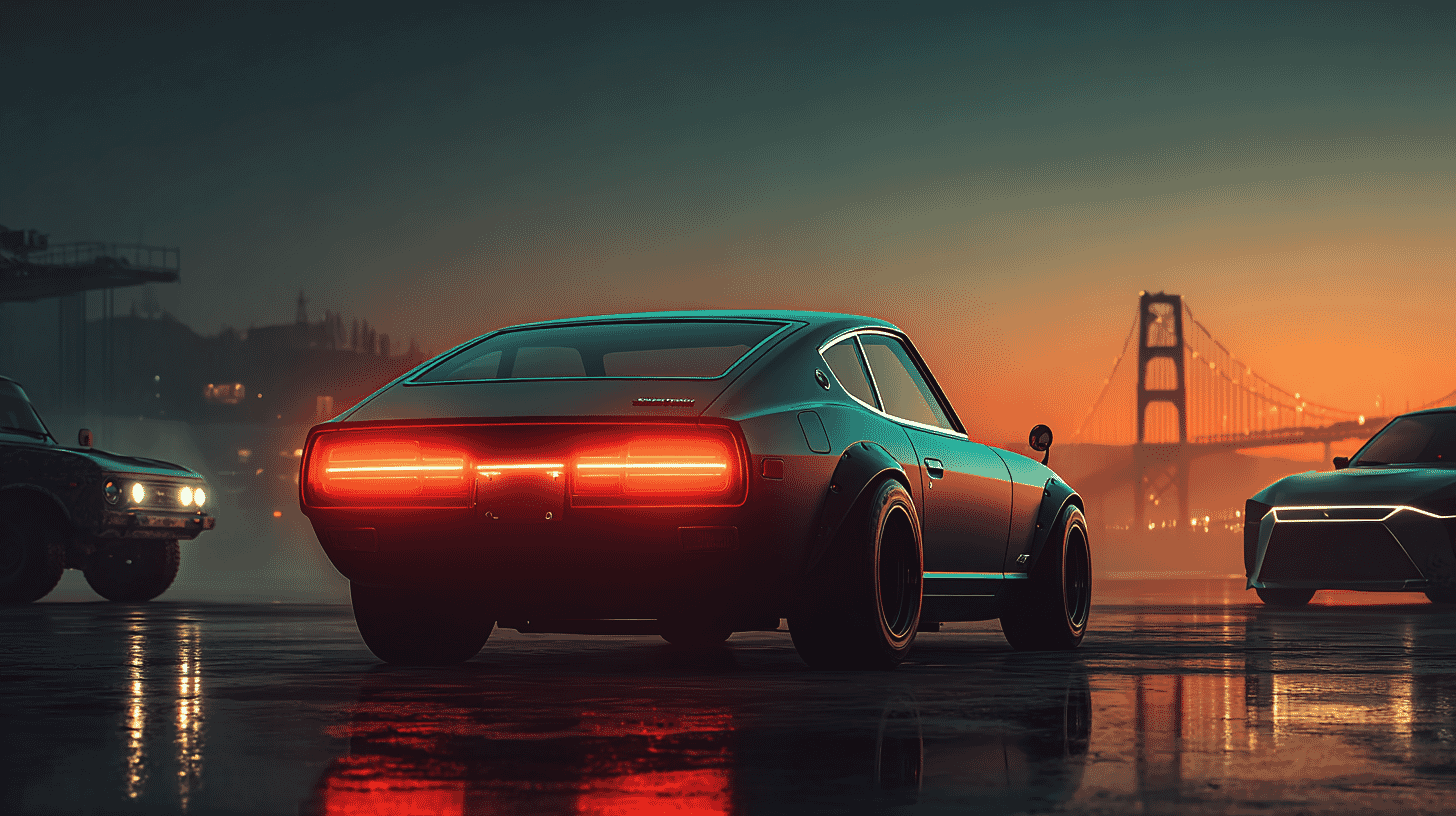
"We are keeping the GT-R. It is one of Nissan's icons, and I believe, one of the auto industry's icons. We have an obligation to keep that tradition alive."
On April 14, 2026, inside the Global Gallery at Nissan's Yokohama headquarters, the all-new X-Trail and a European-market Juke EV stood in the flesh, while the silhouette of a new-generation Skyline, surfline crease intact, glowed on the screen behind them. CEO Ivan Espinosa finished presenting the long-term vision "Mobility Intelligence for Everyday Life," and then, during the CEO roundtable that followed, he dropped the line above.
A Nissan in the middle of a brutal turnaround didn't use this stage only for "AI," "electrification," and "alliances." It lined up actual car names. That's the single most underappreciated feature of this vision announcement, and it's the story we want to tell in this article, as a companion to the three-arrows evaluation we published on April 19 (rare-earth reduction, E2E autonomous driving, robotaxis with Uber and Wayve).
For the strategic framework and our evaluation of the three arrows, see the earlier article linked above. This piece is its product-and-region counterpart.
Headline Number: 56 Models Down to 45, Sorted into Four Roles
Start with the most important number.
- Current portfolio: 56 models
- Target by 2030: 45 models
- In exchange: more powertrain options per model
Instead of chasing volume, Nissan will focus on making each car cut cleanly into a specific market, customer, and purpose. To do that, every model gets reclassified into one of four categories:
| Category | Role | Examples |
|---|---|---|
| Heartbeat | Emotional brand value and innovation | Fairlady Z, Skyline, Leaf, Patrol, GT-R, Xterra |
| Core | Scale and stability, the business engine | X-Trail / Rogue e-POWER, Juke EV |
| Growth | Open up new demand pockets | China-developed EVs, new Japanese compact series |
| Partner | Extend market coverage via disciplined collaboration | Models shared with Mitsubishi Motors and Renault |
The Heartbeat list is what made the room lean in.
The New Skyline Returns With "Surfline" and Round Taillights
When Espinosa said, "Finally, a name that represents the origin and soul of Nissan," the room went silent. The teaser showed only the front and rear. But two design cues were unmistakable to anyone who knows Nissan.
Round taillights, the emblem shared with the GT-R, a mark earned only by Skyline. And the surfline, the single continuous crease that arcs along the body side. Both features returning means Nissan finally sat down and answered the question "what is a Skyline?" honestly.
The current V37 Skyline has been essentially untouched since 2014. The next-generation car will sit in the "Heartbeat" slot as a Japan-focused offering, prioritizing performance, precision, and driver engagement. US outlets are speculating that Infiniti may get its own version as a rear-drive V6 sports sedan, effectively the American Skyline returning under a different badge. That traditional RWD-V6-sports-sedan configuration looks like it's coming back, one way or another.
GT-R: "We're Keeping It": But the Next One Is Not Yet Shown
Domestic sales of the R35 GT-R ended in the summer of 2025. That context makes Espinosa's comment heavy:
"We have an obligation to keep that tradition alive."
The choice of the word "obligation" is striking. No teaser of the next GT-R has been released yet. Some observers noted that the Skyline teaser's taillights looked GT-R-adjacent and speculated the two could share a platform, but at this point it's genuinely just speculation.
Xterra Revival: Not a Crossover, but a Real Body-on-Frame Off-Roader
Nearly unknown in Japan, the Xterra was a body-on-frame, ladder-chassis SUV sold in North America from 1999 to 2015, the kind of vehicle that competes with Toyota's FJ Cruiser and the Jeep Wrangler.
The new Xterra is framed as "adventurous spirit, body-on-frame strength, and purpose-driven design." In North America, it will come with V6 gasoline powertrains and also a body-on-frame V6 HEV, centerpiece of the ~20 new or refreshed North American models planned by 2028.
What matters here is that Nissan is bringing back not a crossover SUV but a real mud-and-rocks off-roader in North America. That signals Nissan is going straight at the renewed demand for traditional pickups and body-on-frame vehicles, the demand that has returned under the Trump administration's policy environment, as EV tax credits went away.
The Two Cars That Actually Showed Up: X-Trail/Rogue e-POWER and Juke EV
These two were on the stage in the flesh.
X-Trail / Rogue e-POWER (Global Core Model)
The new car carries the next generation of Nissan's proprietary e-POWER system, engine generates electricity, motor drives the wheels. According to Nissan, this third-generation unit improves fuel economy by about 20% over the second generation. With EV subsidies contracting in both the US and China, Nissan is pushing e-POWER hard as a "bridge" technology that delivers EV-like driving feel without requiring charging infrastructure.
Juke EV (European Core Model)
This is the visually loudest announcement. The new Juke EV recalls the "Hyperpunk" concept from the 2023 Japan Mobility Show, as if a 3D-CG polygon model had been dropped into the real world. Large, angular surfaces, deliberately "raw" texturing. The Juke has always been a statement piece; now it's dialed past 10.
Europe faces a 2035 ICE ban while Chinese makers push hard into the continent. Nissan's bet is to survive by being the weirdest, boldest-looking EV sub-compact on the market.
Three Lead Markets, Three Different Faces: Japan, US, China
The regional spine of the long-term vision: Japan, the US, and China are "lead markets," and each gets its own dedicated strong lineup.
Japan: Compact Car Series and a 550,000-Unit Target
In Japan, Nissan will launch a new compact car series by 2028 and targets annual sales of 550,000 units. Caught for years between the kei-car segment and mass-market registered cars, Nissan will try to rebuild its home-market position with two pillars, the Heartbeat Skyline on top, and the new compact as the everyday workhorse below.
US: The V6 Returns, Pickups Get Reinvested In
In addition to the Xterra, Nissan will add V6 engines and V6 hybrids across multiple body-on-frame models. V6 options come back into the D-segment (Rogue class) as well. This mirrors the direction Honda has taken since canceling its "Zero Series" EV program and pivoting sharply back to hybrids and trucks in the US.
China: N7 and N6 as an Export Hub
China is shifting from "defense" to "offense" for Nissan. The N7, a China-developed EV sedan launched in April 2025 at 119,900 yuan (around $16,400 / ¥2.6 million), is selling well. Its sibling, the N6 PHEV, followed with the largest battery capacity in its Chinese segment. And crucially, Nissan has now formally committed to exporting Chinese-made EVs to Southeast Asia, the Middle East, and Latin America starting in 2026.
The structure that emerges is learn in China, build in China, ship from China to the world. China has been repositioned from "market we might retreat from" to "technology and manufacturing hub."
Infiniti Revival: Five New Models Starting With the 2027 QX65
The premium brand Infiniti is folded into the comeback script.
- Spring 2027: an all-new QX65 SUV
- Following: a new mid-size hybrid SUV, a V6 performance sedan, and two frame-based hybrid SUVs
That V6 performance sedan is widely expected to be the North American "Skyline", successor to the old Q50, built on the traditional RWD-V6 architecture, potentially with a manual. For enthusiasts in the US who remember the original G35/G37, the prospect is genuinely exciting.
Powertrains: From "One Answer" to "Choices"
Five years ago, Nissan was still positioning itself as "the EV transition leader."
The deepest course correction in this vision is here. Powertrains now look like this:
- e-POWER (core): Nissan's proprietary series hybrid
- Body-on-frame HEV (new): for off-road capability and long-distance confidence
- PHEV / REEV (via partners): range-extender tech licensed in
- BEV: the new Leaf, Juke EV, China N7, etc.
In other words, Nissan has converged toward something structurally similar to Toyota's "multi-pathway strategy." You can't run on BEV alone. But where Toyota dominates strong hybrids (THS) and Honda has e:HEV, Nissan differentiates on e-POWER's distinct philosophy, a series hybrid that drives like an EV but fuels like a gas car.
A Standalone Path After the Honda Merger Collapse
This strategy can't be read without the Honda merger story.
- December 23, 2024: Nissan and Honda signed an MOU to explore a merger
- February 13, 2025: Talks collapsed. Honda's proposal to make Nissan a subsidiary was rejected by Nissan's leadership, which pushed for an equal partnership
- April 1, 2025: CEO Makoto Uchida resigned; Ivan Espinosa took over
- May 2025: Reports (denied by both companies) suggested a Toyota executive had reached out to Nissan about a possible partnership
Toyota Chairman Akio Toyoda had already signaled skepticism at CES in January 2025, pointing out that mergers rarely produce real competitive strength and that "just having volume doesn't necessarily mean you're strong."
So Nissan walked in alone to the April 14 stage. Whether Nissan chose independence or was forced into it is debatable. Either way, Espinosa's "no-taboo collaboration" philosophy means EV and software cooperation with Honda will continue, but the product strategy is now entirely Nissan-led.
Side-by-Side: Toyota, Honda, and Nissan Right Now
| Toyota | Honda | Nissan | |
|---|---|---|---|
| Finances | World #1 by volume, highly profitable | Profitable but struggling in China | FY2024 net loss of ¥670.9 bn (≈$4.2 bn) |
| EV strategy | Multi-pathway, HEV-centric | Zero Series canceled, pivot back to hybrids | e-POWER core, diversified PTs, China offense with N7 |
| Alliances | SUBARU 20%, Mazda 5.1%, Suzuki 4.9%, Isuzu 5.9%, Daihatsu & Hino wholly owned | GM (North America), Sony (Afeela) | Mitsubishi/Renault Alliance, limited Honda collab |
| Recent pain | Losing EV share in China | NA recalls, Zero Series withdrawn | 20,000 layoffs, Oppama plant closure |
| Icon-revival plays | Land Cruiser, GR series | Prelude return | Skyline, GT-R, Xterra |
The three companies have converged on the same move: turning past heritage into future capital. Honda's Prelude, Toyota's GR and Land Cruiser reboot, and Nissan's Skyline/GT-R/Xterra. After realizing EVs alone can't win, Japan's big three are weaponizing emotional value again.
Three Unfinished Pieces
This lineup strategy isn't bulletproof. Three open questions.
1. What does "GT-R continuation" actually mean?
He said "we're keeping it." On what platform? With what electrification? When? BEV, hybrid, or a last-stand V6 ICE? Carrying R35's soul forward will require serious development investment, and Nissan's balance sheet doesn't have much slack.
2. Where do the 11 cut models land?
Which 11 models disappear, and where do their dealers, customers, and suppliers go? The 70% parts reduction (linked to the E2E platform strategy) compounds the pressure on the supplier base. For a company that has missed four of the last five long-term plans, execution precision here is everything.
3. China dependency and geopolitical risk
Turning China into an export hub is elegant on paper, but if US-China tensions escalate, export destinations become constrained fast. Trump tariffs, Southeast Asian wariness toward Chinese EVs, EU tariffs on China-made EVs, each can disrupt this model.
Not EVs, Not AI: Start With the Names of the Cars
The technology-heavy framing of Nissan's vision (the three arrows) pulled attention in one direction. But the heart of this vision is something simpler: Nissan is redefining what Nissan is.
Skyline returns. GT-R continues. Xterra reclaims dirt roads in North America. Juke EV provokes European cities. N7 ships from Guangzhou to the ports of Latin America. These are Espinosa's answer to the question "what is Nissan for?"
With four of the last five long-term plans having missed their targets, skepticism is warranted. But this time, at least, the vision was told through names people remember rather than slides full of numbers. Anyone whose heart moved when Skyline and GT-R came up on that screen already knows what those names weigh.
In Japan, just hearing "the Skyline and GT-R are coming back" makes some people feel something. The names are more than model designations, they carry generational memory. In your country, is there a car model whose return would make your heart skip? And when a struggling legacy automaker bets on reviving legendary nameplates, how does that strategy read to you? We'd love to hear your perspective in the comments.
References
- https://global.nissannews.com/ja-JP/releases/260414-01-j
- https://global.nissannews.com/en/releases/260414-vision
- https://news.yahoo.co.jp/articles/9d976f10c5861b84bf0e7bd59a5d4f1834c47bb7
- https://car.watch.impress.co.jp/docs/news/2102022.html
- https://kuruma-news.jp/post/1045279
- https://www.webcartop.jp/2026/04/1840570/
- https://motor-fan.jp/article/1460107/
- https://www.carscoops.com/2026/04/nissan-skyline-next-generation-2/
- https://carbuzz.com/nissan-skyline-returns-teaser/
- https://www.hagerty.com/media/news/skyline-v-6-xterra-will-be-heartbeats-of-new-nissan-plan/
- https://stupiddope.com/2026/04/nissan-xterra-return-anchors-mobility-intelligence-strategy-through-2028/
- https://usa.nissannews.com/en-US/releases/nissan-sets-long-term-direction-with-vision-of-mobility-intelligence-for-everyday-life
- https://www.nikkei.com/article/DGKKZO89837470V00C25A7MM8000/
- https://evmagazine.com/news/honda-nissan-merger-collapse








Global Discussion
14 comments