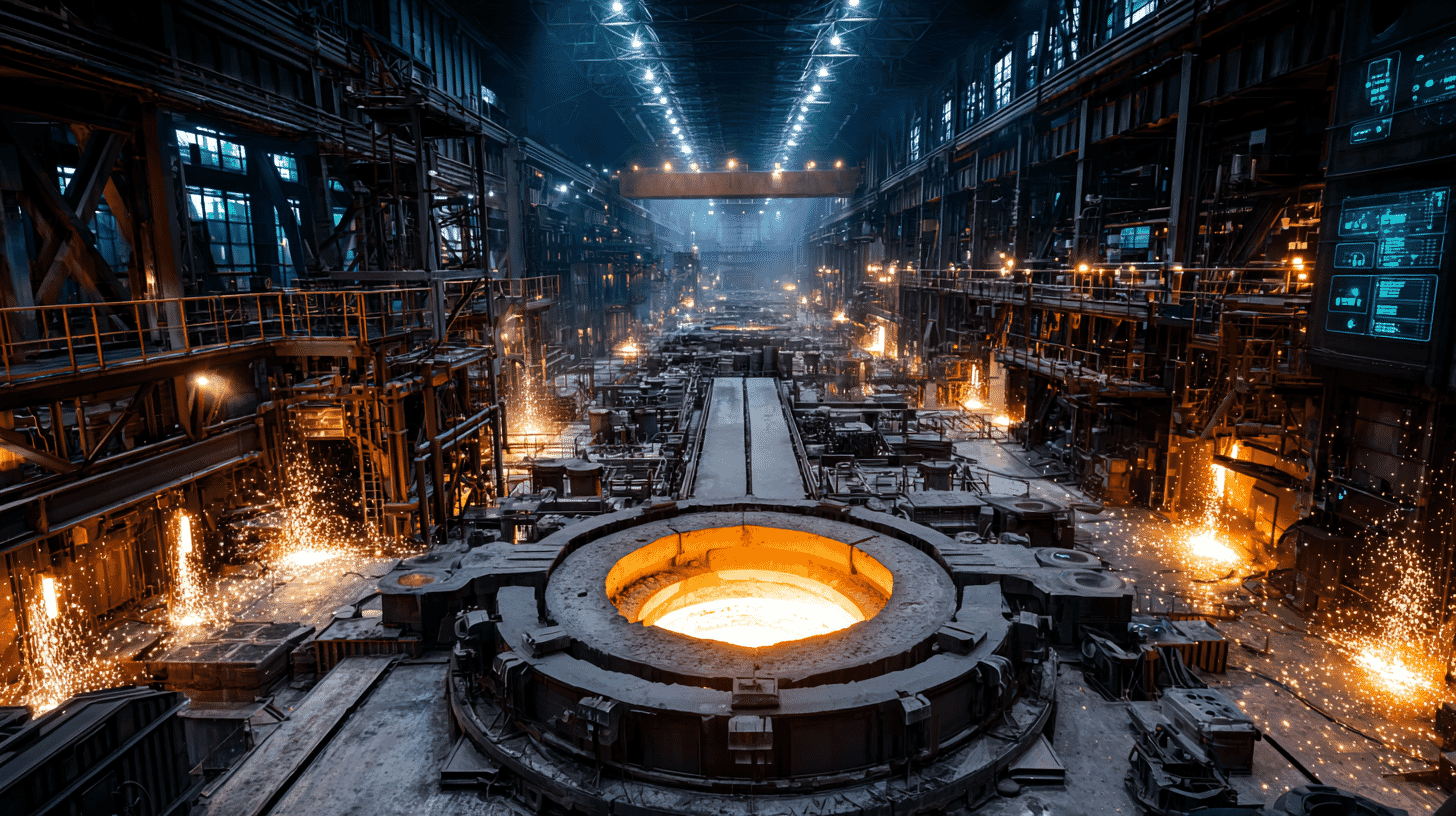
Japan's second-largest steelmaker, JFE, is investing $2.2 billion to replace a blast furnace in Okayama Prefecture with a next-generation electric arc furnace. In March 2026, a government-backed organization stepped in with up to $1.2 billion in debt guarantees. Steel is the largest CO₂ emitter in Japan's industrial sector, and whether this conversion works will shape what the rest of the industry does next.
What Happened: A $1.2 Billion Government Backstop
In March 2026, Japan's GX (Green Transformation) Promotion Organization announced it will provide up to ¥180 billion (approximately $1.2 billion) in debt guarantees for JFE Holdings' subsidiary JFE Steel. In practical terms, this means the Japanese government is essentially co-signing JFE's loans from private banks, dramatically reducing the financial risk of this massive green investment.
The GX Promotion Organization (formally, the Organization for Promotion of Decarbonization Growth-Oriented Economic Structure Transition) was authorized by METI in April 2024 and began operations that July. It is chaired by Yoshinobu Tsutsui, head of the Keidanren business federation. Beyond financial support for GX investment through guarantees and equity, it runs the emissions trading scheme entering full force in FY2026 and collects the fossil fuel levy. Its stated mission is to drive over ¥150 trillion ($1 trillion) in combined public-private investment over the next decade.
This isn't JFE's first round of government support. The project was selected in December 2024 for a GX Transition Bond-funded subsidy program, and in April 2025 the grant was finalized at up to ¥104.5 billion ($700 million). Combined with the new debt guarantees, total government backing reaches approximately $1.9 billion, more than half of the project's $2.2 billion cost. Guarantees are issued with METI's consent and cover 90–95% of the loan depending on the category. JFE Holdings said on March 23, 2026 that roughly ¥8 billion of a transition loan signed with Mizuho Bank carries the guarantee.
From Blast Furnace to Electric Arc Furnace: What Changes
At the heart of this project is the conversion of Blast Furnace No. 2 at JFE Steel's West Japan Works in Kurashiki, Okayama into what JFE calls an "innovative electric arc furnace" (EAF).
Traditional blast furnaces use coke (derived from coal) to chemically reduce iron ore into molten iron. This process generates roughly 2 tonnes of CO₂ for every tonne of steel produced. Electric arc furnaces, by contrast, use electricity to melt iron scrap or reduced iron, cutting emissions to about 0.5 tonnes of CO₂ per tonne of steel when using scrap.
JFE's new EAF will have an annual crude steel production capacity of approximately 2 million tonnes, making it one of the largest in the world. It is expected to begin operations in Q1 of fiscal year 2028 (April–June 2028) and reduce CO₂ emissions by an estimated 2.6 million tonnes per year. Blast Furnace No. 2 was already due for a scheduled rebuild in 2027.
However, the switch comes with significant technical challenges. Conventional EAFs have struggled to produce the high-grade steel products that blast furnaces excel at, products like high-tensile steel sheets for automotive bodies and electromagnetic steel sheets for motors. JFE plans to deploy proprietary refining technologies to achieve blast-furnace-quality output from its new EAF, which would be a major technological breakthrough.
There's also the power question. Blast furnaces generate their own electricity from by-product gases; electric furnaces have no such loop and draw everything from the grid. JFE estimates the new furnace will require additional stable power equivalent to about half a nuclear power plant.
Raw Material Strategy: Scrap, Gas-HBI, and Hydrogen-HBI
JFE envisions three raw material pathways for its new EAF. The first is domestic iron scrap. The second is importing HBI (Hot Briquetted Iron) produced using natural gas in the Middle East. The third, longer term, is hydrogen-based direct reduced iron.
Natural gas HBI will likely be the primary feedstock in the near term. However, it still carries environmental concerns including manufacturing-stage CO₂ emissions and methane leakage. Achieving truly zero-emission steel will ultimately require a transition to H₂-HBI, a technology that aligns with Japan's broader hydrogen economy ambitions.
Japan's Triple-Layer Support System
The JFE project showcases the full architecture of Japan's GX industrial policy, which operates on three levels of support.
Layer 1: Direct Subsidies. Up to ¥104.5 billion ($700 million) from GX Economy Transition Bonds, covering nearly one-third of the total investment cost.
Layer 2: Debt Guarantees. Up to ¥180 billion ($1.2 billion) from the GX Promotion Organization, enabling JFE to secure private bank financing at favorable terms.
Layer 3: Tax Credits. Under the "Strategic Domestic Production Promotion Tax System" introduced in the 2024 tax reform, green steel production receives a tax credit of ¥20,000 (approximately $133) per tonne, declining gradually over a 10-year period and averaging about ¥17,000 ($112) per tonne annually. Eligibility requires converting from blast furnace to EAF and matching blast-furnace steel quality: for ordinary steel, nitrogen at or below 0.004% and phosphorus at or below 0.015%.
This "support first, regulate later" approach is a defining feature of Japan's GX strategy. The government has pledged approximately ¥20 trillion ($133 billion) in upfront investment through GX Transition Bonds, with repayment coming from carbon levies on fossil fuel importers starting in 2028 and revenue from the GX Emissions Trading Scheme (GX-ETS), which enters its mandatory second phase in fiscal year 2026.
Global Comparison: How Japan's Approach Stacks Up
Different major economies are tackling steel decarbonization through fundamentally different mechanisms.
The EU takes a regulation-first approach. The Carbon Border Adjustment Mechanism (CBAM), which entered its definitive phase in January 2026, imposes carbon costs on imported steel based on its embedded emissions. This ensures that domestic producers paying EU carbon prices aren't undercut by cheaper, dirtier imports. Under medium carbon price projections, CBAM could add $72–83 per tonne of imported steel by 2030, and $210–243 per tonne by 2034.
The United States has relied on a mix of incentives and tariffs. The Inflation Reduction Act (IRA) under the Biden administration provided large clean energy tax credits, though direct support for steel decarbonization was limited. The more consequential policy for steel has been the Section 232 tariff, raised from 25% to 50% in June 2025 and, since April 2026, applied to the full customs value of covered imports rather than just their metal content, with 15% caps on certain items from trade-agreement partners including Japan and the EU. Under the current Trump administration, the US withdrawal from the Paris Agreement has pointed industrial climate policy in the opposite direction.
Japan's GX model is an investment-first approach. Rather than imposing border carbon tariffs or relying primarily on regulation, Japan front-loads government financial support to de-risk private investment, then gradually tightens carbon pricing over time. The GX-ETS is expected to become mandatory for companies emitting over 100,000 tonnes of CO₂ annually starting in FY2026, but carbon prices remain significantly lower than in the EU.
A key question is whether Japan's GX-ETS carbon price will be recognized as an "effective carbon price" under CBAM rules. If it is, Japanese steel exports to the EU could receive credit for carbon costs already paid domestically. If not, Japanese producers could face additional CBAM charges, a scenario that would undermine the competitiveness of Japan's green steel in European markets.
The China Problem
These decarbonization investments are unfolding against a challenging backdrop: China's massive steel overcapacity. Despite a domestic real estate downturn, Chinese producers have not reduced output, flooding global markets with cheap steel.
All three of Japan's major blast furnace steelmakers, Nippon Steel, JFE Holdings, and Kobe Steel, projected significant profit declines for FY2025 (ending March 2026). That is the backdrop against which JFE is committing this capital, and it explains why the debt guarantees matter: they let private banks lend into a project that would otherwise look too risky in this market.
The Road to 2050
JFE's Kurashiki EAF is the first major proof-of-concept for blast-furnace-to-EAF conversion in Japan's steel industry. The 2.6 million tonnes of annual CO₂ it removes amount to roughly 2% of the Japanese steel industry's total emissions, on the order of 140 million tonnes a year. The number is small. What isn't small is the demonstration: whether blast-furnace-grade steel can come out of an electric furnace at a cost that competes. That answer will shape what Nippon Steel and everyone else decides to build.
That the government layered ¥284.5 billion of support onto a ¥329.4 billion investment is itself a statement. Read the other way, it says this transition doesn't happen on private economics alone.
How is your country approaching steel decarbonization? Is the government providing financial support, or relying on regulation and carbon pricing?
References
- https://www.nikkei.com/article/DGXZQOUA191IN0Z10C26A3000000/
- https://www.jfe-steel.co.jp/release/2025/04/250410-1.html
- https://transitionasia.org/japans-green-steel-transition/
- https://sustainablejapan.jp/2025/04/14/jfesteel-electric-furnace/112480
- https://www.globalefficiencyintel.com/the-impact-of-the-eu-cbam-on-global-steel-trade
- https://carbonmarketwatch.org/2025/10/16/eus-cbam-will-help-asian-economies-step-up-their-carbon-market-ambitions-simulation-reveals/



Global Discussion
12 comments