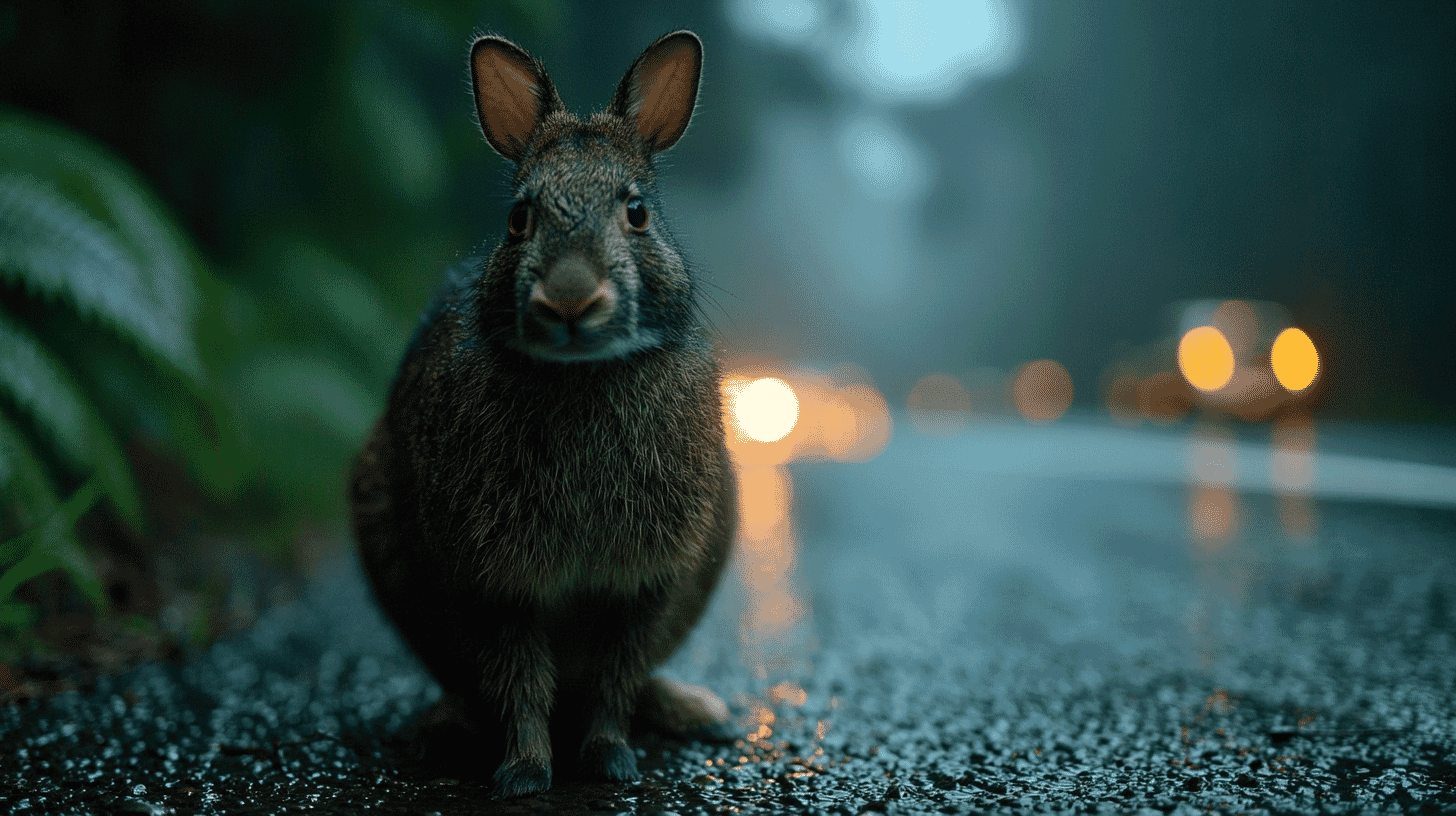
🐇 Japan just finished a 24-year war against an invasive predator on a remote southern island. Conservationists called it a world first. A year later, the rabbit it saved is dying in record numbers, on the roads. In 2025, 185 Amami black rabbits were killed by cars. It's the highest figure ever recorded, and the reason is the very thing that was supposed to save the species.
A grim record in a place celebrated for the opposite
On May 12, 2026, Japan's Ministry of the Environment released figures few people outside the conservation community had been bracing for. In 2025, 185 Amami black rabbits, Pentalagus furnessi, a stocky, dark-furred "living fossil" found only on the islands of Amami Oshima and Tokunoshima in Kagoshima Prefecture, were killed in road collisions. That's 22 more than 2024, and surpasses the previous record of 175 set in 2023.
The breakdown is telling. On Amami Oshima, roadkill jumped to 157, thirty-six more than the year before and a new record. Tokunoshima recorded 28 cases, fourteen fewer than the year before, but still the third-highest tally on file. Total rabbit deaths from all causes hit 284, also the highest ever logged: 213 on Amami Oshima and 71 on Tokunoshima. The 185 road deaths include animals that died after being taken in for treatment.
The collisions cluster in predictable places: the Aminoko Pass section of National Route 58 between Sumiyo in Amami City and Setouchi Town, and the Katoku–Asama Prefectural Road that runs between Amagi and Tokunoshima Towns. These are mountainous, forest-flanked stretches where drivers sweep around blind curves at night, and where the rabbits, slow, ground-bound and with no evolved fear of cars, are now living in numbers nobody has seen for decades.
That last fact is the heart of the story.
The mongoose campaign that worked too well
To understand why 2025 broke the record, you have to go back to a decision made in 1979.
That year, with the well-meaning logic of an earlier era of pest control, prefectural authorities released a population of small Indian mongooses on Amami Oshima. The idea was to control habu, the highly venomous local pit viper. The plan had a fatal design flaw: habu are nocturnal, mongooses are diurnal, and the two animals rarely met in the wild. What mongooses did meet was the Amami rabbit, a species that had evolved on a predator-free island and had no defensive instincts against fast-moving mammalian carnivores.
By 2000, an estimated 10,000 mongooses were loose on the island, and the rabbit was sliding toward extinction. The Ministry of the Environment launched a full eradication program that year, joined in 2005 by a specialized field team known locally as the Amami Mongoose Busters. Over the next two decades they set more than 30,000 traps, deployed sensor cameras across the entire island, trained sniffer dogs, and worked with national research institutes that built statistical models to estimate when the last animal had been removed.
The last mongoose was captured in April 2018. After six years of intensive monitoring without a single new detection, the Ministry of the Environment formally declared the species eradicated on September 3, 2024, the first time an established invasive predator had been wiped from a populated island of this size. We covered that announcement here at the time.
Feral cats, the other major predator, have been the subject of an ongoing trap-and-removal program. The rabbit's recovery has been dramatic. A 2003 study estimated the Amami Oshima population at 2,000 to 4,800 animals. By 2021, the latest comprehensive estimate puts it at 10,024 to 34,427. Tokunoshima's numbers moved from around 200 to between 1,525 and 4,735 over the same period. Eco-tour guides who used to spend months hoping to spot a single rabbit now routinely encounter ten or more in a three-hour night walk.
It is one of the great endemic-species recoveries in Asia. It is also why the roadkill curve has bent the wrong way.
Why success breeds collisions
A rabbit that doesn't exist can't be hit by a car. As the population grew and the range expanded back into forest edges that border the islands' road network, exposure to traffic rose almost mechanically. The Ministry of the Environment's own monitoring confirms this: roadkill has trended upward for most of the past seven years, climbing in step with the recovery.
The species itself makes the problem worse. Amami rabbits are unusually slow-reproducing: research from Okayama University of Science and the University of Tokyo, using growth markers in preserved bone, has shown they take roughly five years to reach adulthood, about five times longer than mainland Japanese hares. That slow life history means a population takes decades to rebuild and can be hammered hard by a single source of mortality once it has rebuilt. Add in the rabbits' tendency to feed along forest verges at night, exactly where headlights aren't expected to find them, and the math becomes ugly.
The hot spots have something else in common. Aminoko Pass and the Katoku–Asama road both cut through prime World Heritage forest. Amami Oshima, Tokunoshima, the northern part of Okinawa Island, and Iriomote Island were inscribed together on UNESCO's natural heritage list in 2021, partly because of the very biodiversity that the eradication programs were designed to save. The roads that bring tourists in to see that biodiversity are now the leading killer of its mascot species.
Tokunoshima's other problem: pets
There's a second number in the 2026 announcement that deserves more attention than it has received. On Tokunoshima, dogs and cats, not feral predators on the mountain but pets and recently-domestic strays in and around towns, killed 19 confirmed Amami rabbits in 2025, more than double the nine recorded the year before. It's the highest figure on record, and it's specific to Tokunoshima: the share of pet-driven mortality there is consistently higher than on Amami Oshima.
The Ministry's response has been blunt. Keep dogs leashed. Keep cats indoors. The message is not new, but it lands differently in a place where the rabbit is no longer an abstraction in a textbook but a creature increasingly likely to wander into a residential garden after dark. Rabbits straying into buildings has become common enough to feature in local reporting.
What Japan is trying, including a sound humans can't hear
The grim arithmetic of the recovery has set off a search for technological countermeasures. The most visible came in March 2025, when Nissan and the agency TBWA\Hakuhodo unveiled "Nissan Animalert," a pilot system that adapts the high-frequency pedestrian-warning chimes already fitted to electric vehicles. Instead of alerting humans, the modified frequencies are tuned to startle wildlife off the road before a car reaches them.
The project is a multi-stakeholder effort involving Nissan, Amami City, the Ministry of the Environment, Okayama University of Science, Nihon University, T.M.Works and the Amami Gunto National Park. Field trials began in December 2024 using a Nissan Sakura kei-class EV fitted with a test emitter on routes through rabbit habitat. Early reports from the trial describe immediate avoidance behavior when the device is active. Nissan acknowledges the tests have so far been at low speeds, and a great deal of validation work remains before any system could be deployed widely.
Japan's broader animal-vehicle problem is sobering. The Ministry of Land, Infrastructure, Transport and Tourism counted more than 70,000 wildlife fatalities on national highways and another 51,000 on expressways in 2022 alone: dogs and cats, raccoon dogs, deer, birds. Forest covers roughly two-thirds of Japan's land area, and the country is wrestling with the same coexistence question that confronts conservation programs from the Florida Keys to the Australian highlands: a recovered species needs more than to stop dying from the original threat. It needs the next threat managed too.
For context, this is the third installment in our ongoing coverage of how Amami Oshima's conservation gains are reshaping life on the islands. We previously reported on the poaching crisis affecting other rare species there and on the 20-year arc of Japan's invasive-species law.
The harder lesson
There is a temptation, reading the 185 figure, to file it under "tragic ironies." It is more useful to read it as the conservation movement's bill coming due.
A species pushed to near-extinction by introduced predators was saved by a 24-year, science-led, community-backed eradication campaign. That campaign worked. The population recovered. The recovery exposed the rabbits to a different, slower, more diffuse killer, one that involves every single driver on the islands, every tourist heading to a night tour, every delivery van threading the coast road at dusk.
This is not an argument against the mongoose campaign. The alternative, letting the rabbit go extinct, was both worse and irreversible. But it is an argument that the headline success in 2024 was a chapter, not the conclusion. The work of 2026 and beyond looks less like trap-and-remove and more like signage, speed limits, AI driver alerts, wildlife corridors, regulated tourism, and the much messier politics of asking people who live and drive on these islands to change their behavior.
What's it like where you are? Has your country's most celebrated conservation success story produced a problem nobody quite knew how to talk about afterward? And did anyone think to ask what comes next?
References
- 南日本新聞 (May 13, 2026): Roadkill of Amami rabbits reaches record 185 in 2025
- 環境省 沖縄奄美自然環境事務所: Amami rabbit population estimates and conservation status
- 環境省 (June 2023): Amami rabbit and Amami woodcock population estimates
- TBWA\Hakuhodo (March 3, 2025): Nissan Animalert launch
- Indianapolis Zoo (November 4, 2024): Conservation Lessons from Japan
- 時事ドットコム (May 16, 2025): Amami rabbit growth research
- Yahoo!ニュース/MBC南日本放送 (May 12, 2026): 185 Amami rabbits killed in traffic accidents









Global Discussion
4 comments