🦕 In 1998, a field team on a Canadian Arctic island pulled bones out of the rock that had no business being there: a crocodile-like reptile more than two meters long, from a place that is polar desert today. The geologist who found them told reporters, "This will be a puzzle for people who model climate." He was right, and the puzzle outlived the century. This summer a team in Japan published an answer, and it turns on a difference of about one degree.
Reptiles that should not have survived that far north
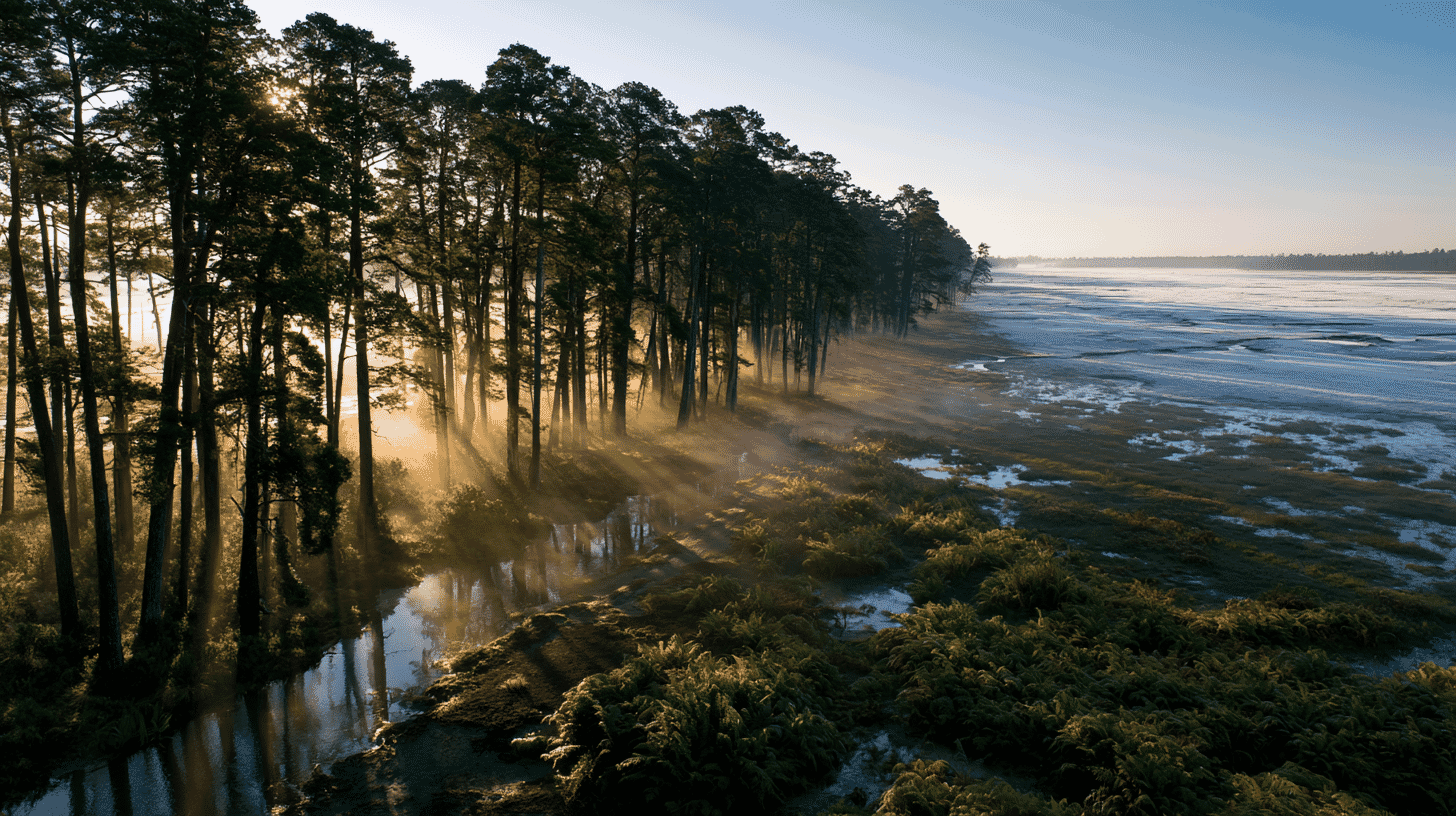
Axel Heiberg Island sits in the Canadian High Arctic, close to 79 degrees north. In the mid-1990s a team led by John Tarduno of the University of Rochester found a fossil bed there, and in 1998 they reported what was in it. Rocks dated between 92 and 86 million years old held champsosaurs, extinct crocodile-like reptiles reaching 2.4 meters, along with turtles and fish. The assemblage implied a mean annual temperature above 14 degrees Celsius rather than something near freezing. Cold-blooded animals of that size cannot bluff their way through a polar winter.
Alaska tells a version of the same story from a later slice of the Cretaceous. The Prince Creek Formation, exposed along the Colville River on the North Slope, has yielded one of the richest collections of polar dinosaurs anywhere, and in 2021 a team reported bones and teeth from hatchlings and perinatal animals. Babies cannot migrate. If they were born there, the adults were staying too.
Arctic Alaska was not tropical. Fossil plants from those beds point to a mean annual temperature of around 6 degrees Celsius, and the animals nested through months of darkness and snow. That is lower than the Axel Heiberg estimate, but the two come from different times and places, and both say the Arctic was far warmer than it is now.
Mainichi Shimbun, summarizing the long-running estimate, puts the Late Cretaceous Arctic annual mean at more than 10 degrees Celsius above pre-industrial levels. The trouble was never the fossils.
Carbon dioxide alone could not get there
The trouble was the computers. Reproducing that warmth in a climate model proved difficult, and the mismatch between geological data and model output became a long-standing problem in the field, according to the Atmosphere and Ocean Research Institute at the University of Tokyo.
Turning up the carbon dioxide is the obvious lever, and it got pulled hard. Mainichi reports the Late Cretaceous atmosphere held three to four times today's concentration. Push a model that far and the whole planet warms, but the poles stubbornly refuse to warm enough.
The missing piece was a modeling habit, not a physical mystery. Simulations of the deep past had generally assumed modern values for Earth's orbital parameters, the slow wobbles that govern how sunlight gets distributed across the planet. Seventy million years of geography got rebuilt from scratch. The orbit stayed where it is now.
The variable they moved was worth one degree
Taro Higuchi, a researcher at the Earth-Life Science Institute (ELSI) at Institute of Science Tokyo, and Ayako Abe-Ouchi, a professor at the Atmosphere and Ocean Research Institute at the University of Tokyo, working with Wing-Le Chan and Ryouta O'ishi, ran MIROC. That is a global climate model developed jointly by the University of Tokyo, the National Institute for Environmental Studies and JAMSTEC, and the version used here couples atmosphere, ocean and vegetation. They loaded the continental layout of about 70 million years ago, the Maastrichtian stage of the Late Cretaceous, then varied the orbital parameters systematically, obliquity, precession and eccentricity, across their full natural range, experiment after experiment. ELSI notes that work on warm climates of the past has mostly looked elsewhere than at orbital variation.
The parameter that mattered most was obliquity, the tilt of Earth's axis. It currently sits at 23.4 degrees. Over the past million years it has swung between 22.1 and 24.5 degrees, and one full oscillation takes about 41,000 years. Mainichi describes the Cretaceous condition as roughly one degree more tilted than today.
One degree sounds like nothing. It is also not an exotic ancient-Earth setting: it sits inside the range the planet still travels.
The runs happened on the Earth Simulator, the machine JAMSTEC operates at its Yokohama Institute. The first generation held the top spot on the TOP500 supercomputer ranking for five consecutive editions starting in June 2002. The current fourth generation went into service on March 1, 2021.
The same degree did far more work in the Cretaceous
The team did not simply stack three warming ingredients until the number came out right. They ran the same change in axial tilt under modern geography and under Maastrichtian geography, then compared the two.

Source: University of Tokyo Atmosphere and Ocean Research Institute and Institute of Science Tokyo press release
The warming that follows an increase in axial tilt at northern high latitudes turned out to be several times larger with the Late Cretaceous layout than with the modern one. The tilt change and the carbon dioxide were identical. Only the world underneath differed.
The kind of ice sheets now sitting on Greenland and Antarctica were absent, and northern high latitudes held more land than they do now. Mainichi puts the Arctic land area at roughly twice the modern figure. Land heats and cools faster than ocean, so a longer and stronger polar summer arrives at a surface that actually responds to it. With no ice sheet, there is also no reflective white lid holding the thermostat down.
Run it that way and the model finally reaches the temperatures the fossils had been insisting on for decades. Mainichi reports the simulations produced Arctic values as much as 14 to 16 degrees Celsius above pre-industrial levels.
The Late Cretaceous Arctic was shaped like an amplifier, and a small astronomical nudge came back as a large temperature swing. The team puts it more cautiously: the result points to a possibility that orbital parameters and the continental layout of the time played an important role.
A model that cannot reproduce the past is hard to trust with the future
Climate models are forecasting instruments, and the closest thing to a test bench is Earth's own history. A model that cannot hit a target we already have physical evidence for has not yet earned confidence about a target we do not. Abe-Ouchi told Mainichi the result gives them material for checking whether the model holds up, and that she wants to carry on redrawing Earth's past by computation. This is one model's result, and the team wants to take the same approach to other geological periods.
The Arctic is amplifying again today. Observational datasets put its warming between 1979 and 2021 at close to four times the global rate, a stronger ratio than most earlier studies had reported. The mechanism is a different one. The study does not address what drives modern warming, the current obliquity is slowly decreasing, and the conditions it models are 70 million years gone.
Polar regions do not respond to a change in proportion to the change. They multiply what they are given, and the multiplier depends on the arrangement of land, ocean and ice. That was true when the amplifier was made of Cretaceous coastline, and it is true now with a different set of parts.
Japan's contribution to this particular puzzle was a model and a machine, aimed at a question about somebody else's ground. Seventy million years ago your own country sat somewhere else on the globe, under a different sky, with something living on it. Has anyone worked out what?
References
- https://www.isct.ac.jp/ja/news/c6aj90wj8jwg
- https://www.aori.u-tokyo.ac.jp/research/news/2026/20260722.html
- https://www.elsi.jp/en/news_events/highlights/2026/enhanced_orbital-forcing_sensitivity/
- https://doi.org/10.1029/2025GL120337
- https://topics.smt.docomo.ne.jp/article/mainichi/nation/mainichi-20260917k0000m040020000c
- https://doi.org/10.1126/science.282.5397.2241
- https://www.sciencedaily.com/releases/1998/12/981218080733.htm
- https://doi.org/10.1016/j.cub.2021.05.041
- https://www.sciencenews.org/article/dinosaur-arctic-bone-fossil-alaska-paleontology
- https://science.nasa.gov/science-research/earth-science/milankovitch-orbital-cycles-and-their-role-in-earths-climate/
- https://www.jamstec.go.jp/es/jp/
- https://www.jamstec.go.jp/es/jp/publication/pdf/Development_ES.pdf
- https://doi.org/10.1038/s43247-022-00498-3





Global Discussion
4 comments