
📡 Terahertz waves promise the kind of 6G speed that makes engineers giddy: tens of gigabits per second, in theory. There's just one catch: they're absurdly fragile. Someone strolls past you, you turn your head, and the link is gone. So while most of the wireless world races to push radio ever faster, a Japanese lab has just shown off something that runs almost the opposite way. Its real trick isn't going fast. It's knowing, instant by instant, exactly when to give up on speed.
A world first, built around a weakness
On May 27, 2026, Japan's National Institute of Information and Communications Technology (NICT), the country's public telecom research body, announced what it calls a world first: a system that combines two very different radio bands and switches between them automatically, in real time, depending on conditions.
The two bands have almost opposite personalities. Millimeter wave, here in the 60 GHz range, is the dependable one. It's already in commercial 5G, it copes reasonably well with obstacles and movement, and in NICT's setup it handles the unglamorous work of keeping the link alive: tracking the other device and holding the connection together. Terahertz wave, at 300 GHz, is the show-off: enormous bandwidth, blistering throughput, and the future of 6G's headline numbers. NICT's architecture lets the terahertz side pour data through the pipe, and the moment that link falters, the system drops back to millimeter wave so the connection never actually breaks. The switch is driven by received signal quality and by distance: terahertz carries the high-speed link up close, while millimeter wave takes over across wider areas and longer ranges.
Why terahertz has a glass jaw
To see why that fallback matters, you have to understand how delicate terahertz really is.
The higher you climb in frequency, the more a radio signal behaves like light. Terahertz beams travel in tight, pencil-thin lines, fade quickly over distance, and get swatted out of the air by walls, furniture, and human bodies. Worse, the beam is so narrow that a small shift, the device moving a few centimeters or a person leaning in, knocks it off target and the connection drops.
Engineers fight this with beamforming, steering the signal by coordinating many tiny antenna elements to aim energy precisely at the receiver. But for terahertz, the beam has to be so sharp that simply finding and following the target eats up time and adds delay. Keep moving, and the link gets even harder to hold. This is the quiet gap between the lab brochure ("tens of gigabits per second!") and a crowded train platform.
It helps to think of terahertz as a laser pointer and millimeter wave as a flashlight. The laser is intense and precise, but aim it a hair off and it misses entirely. The flashlight is dimmer and spreads wider: less spectacular, far more forgiving.
The counterintuitive bet: know when to slow down
Most of the industry optimizes for one thing: peak speed. NICT's design quietly argues that peak speed is the wrong target on its own.
What it built is closer to a relay team. The sprinter, terahertz, only runs when the track is clear, blasting bulk data while conditions hold. The dependable runner, millimeter wave, keeps the baton moving the rest of the time, so the team never stalls. A controller reads the incoming signal quality moment to moment and decides whether the fast lane is still safe to use. The clever part isn't the top speed. It's the judgment of when not to use the fastest link.
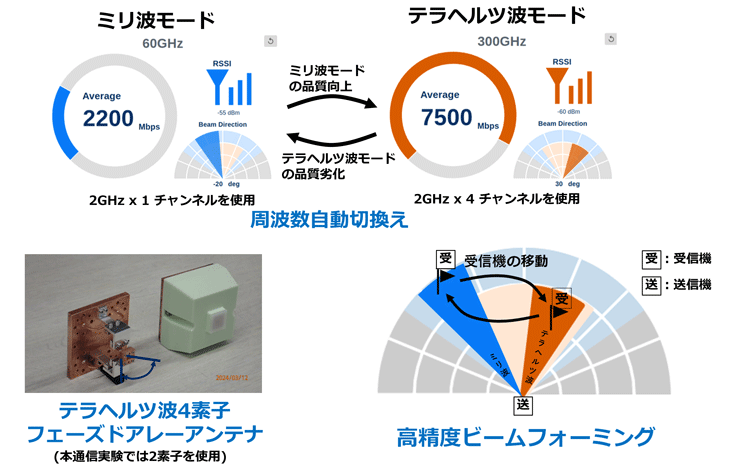
Source: NICT
The measured results back the idea up. A conventional millimeter-wave standard with 2 GHz of bandwidth managed about 2.2 Gbps; switching to terahertz with 8 GHz of bandwidth pushed that to as much as 7.5 Gbps, more than three times faster. The system could also steer its beam across a wide arc: about ±60 degrees on millimeter wave and ±40 degrees on terahertz. The team ran the test by moving the transmitter and changing its position relative to the receiver, so the beam swung with direction and the two bands traded places with distance. And critically, when the terahertz link gave out, throughput didn't crash to zero. It stepped down to a working millimeter-wave connection and carried on.
It's worth being clear-eyed about what this is. The demonstration ran in an anechoic chamber, a sealed room engineered to kill stray reflections, not a busy street with bodies and metal everywhere. NICT itself frames the next steps as widening the terahertz bandwidth, packing in more antenna elements, and sharpening the beamforming, with standardization somewhere down the road. This is a foundation, not a finished product you'll find in next year's phone.
What it's for, and who actually wins the 6G race
Why this matters comes down to what 6G is supposed to enable. XR headsets streaming a blend of the real and virtual world, ultra-high-definition video sent live, smart factories wall-to-wall with networked robots: every one of those needs two things at once: raw speed and a connection that doesn't blink. A link that's blistering but drops every few seconds is useless for a surgeon's headset or a robot arm.
The global 6G race is well underway, and it's tempting to assume the winner will be whoever posts the biggest number. NICT's demo is a quiet counterargument: the hard part was never hitting a high speed in a quiet room, but making that speed survive contact with a messy, moving world. By that measure, the prize may not go to the fastest at all, but to whoever best learns when to ease off.
When you picture 6G in your own country, what comes first: the eye-watering speed, or simply a connection that never drops?









Global Discussion
3 comments